
PC461

PhosphoDetect Anti-p53 (pSer¹⁵) (Ab-6) Rabbit pAb
liquid, Calbiochem®, from rabbit
Product Name
PhosphoDetect Anti-p53 (pSer¹⁵) (Ab-6) Rabbit pAb, liquid, Calbiochem®, from rabbit
biological source
rabbit
antibody product type
primary antibodies
form
liquid
does not contain
preservative
species reactivity
human
manufacturer/tradename
Calbiochem®
storage condition
OK to freeze
avoid repeated freeze/thaw cycles
isotype
IgG
shipped in
wet ice
storage temp.
−20°C
Quality Level
Analysis Note
Positive Control
MCF7 cells or prostate carcinoma tissue
MCF7 cells or prostate carcinoma tissue
Application
Immunoblotting (1:5000-1:10,000)
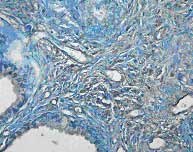
Paraffin Sections (1:1000-1:3000, heat pre-treatment required)
Disclaimer
Toxicity: Standard Handling (A)
General description
Rabbit polyclonal antibody supplied as undiluted serum. Recognizes the ~53 kDa p53 phoshorylated at Ser15.
This PhosphoDetect Anti-p53 (pSer¹⁵) (Ab-6) Rabbit pAb is validated for use in Immunoblotting, Paraffin Sections for the detection of p53 (pSer¹⁵) (Ab-6).
This product has been discontinued.
Recognizes the ~53 kDa p53 protein phosphorylated at Ser15. Does not recognizes unphosphorylated p53.
Recognizes the ~53 kDa p53 protein phosphorylated at Ser15. Does not recognizes unphosphorylated p53.
Immunogen
Human
a synthetic phosphopeptide [VEPPLpSQETFS(C)] corresponding to amino acids 10-20 surrounding the Ser¹⁵ phosphorylation site of human p53
Other Notes
Does not recognizes unphosphorylated p53. Antibody should be titrated for optimal results in individual systems.
Levine, A.J. 1997. Cell88, 323.
Meek, D.W. 1997. Pathol. Biol. Paris45, 804.
Miller, S.D., et al. 1997. Mol. Cell. Biol.17, 2194.
Pellegata, N.S., et al. 1996. Proc. Natl. Acad. Sci. USA93, 15209.
Sturzbecher, H.-W., et al. 1996. EMBO J.15, 1992.
Argarwal, M.L., et al. 1995. Proc. Natl. Acad. Sci. USA92, 8493.
Götz, C. and Montenarh, M. 1995. Int. J. Oncology6, 1129.
Reed, M. et al. 1995. Proc. Natl. Acad. Sci. USA92, 9455.
Waldman, T., et al. 1995. Cancer Res.55, 5187.
Cho, Y., et al. 1994. Science265, 346.
Clarke, A.R., et al. 1994. Oncogene9, 1767.
El-Deiry, W.S., et al. 1994. Cancer Res.54, 1169.
Greenblatt, M.S., et al. 1994. Cancer Res.54, 4855.
Lane, D.P. 1992. Nature358, 15.
Meek, D.W. 1997. Pathol. Biol. Paris45, 804.
Miller, S.D., et al. 1997. Mol. Cell. Biol.17, 2194.
Pellegata, N.S., et al. 1996. Proc. Natl. Acad. Sci. USA93, 15209.
Sturzbecher, H.-W., et al. 1996. EMBO J.15, 1992.
Argarwal, M.L., et al. 1995. Proc. Natl. Acad. Sci. USA92, 8493.
Götz, C. and Montenarh, M. 1995. Int. J. Oncology6, 1129.
Reed, M. et al. 1995. Proc. Natl. Acad. Sci. USA92, 9455.
Waldman, T., et al. 1995. Cancer Res.55, 5187.
Cho, Y., et al. 1994. Science265, 346.
Clarke, A.R., et al. 1994. Oncogene9, 1767.
El-Deiry, W.S., et al. 1994. Cancer Res.54, 1169.
Greenblatt, M.S., et al. 1994. Cancer Res.54, 4855.
Lane, D.P. 1992. Nature358, 15.
Physical form
Undiluted serum.
Preparation Note
Following initial thaw, aliquot and freeze (-20°C).
Legal Information
CALBIOCHEM is a registered trademark of Merck KGaA, Darmstadt, Germany
Not finding the right product?
Try our Product Selector Tool.
Storage Class
10-13 - German Storage Class 10 to 13
Certificates of Analysis (COA)
Search for Certificates of Analysis (COA) by entering the products Lot/Batch Number. Lot and Batch Numbers can be found on a product’s label following the words ‘Lot’ or ‘Batch’.
Already Own This Product?
Find documentation for the products that you have recently purchased in the Document Library.
Gary G Chiang et al.
Methods in molecular biology (Clifton, N.J.), 281, 125-141 (2004-06-29)
Members of the phosphoinositide-3-kinase-related kinase (PIKK) family, which includes mTOR, ATM, ATR, and hSMG-1, play important roles in regulating the cellular response to environmental stimuli. Despite the similarity of their catalytic domain to that of phosphoinositide-3-kinase, these extremely large (>250
Tanya E Johnson et al.
Cell reports, 24(6), 1471-1483 (2018-08-09)
Ataxia-telangiectasia mutated (ATM) is a serine/threonine kinase that coordinates the response to DNA double-strand breaks and oxidative stress. NKX3.1, a prostate-specific transcription factor, was recently shown to directly stimulate ATM kinase activity through its highly conserved homeodomain. Here, we show
Ji-Hoon Lee et al.
The Journal of biological chemistry, 288(18), 12840-12851 (2013-03-26)
The Ataxia Telangiectasia-Mutated (ATM) protein kinase is recruited to sites of double-strand DNA breaks by the Mre11/Rad50/Nbs1 (MRN) complex, which also facilitates ATM monomerization and activation. MRN exists in at least two distinct conformational states, dependent on ATP binding and
Cai Bowen et al.
Cell reports, 4(3), 516-529 (2013-07-31)
The prostate tumor suppressor NKX3.1 augments response to DNA damage and enhances survival after DNA damage. Within minutes of DNA damage, NKX3.1 undergoes phosphorylation at tyrosine 222, which is required for a functional interaction with ataxia telangiectasia mutated (ATM) kinase.
Zhi Guo et al.
Cell cycle (Georgetown, Tex.), 9(24), 4805-4811 (2010-12-15)
The Ataxia-Telangiectasia mutated (ATM) kinase is regarded as the major regulator of the cellular response to DNA double strand breaks (DSBs). In response to DSBs, ATM dimers dissociate into active monomers in a process promoted by the Mre11-Rad50-Nbs1 (MRN) complex.
Related Content
Our team of scientists has experience in all areas of research including Life Science, Material Science, Chemical Synthesis, Chromatography, Analytical and many others.
Contact Technical Service