Product Name
Anti-Orexin A (14-33) (Ab-2) Rabbit pAb, liquid, Calbiochem®
biological source
rabbit
antibody product type
primary antibodies
clone
polyclonal
form
liquid
contains
≤0.1% sodium azide as preservative (antibody only)
species reactivity
mouse, human, rat, bovine
manufacturer/tradename
Calbiochem®
storage condition
OK to freeze
avoid repeated freeze/thaw cycles
isotype
IgG
shipped in
wet ice
storage temp.
−20°C
Quality Level
Analysis Note
Positive Control
Mouse or rat brain
Mouse or rat brain
Application

ELISA (see comments)
Free-floating Sections (1:3500)
Frozen Sections (1:3500)
Immunofluorescence (1:2000)
Disclaimer
Toxicity: Standard Handling (A)
General description
Rabbit polyclonal antibody supplied as undiluted serum. Recognizes orexin A. Supplied with a control peptide.
This product has been discontinued.
Recognizes orexin A in mouse and rat brain. Supplied with a control peptide.
Immunogen
Human
a synthetic peptide (CRLYELLHGAGNHAAGILTL) corresponding to amino acids 14-33 of human orexin A
Other Notes
De Lecea, L., et al. 1998. Proc. Natl. Acad. Sci. USA95, 322.
Flier, J.S. and Maratos-Flier, E. 1998. Cell92, 437.
Sakurai, T., et al. 1998. Cell92, 573.
Schwartz, M.W. 1998. Nat. Med.4, 385.
Flier, J.S. and Maratos-Flier, E. 1998. Cell92, 437.
Sakurai, T., et al. 1998. Cell92, 573.
Schwartz, M.W. 1998. Nat. Med.4, 385.
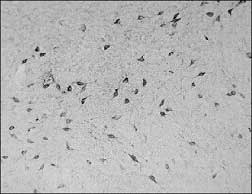
Immunohistochemistry was performed using floating mouse and rat brain sections fixed in 4% paraformaldehyde. Staining was completely abolished by preincubating the antiserum with control peptide at 10-6M. Staining is observed in the lateral hyothalamus. Unconjugated Orexin A Control Peptide has been included for use as an internal control for antibody specificity. This antibody has been tested to work in ELISA. Also available in purified form, Anti-Orexin A (14-33) (Ab-1) Rabbit pAb, Cat. No. PC345. Antibody should be titrated for optimal results in individual systems.
Physical form
Serum or ascites diluted in 5 mM phosphate buffer, pH 7.5 and 25 µg lyophilized control.
Preparation Note
Following initial thaw of antibody, aliquot and freeze (-20°C). Reconstitute control peptide with 25 µl dH₂O for a working stock of 1 mg/ml. Following reconstitution, aliquot and freeze (-20°C).
Legal Information
CALBIOCHEM is a registered trademark of Merck KGaA, Darmstadt, Germany
Not finding the right product?
Try our Product Selector Tool.
Certificates of Analysis (COA)
Search for Certificates of Analysis (COA) by entering the products Lot/Batch Number. Lot and Batch Numbers can be found on a product’s label following the words ‘Lot’ or ‘Batch’.
Already Own This Product?
Find documentation for the products that you have recently purchased in the Document Library.
Aishwarya Ghule et al.
Scientific reports, 10(1), 3821-3821 (2020-03-04)
The neuronal regulation of metabolic and behavioral responses to different diets and feeding regimens is an important research area. Herein, we investigated if the opioid peptide dynorphin modulates feeding behavior and metabolism. Mice lacking dynorphin peptides (KO) were exposed to
Ronald P A Gaykema et al.
Brain, behavior, and immunity, 25(3), 443-460 (2010-11-16)
Immune challenges can lead to marked behavioral changes, including fatigue, reduced social interest, anorexia, and somnolence, but the precise neuronal mechanisms that underlie sickness behavior remain elusive. Part of the neurocircuitry influencing behavior associated with illness likely includes viscerosensory nuclei
Haruto Katahira et al.
Neuropsychiatric disease and treatment, 13, 863-872 (2017-04-01)
Various stressors induce stress responses through the hypothalamic-pituitary-adrenal and the sympathetic-adrenal-medullary axes, which are regulated, in part, by orexin. For example, secretion of orexin in the hypothalamus is increased in rats exposed to the stress of social isolation for 1
Domenico Tupone et al.
The Journal of neuroscience : the official journal of the Society for Neuroscience, 31(44), 15944-15955 (2011-11-04)
Orexin (hypocretin) neurons, located exclusively in the PeF-LH, which includes the perifornical area (PeF), the lateral hypothalamus (LH), and lateral portions of the medial hypothalamus, have widespread projections and influence many physiological functions, including the autonomic regulation of body temperature
Israt Z Shahid et al.
British journal of pharmacology, 165(7), 2292-2303 (2011-09-29)
The rostral ventrolateral medulla (RVLM) maintains sympathetic nerve activity (SNA), and integrates adaptive reflexes. Orexin A-immunoreactive neurones in the lateral hypothalamus project to the RVLM. Microinjection of orexin A into RVLM increases blood pressure and heart rate. However, the expression
Our team of scientists has experience in all areas of research including Life Science, Material Science, Chemical Synthesis, Chromatography, Analytical and many others.
Contact Technical Service