
EMSURE® Granulated Salts for Analytical Chemistry Workflows
Consistent flow meets analytical purity
Analytical chemistry workflows often encounter limitations when using powdered salts, including clumping, dust formation, and moisture sensitivity. EMSURE® granulated salts are developed to address these challenges, offering improved flowability, reduced dust generation, and consistent analytical performance while maintaining established purity specifications.
Produced using a dry granulation process, EMSURE® granulated salts retain the analytical-grade purity and specifications of the original materials while providing handling and workflow advantages in laboratory environments. This article explains the manufacturing process, key performance characteristics, and practical benefits of granulated salts for analytical chemistry applications.

Features & benefits
EMSURE® granulated salts address the most common practical limitations of powdered analytical-grade salts, while retaining the full analytical performance of the EMSURE® product line.
- Analytical-grade purity: Maintains consistent composition for reliable quantitative and qualitative analysis
- Improved flowability: Free-flowing granules enable accurate dosing and reduce material loss
- Specification consistency: Retains original chemical specifications despite physical form conversion
- Reduced dust formation: Minimizes airborne particles and improves laboratory safety
- Chemical stability: Supports consistent performance during storage and handling
Dry granulation process
EMSURE® granulated salts are manufactured using a dry granulation method that does not involve liquid binders or water. Dry granulation is a compaction-based technique that converts fine salt powders into mechanically stable, free-flowing granules while fully preserving the chemical composition and analytical performance of the starting material.
The resulting granules are suitable for wet chemistry and other analytical disciplines that require high reproducibility and long-term material integrity. Because no solvents or binders are introduced, the chemical purity of the product is maintained throughout the manufacturing process.
Dry granulation workflow
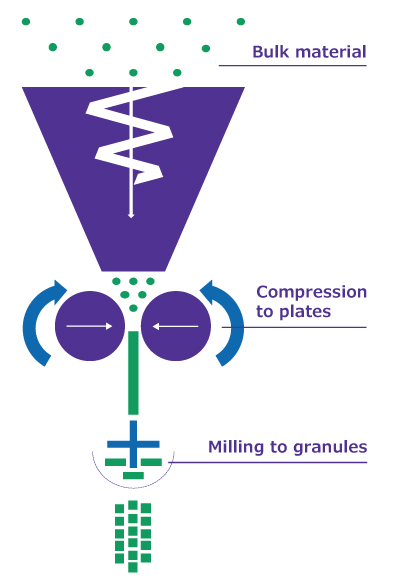
Roller compaction
Counter-rotating rollers compress the powder into a dense ribbon. Roller pressure, feed rate, and gap are precisely controlled.
Milling to granules
The compacted ribbon is milled through a rotor screen into uniform granules. Fine particles are recirculated to maximize yield.
Sieving & QC release
Granules are classified by size. Particle distribution, abrasion resistance, and purity are verified prior to release.
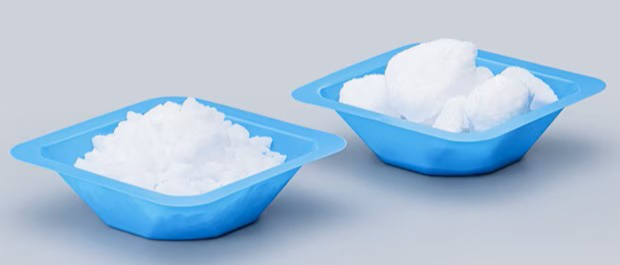
Figure 1.Physical Form Comparison of Granulated and Powdered Salts
Granulated vs. powdered salts
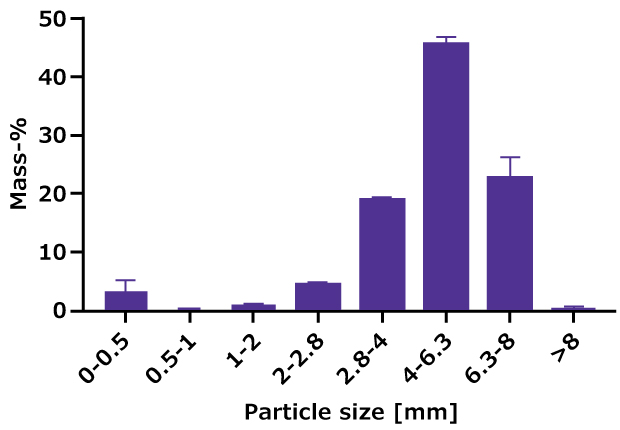
The following four parameters demonstrate the technical performance advantages of EMSURE® granulated salts over conventional powdered forms. Each parameter addresses a distinct aspect of material behavior relevant to analytical laboratory workflows.
Key performance parameters
The following steps are to be followed for this.
Flowability
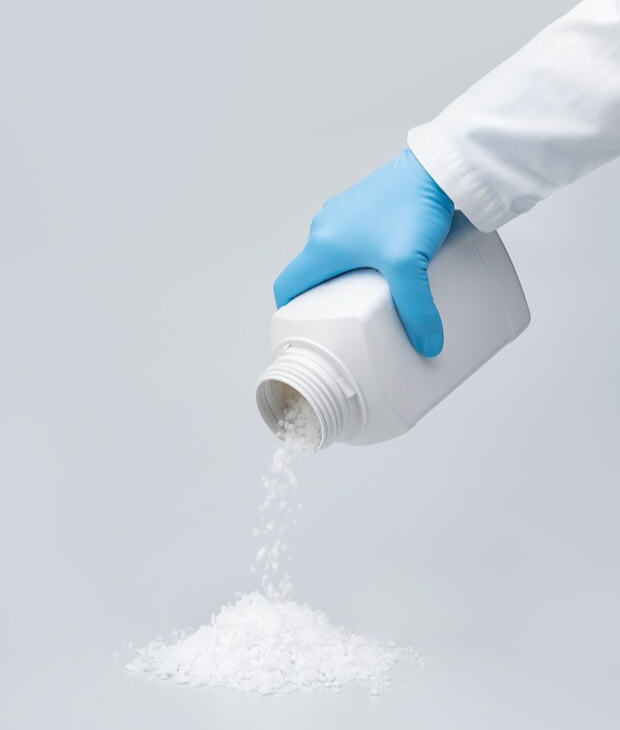
A key functional advantage of EMSURE® granulated salts is their improved flowability compared to powdered forms. In contrast to conventional powdered salts, which are prone to clumping and flow obstruction, the granulated form exhibits free-flowing behavior under typical laboratory handling conditions. This facilitates precise material handling, enabling accurate weighing and efficient transfer without mechanical agitation or scraping. Enhanced flow properties also reduce material loss during transfer and lower the risk of spillage, improving both operational efficiency and laboratory safety.
Dissolution
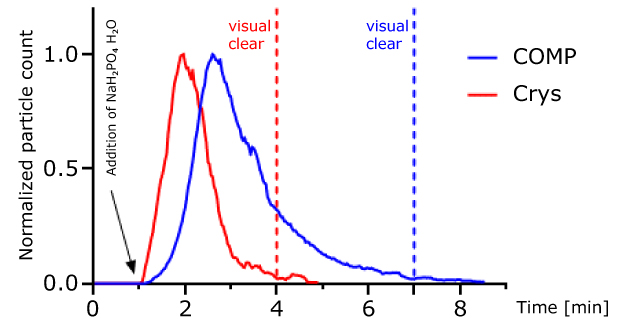
Although powdered salts generally exhibit faster initial dissolution rates due to higher specific surface area, their tendency to form aggregates upon exposure to ambient moisture can adversely affect dissolution kinetics and analytical reproducibility. EMSURE® granulated salts offer a controlled and predictable dissolution profile that is more consistent across variable environmental conditions.
The figure illustrates dissolution profiles for EMSURE® granulated sodium dihydrogen phosphate monohydrate (COMP) and the crystalline powder equivalent (Crys), measured by Focused Beam Reflectance Measurement (FBRM). The granulated form shows a gradual, steady decline in particle count, reflecting controlled and consistent dissolution with minimal fluctuation, while the crystalline powder dissolves more rapidly but with greater variability.
- Ammonium sulfate: Powder dissolved in 4 minutes, while granules dissolved in 7 minutes.
- Potassium chloride: Powder dissolved in 6 minutes, compared to 6.5 minutes for granules.
- Sodium acetate trihydrate: Powder dissolved in 3 minutes, while granules required 5 minutes.
- Sodium chloride: Powder dissolved in 3 minutes, whereas granules dissolved in 6 minutes.
Abrasion resistance
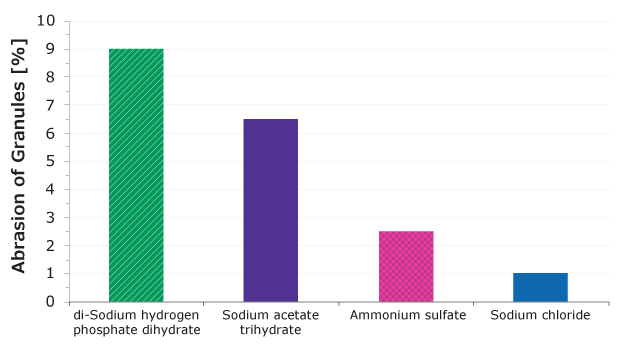
The mechanical integrity of salt granules during storage, handling, and transport directly influences material performance and analytical reliability. Fine particle formation due to granule abrasion reintroduces the same limitations associated with powdered forms, affecting flow, dosing, and contamination risk. EMSURE® granulated salts are validated against a standardized abrasion test (20 rpm, 10 min, ceramic ball drum apparatus) to confirm structural stability under real-world conditions.
The adjacent figure presents 12-month abrasion stability data for EMSURE® sodium dihydrogen phosphate monohydrate in 1 kg and 5 kg formats. Both formats maintained abrasion levels well below the 10% acceptance threshold at all time points. Sodium chloride and ammonium sulfate demonstrated particularly high structural robustness, with abrasion values below 3%.
Ask an Expert
Selecting the appropriate granulated salt can help support efficient laboratory workflows, consistent handling, and reliable analytical performance. Whether you have questions about product characteristics, flowability, dust reduction, or application suitability, our technical specialists can provide guidance based on your specific requirements.
Conclusion
EMSURE® granulated salts represent a practical advancement for analytical laboratories that require consistent, reliable performance from their reagents. By converting commonly used inorganic salts into a controlled granular form through dry granulation, they overcome the handling limitations associated with conventional powdered materials, including dust generation, clumping, and moisture-induced flow obstruction, without altering the underlying chemical specifications or requiring revalidation of existing analytical methods.
The performance data presented in this article demonstrate that EMSURE® granulated salts offer measurable improvements across four critical parameters: particle size control, flowability, dissolution reproducibility, and long-term abrasion resistance. These properties collectively support more consistent material handling, reduced operator exposure, and improved data quality across wet chemistry and other analytical workflows.