
Self-assembly and contact printing
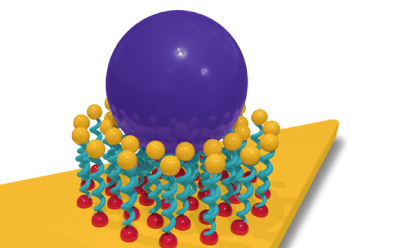
Self-Assembled Monolayers (SAMs) deliver precise molecular-scale control over solid-state interfaces via spontaneous molecular organization. To minimize lattice defects and ensure lot-to-lot reproducibility, our premium portfolio features engineered precursors, with select grades reaching ≥98–99% assay purity. We supply SAM precursors across lab to pilot scale volumes, with consistent purity from first gram to pilot-scale kilogram. The single-source portfolio spanning alkanethiol, organosilane, and phosphonic acid SAM chemistries, trusted across healthcare, electronics, aerospace, and photovoltaics.
Products
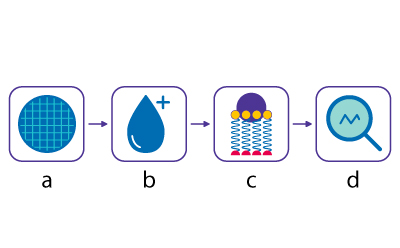
SAM formation follows a four-step protocol : substrate selection (a), cleaning and activation (b), molecule deposition (c), and characterization (d). Refer to the SAM Selection Guide for substrate and chemistry selection criteria.
Healthcare and Life Sciences: Biosensors, diagnostics and medical devices
In healthcare and life sciences, SAMs functionalize surfaces for biomolecule immobilization, control biological interactions, and eliminate non-specific adsorption in diagnostic devices.
- Surface activation: Aminosilanes (3-Aminopropyl)triethoxysilane (APTES) and (3-Aminopropyl)trimethoxysilane (APTMS) anchor proteins, antibodies, and nucleic acids onto glass, silicon oxide, and alumina for IVD and point-of-care platforms.
- Biosensor functionalization: APTES and APTMS activate graphene field-effect transistors and gold nanostructures for real-time biomarker detection (e.g., C-reactive protein, glucose). detection (e.g., C-reactive protein, glucose).
- Antifouling and backfilling: 6-Mercapto-1-hexanol (MCH) co-deposits with probe thiols on gold electrodes to block non-specific protein adsorption in serum and whole-blood matrices.
- Direct immobilization: Diethoxy(3-glycidyloxypropyl)methylsilane(GPTMS) binds enzymes and amine-modified DNA directly to surfaces via epoxy ring-opening directly without secondary crosslinkers.
- Implant surface engineering: Octadecylphosphonic acid (ODPA) forms P–O–Ti bonds directly on titanium and metal oxide implant surfaces with no silane primer required.
Featured precursors:
- APTES -The standard aminosilane for covalent antibody and enzyme immobilization on glass, silicon oxide, and graphene. Ethanol byproduct preferred for live-cell and diagnostic interfaces.
- 6-Mercapto-1-hexanol (MCH) - Biosensor backfiller for gold electrodes. Blocks non-specific protein adsorption in serum and whole-blood matrices.
- 6-(Ferrocenyl)hexanethiol (FHT) - Redox-active SAM on gold electrodes for label-free electrochemical detection of glucose and viral antigens.
- GPTMS - Direct enzyme and DNA coupling via epoxy ring-opening. No EDC/NHS crosslinker required.
- Octadecylphosphonic acid (ODPA) - Direct P-O-Ti bonding on titanium implant surfaces. No silane primer required.
Surface chemistries built for reproducible, low-background biosensing from first prototype to clinical-scale supply
Electronics, component manufacturing and photovoltaics
In electronics manufacturing, SAMs modify surface properties at the molecular scale, enhance adhesion, and optimize electron transport in semiconductors, nanodielectrics, and photovoltaics.
- Adhesion Promotion (MLCC and packaging): Glycidoxysilanes secure bonds between dissimilar materials, such as ceramic dielectrics to polymer encapsulants at inorganic–organic interfaces, maintaining integrity under thermal cycling and humidity stress.
- Metallic Substrates: High-purity Alkanethiols form dense, ordered SAMs on gold and copper, preventing oxidation and tuning surface energy for electronic component fabrication.
- Hole-Selective SAMs for Perovskite Solar Cells (PVSCs): Phosphonic acid SAM precursors deliver PEDOT:PSS-free hole-transport layers with tunable energy alignment for perovskite solar cells.
- Low-voltage electronics: Self-Assembled Nanodielectrics (SANDs) replace thick SiO₂ with ultrathin insulating layers, enabling low-operating-voltage organic transistors and flexible electronics.
- Aerospace and defense coatings: Alkanethiol and fluorosilane SAMs provide corrosion-resistant, low-friction, and anti-icing surface layers on structural metals and sensor components for demanding aerospace and defense environments.
Featured precursors:
- GPTMS - Ceramic-to-polymer adhesion in MLCCs and advanced packaging. Stable under thermal cycling and humidity stress.
- 1-Dodecanethiol - Dense, ordered SAMs on gold and copper for oxidation protection and surface energy control in component fabrication.
- Trichloro(1H,1H,2H,2H-perfluorooctyl)silane (PFOCTS) – Superhydrophobic fluorosilane SAM for PDMS mold release, microfluidic device fabrication, OFET dielectric passivation, and anti-stiction coatings in MEMS. Requires anhydrous deposition conditions.
High-purity SAM precursors for the batch-to-batch consistency that electronics manufacturing demands.
Every workflow step needs the right materials. Our focus is high-purity SAM molecules for precise control over adhesion, molecular organization, and surface performance.
Related resources
- Article: Preparing self-assembled monolayers
SAMs are versatile surface coatings for chemical resistance, bio-compatibility, sensitization, and molecular recognition for sensors and nano fabrication.
- Article: The role of alkanethiols in interfacial engineering
High-purity alkanethiols and SAMs for advanced surface engineering. Optimize OTFTs, selective ALD blocking, and corrosion barriers. Browse our catalog.
- Article: Self-assembly materials in advanced technologies
Explore self-assembled monolayers for advanced surface engineering in electronics, biomedicine, and nanocomposites.
- Article: Scalable fabrication of organic electronic devices using SAMs
Enable organic electronics fabrication using SAMs and polymers for controlled interfaces and consistent device performance.
- Article: Chemistry at surfaces with self-assembled monolayers and SAMDI-ToF mass spectrometry
Discover how SAMDI-MS rapidly characterizes products and yields of surface reactions on self-assembled monolayers, enabling complex chemistry and functional arrays.
- Article: Electronics and self-assembly with single molecules
Single molecule electronics is the endeavour of constructing electronic circuitry with single molecules as the fundamental building block.