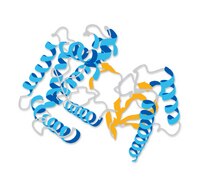
A novel non-canonical mechanism of regulation of MST3 (mammalian Sterile20-related kinase 3).
Stephen J Fuller,Liam J McGuffin,Andrew K Marshall,Alejandro Giraldo,Sampsa Pikkarainen,Angela Clerk,Peter H Sugden
The Biochemical journal
442
2011
Afficher le résumé
The canonical pathway of regulation of the GCK (germinal centre kinase) III subgroup member, MST3 (mammalian Sterile20-related kinase 3), involves a caspase-mediated cleavage between N-terminal catalytic and C-terminal regulatory domains with possible concurrent autophosphorylation of the activation loop MST3(Thr(178)), induction of serine/threonine protein kinase activity and nuclear localization. We identified an alternative 'non-canonical' pathway of MST3 activation (regulated primarily through dephosphorylation) which may also be applicable to other GCKIII (and GCKVI) subgroup members. In the basal state, inactive MST3 co-immunoprecipitated with the Golgi protein GOLGA2/gm130 (golgin A2/Golgi matrix protein 130). Activation of MST3 by calyculin A (a protein serine/threonine phosphatase 1/2A inhibitor) stimulated (auto)phosphorylation of MST3(Thr(178)) in the catalytic domain with essentially simultaneous cis-autophosphorylation of MST3(Thr(328)) in the regulatory domain, an event also requiring the MST3(341-376) sequence which acts as a putative docking domain. MST3(Thr(178)) phosphorylation increased MST3 kinase activity, but this activity was independent of MST3(Thr(328)) phosphorylation. Interestingly, MST3(Thr(328)) lies immediately C-terminal to a STRAD (Sterile20-related adaptor) pseudokinase-like site identified recently as being involved in binding of GCKIII/GCKVI members to MO25 scaffolding proteins. MST3(Thr(178)/Thr(328)) phosphorylation was concurrent with dissociation of MST3 from GOLGA2/gm130 and association of MST3 with MO25, and MST3(Thr(328)) phosphorylation was necessary for formation of the activated MST3-MO25 holocomplex. | | 22229648
 |
Antidepressant-like effect of the novel thiadiazolidinone NP031115 in mice.
Angelo O Rosa,Manuella P Kaster,Ricardo W Binfaré,Susana Morales,Ester Martín-Aparicio,Maria Luisa Navarro-Rico,Ana Martinez,Miguel Medina,Antonio G García,Manuela G López,Ana Lúcia S Rodrigues
Progress in neuro-psychopharmacology & biological psychiatry
32
2008
Afficher le résumé
Glycogen synthase kinase-3beta (GSK-3beta) is an enzyme that phosphorylates glycogen synthase, thereby inhibiting glycogen synthesis. Besides this role, it is now believed that this enzyme plays an important role in the pathophysiology of many brain diseases including depression. Some inhibitors of this enzyme have shown antidepressant effects in animal models. This study investigated the effects of a novel thiadiazolidinone NP031115, a putative GSK-3beta inhibitor, and the well-established GSK-3beta inhibitor AR-A014418 in the mouse forced swimming test (FST), a model widely used to evaluate antidepressant activity. We found that NP031115 had an IC50 of 1.23 and 6.5 microM for GSK-3beta and GSK-3alpha, respectively. NP031115 (0.5 and 5 mg/kg, i.p.), in a way similar to imipramine (15 mg/kg, i.p), fluoxetine (32 mg/kg, i.p), AR-A014418 (9 mg/kg, i.p.), and rosiglitazone (5 microg/site, i.c.v.), significantly reduced immobility time in the FST. NP031115 at the higher dose and AR-A014418 (9 mg/kg, i.p.) reduced locomotion in the open-field test. Rosiglitazone (30 microM), AR-A014418 (1 microM), PG(J2) (10 microM), and NP031115 (1, 10 and 25 microM) activate PPARgamma in CHO transfected cells. GW-9662 (10 microg/site, i.c.v, a PPARgamma antagonist) administered 15 min before NP03115 (5 mg/kg, i.p.) or co-administered with rosiglitazone (5 microg/site, i.c.v.) prevented the antidepressant-like effect of these drugs in the FST. The results of this study show that NP031115 can exhibit an antidepressant effect, likely by inhibiting GSK-3beta and enhancing PPARgamma activity. | | 18579278
|
Slit protein-mediated inhibition of CXCR4-induced chemotactic and chemoinvasive signaling pathways in breast cancer cells.
Prasad, Anil, et al.
J. Biol. Chem., 279: 9115-24 (2004)
2004
Afficher le résumé
Slit, which mediates its function by binding to the Roundabout (Robo) receptor, has been shown to regulate neuronal and CXCR4-mediated leukocyte migration. Slit-2 was shown to be frequently inactivated in lung and breast cancers because of hypermethylation of its promoter region. Furthermore, the CXCR4/CXCL12 axis has been reported recently to be actively involved in breast cancer metastasis to target organs such as lymph nodes, lung, and bone. In this study, we sought to characterize the effect of Slit (=Slit-2) on the CXCL12/CXCR4-mediated metastatic properties of breast cancer cells. We demonstrate here that breast cancer cells and tissues derived from breast cancer patients express Robo 1 and 2 receptors. We also show that Slit treatment inhibits CXCL12/CXCR4-induced breast cancer cell chemotaxis, chemoinvasion, and adhesion, the fundamental components that promote metastasis. Slit had no significant effect on the CXCL12-induced internalization process of CXCR4. In addition, characterization of signaling events revealed that Slit inhibits CXCL12-induced tyrosine phosphorylation of focal adhesion components such as RAFTK/Pyk2 at residues 580 and 881, focal adhesion kinase at residue 576, and paxillin. We found that Slit also inhibits CXCL12-induced phosphatidylinositol 3-kinase, p44/42 MAP kinase, and metalloproteinase 2 and 9 activities. However, it showed no effect on JNK and p38 MAP kinase activities. To our knowledge, this is the first report to analyze in detail the effect of Slit on breast cancer cell motility as well as its effect on the critical components of the cancer cell chemotactic machinery. Studies of the Slit-Robo complex may foster new anti-chemotactic approaches to block cancer cell metastasis. | Kinase Assay | 14645233
|
Ten ERK-related proteins in three distinct classes associate with AP-1 proteins and/or AP-1 DNA
N V Kumar 1 , L R Bernstein
J Biol Chem
276(34)
32362-72
2001
Afficher le résumé
We have identified seven ERK-related proteins ("ERPs"), including ERK2, that are stably associated in vivo with AP-1 dimers composed of diverse Jun and Fos family proteins. These complexes have kinase activity. We designate them as "class I ERPs." We originally hypothesized that these ERPs associate with DNA along with AP-1 proteins. We devised a DNA affinity chromatography-based analytical assay for DNA binding, the "nucleotide affinity preincubation specificity test recognition" (NAPSTER) assay. In this assay, class I ERPs do not associate with AP-1 DNA. However, several new "class II" ERPs do associate with DNA. p41 and p44 are ERK1/2-related ERPs that lack kinase activity and associate along with AP-1 proteins with AP-1 DNA. Class I ERPs and their associated kinase activity thus appear to bind AP-1 dimers when they are not bound to DNA and then disengage and are replaced by class II ERPs to form higher order complexes when AP-1 dimers bind DNA. p97 is a class III ERP, related to ERK3, that associates with AP-1 DNA without AP-1 proteins. With the exception of ERK2, none of the 10 ERPs appear to be known mitogen-activated protein kinase superfamily members. | Kinase Assay | 11431474
|
Cep-1347 (KT7515), a semisynthetic inhibitor of the mixed lineage kinase family
Maroney, A. C., et al
J Biol Chem, 276:25302-8 (2001)
2001
| Kinase Assay | 11325962
|
Biomechanical stress-induced apoptosis in vein grafts involves p38 mitogen-activated protein kinases
Mayr, M., et al
Faseb J, 14:261-70 (2000)
1999
| Kinase Assay | 10660448
|
A phosphatidylinositol 3-kinase-dependent pathway that differentially regulates c-Raf and A-Raf
Sutor, S. L., et al
J Biol Chem, 274:7002-10 (1999)
1998
| | 10066754
|
NSP1 defines a novel family of adaptor proteins linking integrin and tyrosine kinase receptors to the c-Jun N-terminal kinase/stress-activated protein kinase signaling pathway
Lu, Y., et al
J Biol Chem, 274:10047-52 (1999)
1998
| Kinase Assay | 10187783
|
Sequences within fibrinogen and intercellular adhesion molecule-1 (ICAM-1) modulate signals required for mitogenesis
Gardiner, E. E. and D'Souza, S. E.
J Biol Chem, 274:11930-6 (1999)
1998
| Kinase Assay | 10207014
|
Identification of a novel inhibitor of mitogen-activated protein kinase kinase.
Favata, M F, et al.
J. Biol. Chem., 273: 18623-32 (1998)
1998
Afficher le résumé
The compound U0126 (1,4-diamino-2,3-dicyano-1, 4-bis[2-aminophenylthio]butadiene) was identified as an inhibitor of AP-1 transactivation in a cell-based reporter assay. U0126 was also shown to inhibit endogenous promoters containing AP-1 response elements but did not affect genes lacking an AP-1 response element in their promoters. These effects of U0126 result from direct inhibition of the mitogen-activated protein kinase kinase family members, MEK-1 and MEK-2. Inhibition is selective for MEK-1 and -2, as U0126 shows little, if any, effect on the kinase activities of protein kinase C, Abl, Raf, MEKK, ERK, JNK, MKK-3, MKK-4/SEK, MKK-6, Cdk2, or Cdk4. Comparative kinetic analysis of U0126 and the MEK inhibitor PD098059 (Dudley, D. T., Pang, L., Decker, S. J., Bridges, A. J., and Saltiel, A. R. (1995) Proc. Natl. Acad. Sci U. S. A. 92, 7686-7689) demonstrates that U0126 and PD098059 are noncompetitive inhibitors with respect to both MEK substrates, ATP and ERK. We further demonstrate that the two compounds bind to deltaN3-S218E/S222D MEK in a mutually exclusive fashion, suggesting that they may share a common or overlapping binding site(s). Quantitative evaluation of the steady state kinetics of MEK inhibition by these compounds reveals that U0126 has approximately 100-fold higher affinity for deltaN3-S218E/S222D MEK than does PD098059. We further tested the effects of these compounds on the activity of wild type MEK isolated after activation from stimulated cells. Surprisingly, we observe a significant diminution in affinity of both compounds for wild type MEK as compared with the deltaN3-S218E/S222D mutant enzyme. These results suggest that the affinity of both compounds is mediated by subtle conformational differences between the two activated MEK forms. The MEK affinity of U0126, its selectivity for MEK over other kinases, and its cellular efficacy suggest that this compound will serve as a powerful tool for in vitro and cellular investigations of mitogen-activated protein kinase-mediated signal transduction. | | 9660836
|