Chiudendo, la configurazione personalizzata non sarà salvata, a meno che l'articolo non sia stato aggiunto al carrello della spesa o ai prodotti preferiti.
Clicchi OK per chiudere MILLIPLEX® MAP, oppure Annulla per tornare alla selezione.
Scelga pannelli su misura e kit premiscelati, OPPURE le microsfere MAPmates™ per la trasduzione del segnale
Progetti e calcoli il prezzo dei Suoi kit MILLIPLEX® MAP.
Pannelli su misura e kit premiscelati
La nostra ampia gamma comprende pannelli multiplex che consentono di scegliere, nell'ambito del pannello, gli analiti più adatti per le Sue esigenze. Oppure Lei può scegliere le citochine premiscelate o i kit single plex.
Kit e MAPmates™ per studi di trasduzione del segnale
Scelga i kit premiscelati che permettono di esplorare interi processi e pathway. Oppure progetti kit su misura scegliendo le microsfere MAPmates™ single plex e seguendo le linee guida fornite.
Le seguenti MAPmates™ non possono essere dosate insieme: -MAPmates™ che richiedono tamponi differenti per l'analisi. -MAPmate™ fosfo-specifiche e totali, es GSK3β totale e GSK3β (Ser 9). -MAPmates™ PanTyr e sito-specifiche come fosfo-recettore EGF e fosfo-STAT1 (Tyr701). -Più di 1 fosfo-MAPmate™ per un solo bersaglio (Akt, STAT3). -GAPDH e β-Tubulina non possono essere miscelati con kit o MAPmates™ contenenti panTyr.
.
Numero di catalogo
Descrizione dell'ordine
Qtà/conf
Elenca
Questo articolo è stato aggiunto ai prodotti preferiti.
Selezioni una specie, un tipo di pannello, un kit o un tipo di campione
Per cominciare a progettare il Suo kit MILLIPLEX® MAP, selezioni una specie, un tipo di pannello o un kit di Suo interesse.
Custom Premix Selecting "Custom Premix" option means that all of the beads you have chosen will be premixed in manufacturing before the kit is sent to you.
Catalogue Number
Ordering Description
Qty/Pack
List
Questo articolo è stato aggiunto ai prodotti preferiti.
Specie
Tipo di pannello
Kit selezionato
Qtà
Numero di catalogo
Descrizione dell'ordine
Qtà/conf
Prezzo di listino
96-Well Plate
Qtà
Numero di catalogo
Descrizione dell'ordine
Qtà/conf
Prezzo di listino
Aggiungi altri reagenti (Le microsfere MAPmate devono essere utilizzate con un tampone ed un kit di rilevazione)
Qtà
Numero di catalogo
Descrizione dell'ordine
Qtà/conf
Prezzo di listino
48-602MAG
Buffer Detection Kit for Magnetic Beads
1 Kit
Opzione salva-spazio I Clienti che ordinano diversi kit possono scegliere di ridurre lo spazio necessario per lo stoccaggio, rinunciando al confezionamento del kit e ricevendo i vari reagenti per il saggio multiplex in buste di plastica.
Questo articolo è stato aggiunto ai prodotti preferiti.
Il prodotto è stato aggiunto al carrello.
Ora può disegnare un altro kit su misura, scegliere un kit premiscelato, procedere con il check out dell'ordine, oppure chiudere lo strumento per gli ordini on-line.
615700
Sigma-AldrichTotal Antioxidant Status Assay Kit
Total Antioxidant Status Assay Kit: MSDS (material safety data sheet) o SDS, certificato d’analisi (CoA) e certificato di qualità (CoQ), dossier, brochure e altri documenti disponibili.
The quantity field is empty. Please enter a quantity of 1 or more to add items to your cart.
Description
Overview
A colorimetric assay kit for the measurement of the total antioxidant status. Each kit is suitable for performing a minimum of 50 assays.
Note: Spectrophotometer equipped with a temperature-controlled cuvette holder is strongly recommended for use with this kit.
Catalogue Number
615700
Brand Family
Calbiochem®
Application Data
Materials Required but Not Delivered
• Spectrophotometer or automated analyzer capable of measuring absorbance at 600 nm. A temperature controlled cuvette holder is highly recommended. • Cuvettes with 1-cm path length
References
References
Miller, N.J., et al. 1993. Clin. Science 84, 407.
Product Information
Detection method
Colorimetric
Form
50 Tests
Format
Cuvette
HS Code
3822 00 90
Kit contains
Substrate, Chromogen, Standard, Buffer, and a user protocol.
The Calbiochem® Total Antioxidant Status Assay Kit is designed to assay antioxidant levels in serum or plasma samples. Additionally, the assay may be used to measure the antioxidant potential of (suitably solubilized) food and drug samples.
Storage and Shipping Information
Ship Code
Ambient Temperature Only
Toxicity
Standard Handling
Storage
+2°C to +8°C
Storage Conditions
Upon arrival store the entire kit contents at 4°C. Note: The concentration of the standard is lot-specific. Please refer to the vial label for lot-specific concentration.
Do not freeze
Ok to freeze
Packaging Information
Transport Information
Supplemental Information
Kit contains
Substrate, Chromogen, Standard, Buffer, and a user protocol.
Upon arrival store the entire kit contents at 4°C. Note: The concentration of the standard is lot-specific. Please refer to the vial label for lot-specific concentration.
Intended use
The Calbiochem® Total Antioxidant Status Assay Kit is designed to assay antioxidant levels in serum or plasma samples. Additionally, the assay may be used to measure the antioxidant potential of (suitably solubilized) food and drug samples.
Background
Free radicals are highly reactive molecules generated by the biochemical redox reactions that occur as part of normal cell metabolism, and by exposure to environmental factors such as UV light, cigarette smoke, environmental pollutants and gamma radiation. Once formed, free radicals attack cell structures in the body. As a result, free radicals have been implicated in numerous diseases, including cancer, atherosclerosis, rheumatoid arthritis, diabetes, liver damage, and central nervous system disorders.
Principles of the assay
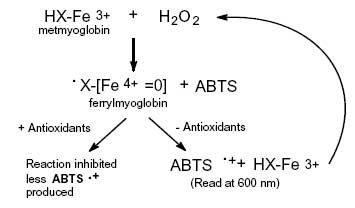
The Total Antioxidant Status Kit is dependent on antioxidants in the sample inhibiting the oxidation of ABTS™ (2,2'-Azino-di-[3-ethylbenz-thiazoline sulphonate]) substrate to ABTS™•+ product by metmyoglobin (a peroxidase). The amount of ABTS™•+ product can be monitored by reading the absorbance at 600 nm. Under the reaction conditions used, the antioxidants in the sample cause suppression of the absorbance at 600 nm to a degree that is proportional to their concentration.
Figure 1: Principle of the Assay
Materials provided
• Buffer (Kit Component No. KP1001): 1 bottle, 100 ml, Phosphate Buffered Saline • Chromogen (Kit Component No. KP1002): 5 vials, 10 ml each, Metmyoglobin and ABTS™ • Substrate (Kit Component No. KP1003): 2 vials, 5 ml each, stabilized H₂O₂ • Standard (Kit Component No. KP1004): 5 vials, 1 ml each, 6-Hydroxy-2,5,7,8-tetramethylchroman-2-carboxylic acid* *The concentration of the standard is lot specific. Please consult the vial label for the concentration.
Materials Required but not provided
• Spectrophotometer or automated analyzer capable of measuring absorbance at 600 nm. A temperature controlled cuvette holder is highly recommended. • Cuvettes with 1-cm path length
Precautions and recommendations
• All pipettes should be thoroughly cleaned before use. Water used in the assay must be as pure as possible, the minimum standard being double-deionized water. • Ensure that all pipettes have been accurately calibrated and are dispensing the correct volume. • Ensure that all glassware and disposables are free from contamination, especially from hypochlorite and detergents. • Check the temperature of the equipment being used for incubation of the samples. • Time the reaction carefully. The absorbance changes very rapidly, and any delay in taking the reading can lead to a substantial error. • Ensure that there has been no loss of standard material upon opening the vial. The standard is supplied in lyophilized form, and the vials are, therefore, under vacuum. The stopper must be removed slowly to allow air to enter the vial gradually; otherwise there is a risk that material will be lost. In addition, before the stopper is fully removed, the bottle should be sharply tapped on the bench several times to dislodge any material adhering to the stopper. The stopper should then be removed and placed flat side down on the bench while the appropriate volume is dispensed into the vial for reconstitution. The stopper should then be replaced and the contents mixed, ensuring that the liquid comes into contact with the stopper, so that any material adhering to the stopper is dissolved.
Reagent preparation
• Chromogen: Add 10 ml Buffer to each vial of Chromogen needed for the assay (10 tests per vial). After reconstitution, the Chromogen is stable for 2 days at 4°C or 8 h at room temperature. • Substrate: Dilute each vial of Substrate needed for the assay by adding 7.5 ml Buffer. After dilution, the substrate is stable for 24 h at 4°C. NOTE: Some automated methods do not require substrate dilution. • Standard: Add 1 ml distilled water to each vial of Standard needed for the assay. After reconstitution, the Standard is stable for 2 days at 4°C or 1 month at -20°C.
Detailed protocol
1. Zero the spectrophotometer at 600 nm against air and set temperature to 37°C. Equilibrate the diluted Substrate and Chromogen at 37°C for 5 min just prior to use. NOTE: It is advisable to equilibrate only the amount of each reagent necessary for the assays to be performed. A temperature of 37°C must be maintained throughout the assay. 2. Add the following to a cuvette:
Table 1: Addition of Reagents
3. Mix well and read the initial absorbance (Ao) 4. Add 200 µl diluted Substrate to each cuvette. Mix and start the timer simultaneously. 5. Read the absorbance after exactly 3 min (A)
Calculations
Calculation of Total Antioxidant Status
The antioxidant concentration of the Standard is used to calculate the antioxidant levels in the samples.
1. Determine the ΔA for the samples, standard, and blank. ΔA = A - Ao 2. Calculate the concentration of antioxidants in the sample using the formula below:
Figure 2: Antioxidant Concentration Formula
NOTE: If the antioxidant concentration is greater than 2.5 mM dilute the sample with 0.9% NaCl and re-assay. Typical antioxidant levels in normal human plasma are 1.30-1.77 mM.
Sensitivity Notes
Typically serum or plasma samples of 20 µl are sufficient when using the manual method. Samples of 5 µl are typically sufficient when using an automated analyzer. The assay is linear for antioxidant levels less than 2.5 mM.
Assay Range
0-25 nmol/10 µl plasma
Precision
Intra-assay coefficient of variation = 1.2% (mean = 1.37 mM; n = 20) Inter-assay coefficient of variation = 2.4% (mean = 1.35 mM; n = 18).
Registered Trademarks
Calbiochem® is a registered trademark of EMD Chemicals, Inc. Interactive Pathways™ is a trademark of EMD Chemicals, Inc. ABTS™ is a trademark of Roche Diagnostics