
Automated mRNA-LNP formulation using SM-102 and NanoFabTx™ Lipid Mixes with the LNP Screening Array
Abstract
Developed through a collaboration between Parallel Fluidics × Merck, this application note evaluates the LNP Screening Array for automated mRNA-LNP formulation. SM-102 and NanoFabTx™ DOTAP Lipid Mixes were formulated with firefly luciferase (Fluc) mRNA and characterized for particle size, PDI, encapsulation efficiency, and in vitro luciferase expression. Results were compared with those obtained using the Unchained Labs SUNSCREEN system. Both platforms demonstrated high encapsulation efficiency and supported functional mRNA delivery, highlighting the potential of the LNP Screening Array for rapid, automated, high-throughput LNP formulation screening.
Section overview
Introduction
Lipid nanoparticles (LNPs) are a critical delivery vehicle for a nucleic acid therapeutics, including mRNA vaccines, small interfering (siRNA) and gene editing payloads. LNP development requires screening many low-volume formulations at an early stage, as minor changes in lipid composition or chemistry can affect their particle size, encapsulation efficiency, and delivery performance to the target cells. Established small-scale formulation methods can require several minutes per formulation thereby limiting the number of formulations that can be evaluated during early development and potentially creating a bottleneck in the therapeutic development process.
To address this throughput limitation, the LNP Screening Array, a single-use microfluidic consumable, was designed to enable high-throughput LNP formulation on automated liquid-handling platforms. The array contains eight independent micromixers, enabling parallel formulation, with each formulation generated in under 3 minutes. This configuration enables a throughput of over 100 unique formulations per hour. The device geometry sets an aqueous-to-lipid flow rate ratio (FRR) of 3:1, while the total flow rate is established by liquid handler protocol.
In addition to the formulation platform, the selection of lipid components is an important consideration in LNP development. NanoFabTx™ lipid mixes provide ready-to-use lipid compositions for nanoparticle formulation. The NanoFabTx™-DOTAP Lipid Mix (926027) combines the cationic lipid 1,2-dioleoyl-3-trimethylammonium-propane (DOTAP) with the helper lipid 1,2-dioleoyl-sn-glycero-3-phosphoethanolamine (DOPE) and cholesterol, providing a defined lipid composition for LNP formulation.
In this study, the LNP Screening Array was evaluated for the preparation of mRNA-loaded LNPs using the NanoFabTx™ DOTAP Lipid Mix and an SM-102-based lipid mixture as a reference formulation. Formulations were prepared on the AAW™ Automated Assay Workstation, featuring an Opentrons® Flex (liquid handler), and compared with those prepared on the Unchained Labs SUNSCREEN system. The resulting LNPs were characterized for selected critical quality attributes (CQAs) to assess formulation outcomes across the two platforms.
Materials and methods
Study design
In this study, two lipid formulations, one containing the ionizable lipid SM-102 and the other comprising the NanoFabTx™ DOTAP Lipid Mix, were formulated with firefly luciferase (Fluc) mRNA using the LNP Screening Array on the AAW™ Automated Assay Workstation. The same lipid formulations were also prepared on the Unchained Labs SUNSCREEN system to compare the quality attributes of the resulting LNPs. Following formulation, all LNP samples were purified using Amicon® Ultra centrifugal filters (100 kDa molecular weight cutoff [MWCO]) and characterized for Z-average diameter (hydrodynamic particle diameter), polydispersity index (PDI), encapsulation efficiency, and in vitro luciferase expression.
Eight replicate formulations of each lipid formulation were prepared in a single run using the LNP Screening Array, with an output volume of 250 µL per formulation, comprising 187.5 µL of mRNA in aqueous buffer and 62.5 µL of lipid mix in ethanol. Three replicate formulations of each lipid formulation were prepared using the Unchained Labs SUNSCREEN system equipped with the Sunny 275X mixer. The output volume was 400 µL per formulation, corresponding to the minimum volume supported by this SUNSCREEN configuration.
LNP Screening Array workflow
The LNP formulation workflow using the LNP Screening Array on the AAW™ Automated Assay Workstation involved three steps:
- Step 1. Sample loading: The aqueous mRNA solution and lipid solution were loaded into separate wells of a 96-well source plate.
- Step 2. Automated dispensing: The AAW™ Automated Assay Workstation dispensed both phases into the LNP Screening Array using an 8-channel, 1000 µL pipette arm.
- Step 3. LNP collection: The formulated LNPs were collected from the outlet reservoirs for subsequent purification.
The formulation and platform parameters are listed in Tables 1 and 2.
Protocol setup and run time
The LNP Screening Array protocol was executed on the AAW™ Automated Assay Workstation without modifications to the protocol itself, apart from adjustments to the deck layout and z-axis labware calibration. In this study, eight formulations were prepared using the LNP Screening Array and collected in an output plate. The automated protocol execution time was 2 min 54 s, corresponding to an average processing time of approximately 22 s per formulation. For comparison, preparation of three formulations on the Unchained Labs SUNSCREEN system took approximately 10 min, excluding system initialization and priming between runs.
The LNP Screening Array draws the aqueous and lipid inputs for each formulation from separate source wells, allowing the composition of the aqueous and lipid phases to be varied independently between formulations within a single run.
LNP characterization
Z-average diameter and polydispersity index (PDI) were measured by dynamic light scattering (DLS) using a Zetasizer Ultra (Malvern Panalytical). Measurements were performed on purified LNP samples, with three measurement replicates per sample. Encapsulation efficiency (EE) was determined using the Quant-iT™ RiboGreen™ RNA assay on a Varioskan plate reader (Thermo Scientific). For in vitro expression studies, HEK293T cells were treated with LNPs containing approximately 100 ng of Fluc mRNA per well. Luciferase expression was measured 24 h after treatment using the Steady-Glo® Luciferase Assay System (Promega), according to the manufacturer's instructions.
All characterization assays were performed using the same instruments and analytical methods for samples prepared on both formulation platforms.
Results and discussion
Consistency of particle size and PDI across formulations
Figure 1 summarizes the Z-average diameter and polydispersity index (PDI) of SM-102 and NanoFabTx™ DOTAP LNPs prepared using the LNP Screening Array and the Unchained Labs SUNSCREEN system.
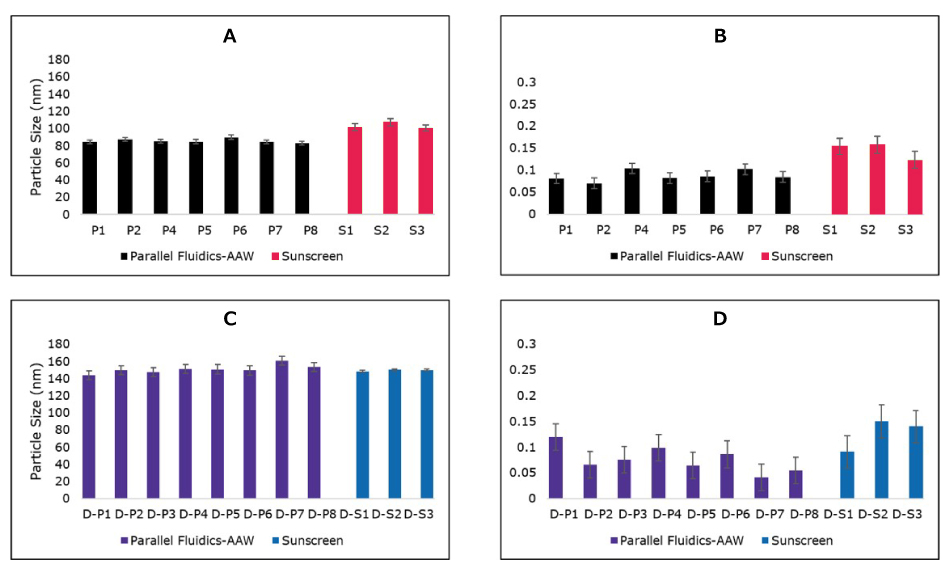
Figure 1.Z-average diameter and polydispersity index (PDI) of SM-102 and NanoFabTx™ DOTAP LNPs prepared using the LNP Screening Array on the AAW™ Automated Assay Workstation and the Unchained Labs SUNSCREEN system. (A) Z-average diameter and (B) PDI of SM-102 LNPs. (C) Z-average diameter and (D) PDI of NanoFabTx™ DOTAP LNPs. Error bars represent the standard deviation (SD) of three replicate DLS measurements per formulation.
SM-102 LNPs prepared using the LNP Screening Array had a mean Z-average diameter of 86 nm and a mean PDI of 0.09, compared with 103 nm and 0.14, respectively, for LNPs prepared using the SUNSCREEN system. The coefficient of variation (CV) in particle size across the independently prepared formulations was 2.7% for the LNP Screening Array (n = 7) and 3.7% for SUNSCREEN (n = 3).
NanoFabTx™ DOTAP LNPs had mean Z-average diameters of 151 nm and 150 nm when prepared using the LNP Screening Array and SUNSCREEN system, respectively. The corresponding mean PDI values were 0.08 and 0.13. Particle size CV values across the independently prepared formulations were 3.8% for the LNP Screening Array (n = 8) and 0.6% for SUNSCREEN (n = 3).
For both lipid formulations, the mean PDI values were lower for LNPs prepared using the LNP Screening Array than for those prepared using SUNSCREEN. The mean particle size was similar between platforms for NanoFabTx™ DOTAP LNPs, whereas SM-102 LNPs prepared using the LNP Screening Array had a lower mean particle size than those prepared using SUNSCREEN.
Overall, both platforms produced LNPs with relatively low particle size variability across the tested formulations. The results also demonstrate differences in particle size and PDI between the two lipid formulations and formulation platforms under the conditions evaluated.
Encapsulation efficiency
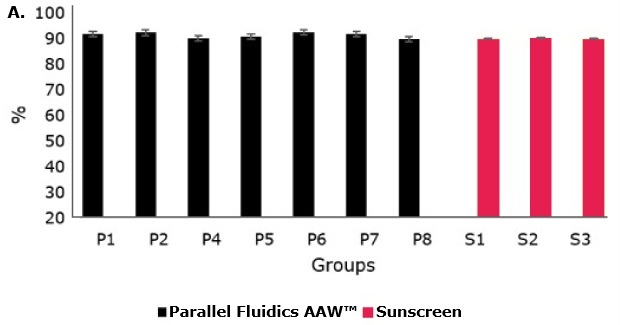
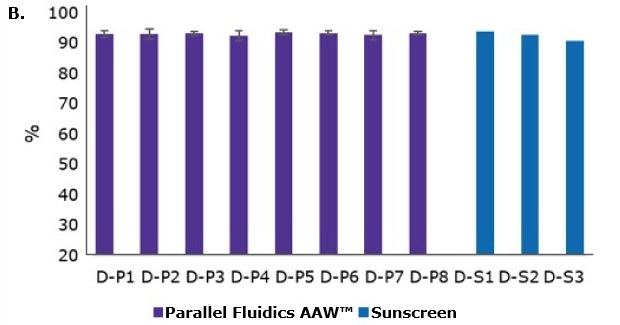
Figure 2.Encapsulation efficiency (EE) of (A) SM-102 and (B) NanoFabTx™ DOTAP LNPs prepared using the LNP Screening Array on the AAW™ Automated Assay Workstation and the Unchained Labs SUNSCREEN system. EE was determined using the Quant-iT™ RiboGreen™ RNA assay following LNP purification. Error bars represent the standard deviation (SD) of three replicate measurements per formulation.
Figure 2 shows the encapsulation efficiency (EE) of SM-102 and NanoFabTx™ DOTAP LNPs prepared using the LNP Screening Array and the SUNSCREEN system. SM-102 LNPs exhibited mean EE values of 91% and 89% on the LNP Screening Array and SUNSCREEN system, respectively. Similarly, NanoFabTx™ DOTAP LNPs achieved mean EE values of 93% and 92%, respectively. All LNP Screening Array formulations exhibited EE values of approximately 90% or higher. These results demonstrate consistently high mRNA encapsulation efficiency across both lipid formulations and platforms.
In vitro luciferase expression
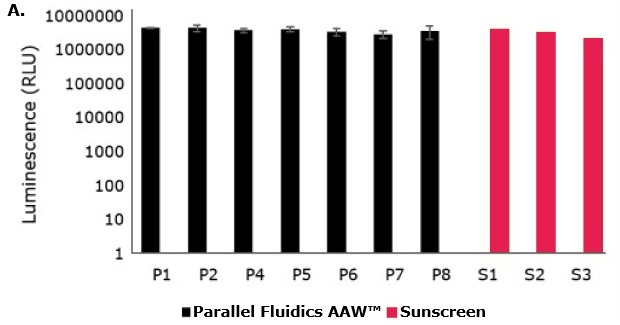
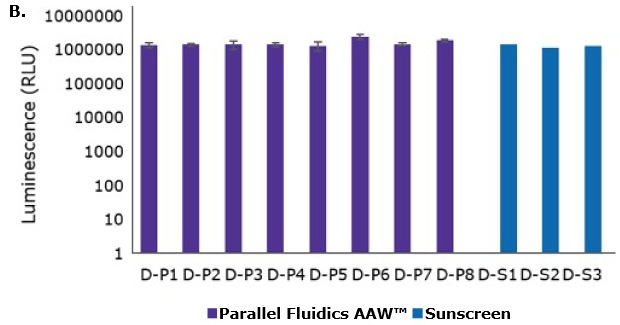
Figure 3.Firefly luciferase expression in HEK293T cells 24 h after treatment with LNPs containing approximately 100 ng Fluc mRNA per well. (A) SM-102 LNPs and (B) NanoFabTx™ DOTAP LNPs. Error bars represent the standard deviation (SD) of three replicate measurements per formulation.
Figure 3 shows luciferase expression in HEK293T cells 24 h after treatment with SM-102 and NanoFabTx™ DOTAP LNPs prepared using the LNP Screening Array and the SUNSCREEN system. Luminescence signals from the LNP Screening Array formulations were within the same order of magnitude as those obtained with SUNSCREEN for both lipid formulations, with values generally in the range of 10⁶ relative luminescence units (RLU). All replicate formulations prepared using the LNP Screening Array produced detectable luciferase expression within a similar range.
These results demonstrate that the LNPs prepared using the LNP Screening Array retained the ability to deliver functional mRNA and support protein expression in HEK293T cells. The observed expression profiles were broadly similar to those obtained with the SUNSCREEN system for both the ionizable and the cationic lipid mix formulations.
Conclusion
In this study, the LNP Screening Array was used to formulate mRNA-loaded LNPs containing an SM-102-based reference formulation and the NanoFabTx™ DOTAP Lipid Mix on the AAW™ Automated Assay Workstation equipped with an Opentrons® Flex liquid handler. The resulting LNPs were characterized and compared with those prepared using the Unchained Labs SUNSCREEN system. Both platforms produced LNPs with high encapsulation efficiency and supported functional mRNA delivery, as demonstrated by in vitro luciferase expression in HEK293T cells. Mean PDI values were lower for LNPs prepared using the LNP Screening Array for both lipid formulations. For NanoFabTx™ DOTAP LNPs, mean particle sizes were similar between platforms (151 nm and 150 nm, respectively), whereas SM-102 LNPs prepared using the LNP Screening Array had a smaller mean particle size (86 nm) than those prepared using SUNSCREEN (103 nm).
The LNP Screening Array enables automated, parallel LNP formulation, with eight independent micromixers supporting the preparation of multiple formulations within a single run. In this study, eight formulations were prepared in 2 min 54 s, corresponding to an average processing time of approximately 22 s per formulation, with an output volume of 250 µL per formulation. In comparison, preparation of three formulations on the SUNSCREEN system required approximately 10 min, excluding system initialization and priming. Each formulation on the LNP Screening Array draws its aqueous and lipid inputs from separate source wells and is processed through an independent micromixer, allowing lipid composition, N/P ratio, and buffer conditions to be varied between formulations within a single run. Combined with NanoFabTx™ lipid mixes and Amicon® Ultra centrifugal filtration, the LNP Screening Array provides an automated workflow for high-throughput LNP formulation screening, with lower formulation volumes and shorter processing times under the conditions evaluated.