
Thioacetate deprotection procedure
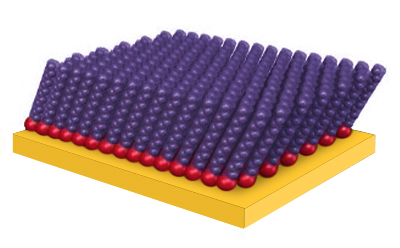
Figure 1.Schematic showing an ordered self-assembled monolayer of densely packed alkane thiols.
One way to address this problem is to protect the free thiol groups. Several methods have been reported to accomplish this, such as using thioether, thioester, and disulfide functionalities.1 More recently, the direct use of a thioacetate group for the preparation of SAMs on the gold surface was demonstrated.2 However, SAMs produced using thioacetates are not as densely packed or as well ordered as SAMs produced by the free thiol analogs.2 Thioacetates also take longer to absorb on the gold surface than the free thiols.2
This problem can be addressed by deprotecting a free thiol from its protected derivative just before use. One method to obtain inherently unstable free thiols quickly and easily is from the hydrolysis of thioacetate using hydrolyzing agents1 such as: sodium hydroxide (221465), potassium hydroxide (221473), potassium carbonate (209619) and sodium methoxide (164992).
The resulting free thiol can be used immediately or stored for hours to days at room temperature, depending on the stability of the free thiol. The deprotection of S-(10-undecenyl) thioacetate (1) to generate 11-mercapto-1-undecene (2) is described in this article. This compound is a good candidate for this technique, as it is difficult to store for an extended period of time due to the reactivity of thiol group with the alkenyl functionality.
Reagents and equipment recommended
Procedure
Deprotection of S-(10-Undecenyl) thioacetate (Figure 2)
- Dissolve S-(10-Undecenyl) thioacetate (1) (2.0 g, 8.76 mmol) in 10 mL of ethanol (459844) using a 250 mL, three neck, round bottom flask (Z418668) under inert atmosphere.
- Add NaOH solution (700 mg, 18 mmol in 2.5 mL of H2O) in a drop-wise fashion.
- Reflux reaction mixture for 2 hours before cooling to room temperature.
- Neutralize mixture with 6 mL of degassed 2 M HCl solution and transfer it to a separatory funnel under inert atmosphere.
- Add 20 mL of degassed diethyl ether (346136) and 10 mL of degassed water to the separatory funnel before separating the organic layer.
- Wash organic layer with 10 mL of degassed water and dry over Na2SO4 (238597).
- Remove the solvent at 40 °C using a rotary evaporator.

Figure 2.Deprotection of S-(10-Undecenyl) thioacetate
Results
This procedure resulted in 1.3 g of 11-mercapto- 1-undecene (2)3 with 95% purity, which can be stabilized by adding small amount of 4-tert-butylcatechol.
Figures 3 (a) and 3 (b) show the H1-NMR of the thioacetate (1) and the resulting free thiol (2) respectively. This free thiol can be directly used to create self-assembled monolayers.
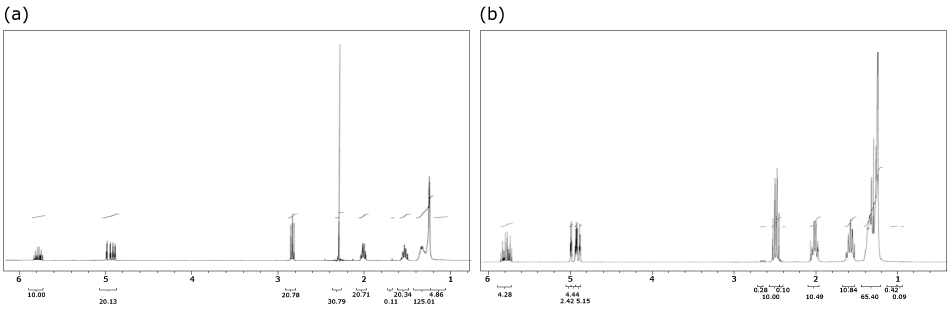
Figure 3.¹H NMR spectra illustrating the conversion of S-(10-undecenyl) thioacetate to 11-mercapto-1-undecene through thioacetate deprotection. (a) ¹H NMR spectrum of S-(10-undecenyl) thioacetate before hydrolysis. (b) ¹H NMR spectrum of the resulting 11-mercapto-1-undecene after deprotection.