Base editing made easy with PURedit® Cas9 cytosine base editor proteins
Be the base edit boss. Install precise C-to-T substitutions using CRISPR technology, without the need for DNA double strand breaks.
Flexible and precise PURedit® Cas9 cytosine base editors
Our scientists developed PURedit® Cas9 cytosine base editor proteins to offer a cutting-edge approach for precision genome editing, allowing specific C-to-T substitutions without the risks associated with double-strand breaks. By combining our unique editing variants with uracil glycosylase inhibitor (UGI) and our transfection enhancer PEXBUFF, researchers can achieve higher editing efficiencies and reduced off-target effects across cell types. This technology represents a significant advancement in the field of genetic engineering, making precise edits more accessible for scientific research.

Key takeaways:
- Targeted edits: PURedit® Cas9 cytosine base editor (CBE) proteins allow precise C-to-T changes without causing harmful dsDNA breaks.
- Improved efficiency: The combination of different CBE variants, UGI, and transfection enhancer boosts editing success rates and accuracy.
- Wide applicability: This technology works well in cell lines and primary T cells, making it useful for many genetic studies.
Section overview
- Best practices for cytosine base editor proteins
- Watch a video of CBE in action
- Precision genome editing: HDR vs base editing
- Developing PURedit® cytosine base editor kits
- Base editing vs CRISPR
- Base editing results and data
- Summary
- Transfection method
- Required and related cytosine base editor products
Best practices for cytosine base editor proteins
- Guide RNA Design and Target Selection: Proper target selection and guide RNA design accounts for the editing window of the base editor protein and for the surrounding sequence. Use our guide design webtool to take the guesswork out of target selection.
- Protocol Optimization: Effective editing requires using optimal transfection conditions and maintaining stability of the editing reagents.
- Figure 1 shows an overview of the steps for transfection for our PURedit® cytosine base editor proteins. The transfection method is detailed at the end of this page as well.

Figure 1.Transfection workflow for PURedit® Cas9 cytosine base editor proteins. *Products included in kit.
Precision genome editing: HDR vs base editing
Precision genome editing is the process of making targeted, specific alterations to the genome of an organism, enabling the installation of defined changes to a genetic element (such as a gene) in its native locus and context. CRISPR/Cas technology has made these edits relatively accessible to researchers through approaches such as homology-directed repair (HDR) and base editing.
HDR
Precision editing by HDR utilizes a DNA donor molecule to template the repair of a CRISPR-directed DNA double-strand break (DSB). While the technique is versatile, its utility is limited by low efficiency and a high rate of untemplated insertion and deletion (indel) byproducts. Additionally, the requirement for DSBs can lead to large, nonspecific genomic deletions and rearrangements that may require whole genome sequencing approaches to identify.
Base editing
In contrast, base editing systems use a catalytic effector domain fused to an inactivated Cas nuclease protein to chemically modify a nucleobase, installing base substitutions without requiring the formation of DSBs and thereby reducing the rate of undesired indel byproducts and large genome rearrangements. Base editing systems also typically result in editing rates higher than HDR, making them attractive options for precision editing. In cytosine base editing, cytosine residues are chemically converted to uracil, installing C-to-T substitutions.
Developing PURedit® cytosine base editor kits
Our scientists developed two different kits (Flexible and Precision) for our PURedit® Cas9 cytosine base editor proteins (Figure 2) to have complementary editing windows for use in different experimental applications.
- Flexible is a cytosine deaminase domain fused to the N-terminus of the SpCas9 D10A nickase protein by a peptide linker.
- Precision also contains an additional DNA-binding domain at the N-terminus that results in a narrowed editing window.
Both proteins bear nuclear localization signals to promote entry into the nucleus for efficient editing activity. Each kit also includes uracil glycosylase inhibitor (UGI) protein from Bacillus phage bearing a 2x NLS tag to inhibit the cellular base excision repair pathway and PEXBUFF Transfection Enhancer reagent, which is a non-nucleic acid polymer that increases transfection efficiency in many cell types.
Our experts published a peer-reviewed article that extensively documents the development of the products and characterizes the protein activity. This article offers a more concise overview of PURedit® Cas9 cytosine base editor proteins.
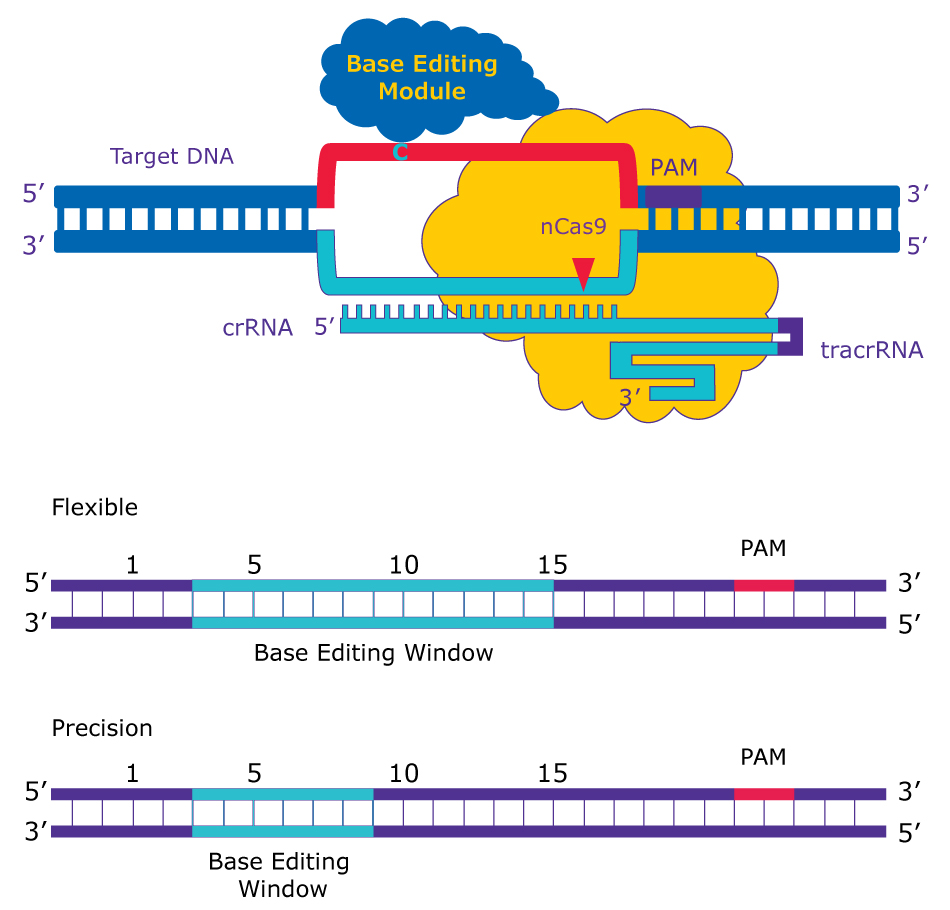
Figure 2.PURedit® cytosine base editor protein mechanism schematic, simplified to represent the nCas9 and base editing components (top) and editing windows (bottom).
Base editing vs traditional CRISPR editing
How is base editing different than traditional Cas9 CRISPR editing? Base editing differs from traditional CRISPR Cas9 editing in method of action, advantages, and drawbacks. Table 1 shows the differences in detail.
Base editor experimental considerations
- Editing Window determines ability to generate desired change
- Outside window: no editing
- Multiple editable residues in window: possible concurrent editing
- Base excision DNA repair removes uracil from genome:
- Edited bases can be reverted to the unedited state or converted to other substitutions or indels
- Addition of uracil glycosylase inhibitor (UGI) prevents removal of uracil and promotes installation of C-to-T substitutions
- Ribonucleoprotein (RNP) delivery of reagents yields higher specificity than plasmid-based delivery
Can cytosine base editors convert thymine to cytosine?
No, cytosine base editors cannot convert thymine to cytosine. They are designed to convert cytosine (C) into thymine (T).
Can cytosine base editors edit any of the other bases?
Cytosine base editor proteins only act on cytosine residues. However, guide RNAs can be designed to target either strand of DNA. A successfully targeted cytosine residue on the antisense strand would appear as a G-to-A substitution on the sense strand. Our guide design tool can assist with targeting the correct strand for the intended base change.
Base editing results and data
We tested different combinations of base editing components for both proteins at genomic targets in HEK293 cells: RNP alone; RNP plus UGI; RNP plus the transfection enhancer PEXBUFF; and RNP plus PEXBUFF and UGI. We harvested the cells three days post-transfection and analyzed editing by next-generation sequencing (NGS).
C-to-T editing
Meaningful levels of C-to-T editing were observed in all samples (Figure 3). Inclusion of PEXBUFF Transfection Enhancer increased overall rates of all base editing outcomes, including C-to-T editing, indel byproduct formation, and C-to-R substitutions. It did not impact the proportion of cytosine substitutions that were C-to-T, indicating that it promotes deamination events without impacting downstream processes. Addition of UGI to the transfections increased the rate of C-to-T formation; decreased the rate of indel byproduct formation; and increased the proportion of cytosine substitutions that are C-to-T.
Notably, the combination of UGI and PEXBUFF conferred additive benefits to base editing, with lower rates of indel byproduct formation and higher proportions of cytosine substitutions that are C-to-T than transfections containing PEXBUFF but omitting UGI, and higher rates of C-to-T editing than transfections containing UGI but omitting PEXBUFF.
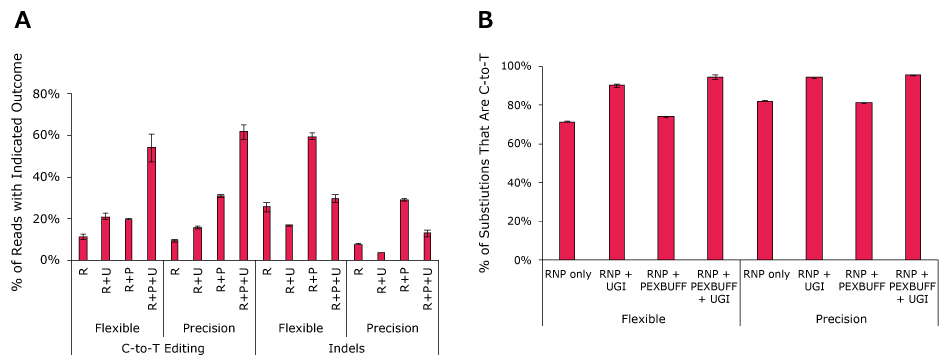
Figure 3.Co-delivery of PURedit® Cas9 cytosine base editor proteins with the editing boosters PEXBUFF and UGI boost C-to-T editing. Flexible and Precision CBE proteins were delivered to HEK293 cells as RNP (R), co-transfected with UGI (R+U), co-transfected with PEXBUFF (R+P), or all three components delivered together (R+P+U). A) Absolute rates of C-to-T editing and indel formation at genomic target EMX1-15. B) Percent of cytosine substitutions that are C-to-T at genomic target EMX1-15.
Off-target editing
We assessed the off-target editing of PURedit® Cas9 cytosine base editor proteins and compared their specificity to plasmid delivery of the same editors. CRISPR/Cas systems are known to suffer from a propensity to mismatch editing at sites with high sequence similarity to the intended target, and RNP delivery has been shown to mitigate this challenge.
We tested editing by Flexible and Precision proteins at the genomic target EMX1-11 and a similar off-target site in HEK293 cells with and without PEXBUFF and UGI. In parallel, we expressed the base editor and guide RNA from plasmids under control of the CMV and U6 promoters, respectively. We harvested cells three days post-transfection and analyzed editing by next-generation sequencing (NGS).
Flexible and Precision base editor proteins followed the established pattern (Figure 4), with plasmid delivery resulting in the highest absolute level of editing at the off-target mismatch site. Simultaneously, RNP delivery with UGI and PEXBUFF achieved C-to-T editing rates similar to plasmid delivery. Thus, RNP delivery of PURedit® Cas9 cytosine base editors can achieve improved specificity without sacrificing overall editing efficiency.

Figure 4.RNP delivery of PURedit® Cas9 cytosine base editors is more specific than plasmid delivery. Absolute editing rates at the (A) EMX1-11 on-target and (B) mismatch off-target sites. Flexible and Precision CBE proteins were delivered to HEK293 cells as RNP (R), co-transfected with UGI (R+U), co-transfected with PEXBUFF (R+P), all three components delivered together (R+P+U), or via plasmid. Editing outcomes are indicated by colored stacked bars: red, C-to-T substitutions; purple, C-to-R substitutions; blue, indels.
Characterizing base editor proteins
Thorough characterization of editing activities is crucial to successful use of a base editor. To characterize our PURedit® Cas9 cytosine base editor proteins, we developed an in vitro assay to directly measure the editing efficiency at each position of the protospacer, in each dinucleotide context.
Briefly, we designed a set of duplex DNAs with three cytosine residues that tiled across the protospacer, so that each position was covered at least once, in each dinucleotide sequence context. We found that PURedit® Cas9 cytosine base editor proteins had highest activity at TpC dinucleotide targets relative to other dinucleotide sequence contexts (Figure 5A). We further found that CpC dinucleotide targets were edited more strongly than ApC or GpC dinucleotide targets.
We then used the editing data from TpC dinucleotide targets to define editing windows for both Flexible and Precision kits. We found that the Flexible kit efficiently edited residues from the third position of the protospacer to the 15th position. In contrast, the Precision kit edited from the third to the tenth positions of the protospacer, with a distinct peak at position six. We have used this in vitro editing data to train a computational model to predict editing outcomes at any user-provided target site to facilitate guide RNA design. You can test this out in our free online CRISPR Design Tool.
In eukaryotic cells, cytosine residues in CpG dinucleotides may be methylated at the C5 position. To evaluate the effect of cytosine methylation on the editing activity of PURedit® Cas9 cytosine base editors we designed dsDNA oligonucleotides that harbored CpG sequences, which were left unmethylated or methylated chemically during oligo synthesis.
After editing in vitro, we sequenced the oligonucleotide targets by NGS and measured the rate of editing at each cytosine position (Figure 5B). We found that methylation of the edited strand (non-target strand, NTS), but not the sgRNA-binding strand (target strand, TS), compromised editing by 50–75%.
For editing in cells, this has implications for the editing outcomes at methylated residues. C-to-R editing and indel byproduct formation result from base excision of uracil. However, deamination of methylcytosine yields thymine instead of uracil; therefore, editing of methylated residues is unlikely to result in C-to-R substitutions or indels at that position.

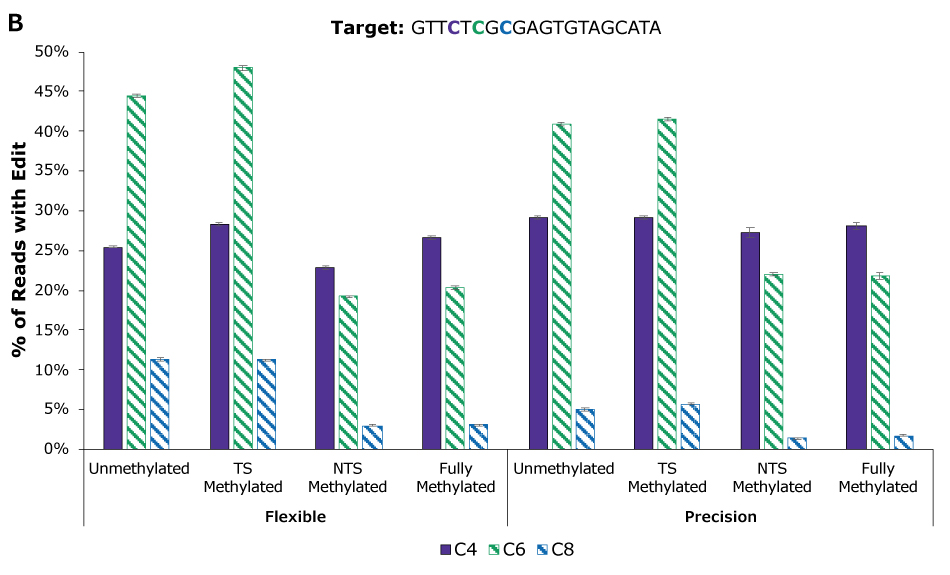
Figure 5.PURedit® Cas9 cytosine base editor Flexible and Precision proteins exhibit preferences for TC dinucleotides and unmethylated residues. A) Editing rate for in vitro reactions to define editing windows and dinucleotide sequence contexts for Flexible (top graph) and Precision (bottom graph). Editing rates for positions in a CC context include the outcomes CT and TT (YT). Below the plots is a heat map representation of editing rates for each editor, calculated using the editing rates for the TC dinucleotide. B) Methylation of cytosines on the non-target strand impedes base editing. The CpG target sequence is given above the chart, with cytosine residues in the editing window bolded and colored as in the plot. Cytosine residues that may be methylated are indicated by hashed bars, while solid color indicates that a residue is unmethylated in all targets (target strand, TS; non-target strand, NTS)
Testing in various cell types
Finally, we tested editing of PURedit® Cas9 cytosine base editor proteins in additional cell types (Figure 6). K562 cells were edited efficiently by Flexible and Precision cytosine base editors, with the inclusion of UGI increasing the rate of C-to-T editing and decreasing the rate of indel byproducts. As with the HEK293 cells, addition of PEXBUFF Transfection Enhancer increased the overall rate of editing in K562 cells.
Rates of editing were lower but measurable in primary human T cells. While the inclusion of PEXBUFF had little effect on overall editing rates in this cell type, addition of UGI increased the absolute rate of C-to-T editing and decreased the rate of indel byproducts.
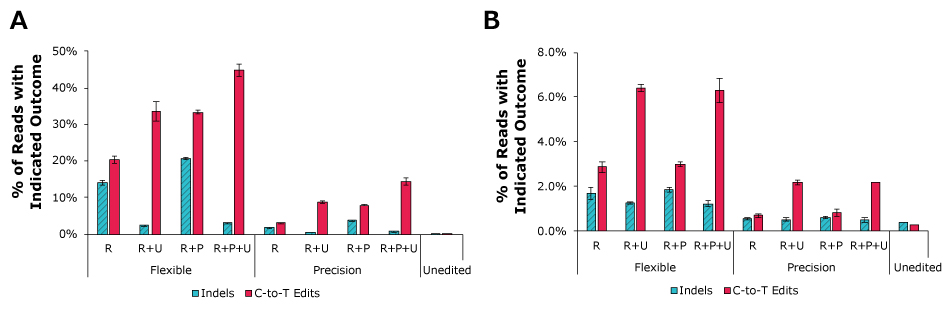
Figure 6.Flexible and Precision PURedit® Cas9 cytosine base editor proteins are effective in K562 and primary human T cells. Absolute rates of indel formation (blue bars) and C-to-T editing (red bars) for the genomic target RNF2 in (A) K562 cells and (B) primary human T cells. R, RNP; R+U, RNP + UGI; R+P, RNP + PEXBUFF; R+P+U, RNP + PEXBUFF + UGI.
Summary
We conducted transfection experiments with our PURedit® Cas9 cytosine base editors at multiple genomic targets in several cell types. We have shown that the Flexible editor has a wider editing window, enabling more freedom in placement of the guide RNA relative to the target residue, and that the Precision editor has a narrowed editing window, enabling greater discrimination between nearby cytosine residues.
Both base editor proteins can be co-transfected with UGI protein to increase the rate of C-to-T editing, increase the proportion of substitutions that are C-to-T, and decrease the rate of indel byproduct formation. Alternatively, UGI may be omitted from editing reactions to enable C-to-A or C-to-G editing. Further, both proteins can be co-transfected with PEXBUFF Transfection Enhancer to increase the overall rate of editing in many cell types.
PURedit® Cas9 cytosine base editor proteins are most efficient on cytosine residues that are preceded by thymine (TpC dinucleotides), with lesser but substantial editing of cytosine residues preceded by another cytosine residue (CpC dinucleotides), and the lowest editing efficiency at cytosine residues preceded by adenine or guanine (ApC and GpC dinucleotides). Both proteins also edit unmethylated cytosine residues with higher efficiency than methylated residues. However, editing of methylated residues is less likely to result in C-to-R substitutions and indels.
Finally, editing by PURedit® Cas9 cytosine base editor proteins is more specific than the same editors delivered via plasmid. These proteins provide a versatile toolset to facilitate base editing experiments with increased precision over plasmid delivery.
Transfection method
To perform transfections of PURedit® Cas9 cytosine base editor proteins, seed the cells at optimal concentrations 24 or 48 hours before the experiment, dependent on the cell type.
On the transfection day, assemble the RNP complex by mixing CBE protein with guide RNA and UGI protein and incubating at room temperature for 5-10 minutes. Harvest the desired number of cells for the transfection and wash them with Hank’s Balanced Salt Solution twice. After resuspending the cells in the transfection solution, transfer the desired number of cells for one transfection to a single tube containing PEXBUFF Transfection Enhancer and mix by gentle pipetting. Transfer the PEXBUFF-enhanced cells to the RNP complex and mix by gentle pipetting before performing the transfection.
For best results, use proper RNA-handling technique and maintain RNP assemblies on ice until the time of transfection. Prolonged incubation of cells in PEXBUFF-containing transfection solution may cause toxic effects and reduce editing rates. We suggest that researchers optimize the number of cells per transfection and amount of PEXBUFF Transfection Enhancer, as different cell types have different optimal dosages.
Further, the amount of UGI may be optimized on a target-by-target basis for best results. Detailed transfection methods can be found in the PURedit® Cas9 cytosine base editor user guide and in our peer-reviewed publication.
Required and related cytosine base editor products
- You can also design and order your gRNAs to complete your RNP complex:
- Design your CRISPR gRNA for standard Cas9 applications and PURedit® Cas9 cytosine base editors
- Order Custom gRNA for standard Cas9 applications and PURedit® Cas9 cytosine base editors