
Optimizing Lipid Nanoparticle Formulations Through Ultrafiltration with Amicon® Ultra Devices
Lipid nanoparticles for drug delivery are increasingly being studied for various therapeutics. See how Amicon® Ultra ultrafiltration devices can enhance LNP formulation by maintaining lipid properties after concentration without sacrificing recovery rates.
Section Overview
- Lipid Nanoparticles for Drug Delivery
- Role of Amicon® Ultra Devices In LNP Production
- How Concentration and Buffer Exchange Impacts LNP Quality
- Factors To Consider When Selecting Ultrafiltration Devices For LNPs
- Characterization of LNP Formulations
- Case Study: mRNA-LNP Properties and Recovery Using Amicon® Ultra Filtration
- Summary
- Amicon® Ultra Products
Lipid Nanoparticles for Drug Delivery
In recent years, Lipid Nanoparticles (LNPs) have emerged as a leading technology for drug delivery, offering an efficient and stable means of transporting therapeutic molecules into the cells. LNPs have been studied for decades as potential effective drug carriers, but their clinical relevance gained more widespread attention during the COVID-19 pandemic, due to the essential role they played in the formulation and successful delivery of mRNA-based COVID vaccines.1 These vaccines demonstrated the feasibility of LNP-mediated mRNA delivery, along with their potential for rapid development and scalable manufacturing.
What Are the 4 Components of LNPs?
LNPs are composed of four different components: ionizable lipids, PEGylated lipids, phospholipids, and cholesterol, each of which have their own function in the carrier system. Ionizable lipids facilitate nucleic acid encapsulation and support endosomal escape following cellular uptake of the drug. PEGylated lipids help prevent aggregation and extend blood circulation time. Helper lipids, such as phospholipids and cholesterol, support the overall structure, and enhance stability and delivery of the LNPs.2
How LNPs Work
Once the drug is administered, the LNPs encapsulating the therapeutic molecule, such as mRNA, facilitate its entry into the target cells via endocytosis. Endosomal escape allows for the release of the nucleic acid into the cytoplasm, where the mRNA can be translated into proteins, and exert its intended effect.
LNP Formulation
LNPs can be formulated in a variety of different methods, but one of the critical processes during LNP formulation and manufacturing is purification and buffer exchange during downstream processing. Techniques such as ultrafiltration, dialysis, and diafiltration are commonly used to remove unencapsulated mRNA, exchange solvents for compatible buffers, and concentrate the final product. These steps are important to maintain stability, safety, and efficacy of LNP formulations.
Role of Amicon® Ultra Devices In LNP Production
Amicon® Ultra devices are centrifugal filter devices that can be used for the concentration and purification of biomolecules, such as proteins and nucleic acids, along with desalting and diafiltration, through a process called ultrafiltration. They utilize a semipermeable regenerated cellulose (RC) membrane, to separate molecules based on size, allowing for efficient sample preparation in various laboratory applications. RC membrane in Amicon® Ultra devices comes in a variety of molecular weight cut offs (MWCO), ranging from 3 kDa to 100 kDa.
Amicon® Ultra filters are widely used in LNP formulation workflows in academic and small-scale research settings and are frequently referenced in LNP-related literature and protocols, reinforcing their status as a standard tool in this workflow. For scale-up and manufacturing, tangential flow filtration (TFF) becomes more prominent due to better control over factors such as flow rates and shear stress.
Amicon® Ultra devices are popular because they offer:
- High Recovery Rates: Their design minimizes sample loss, which is important when working with expensive or limited LNP formulations.
- Wide Range of MWCOs: Suitable for excluding small molecules while retaining larger LNPs.
- Ease of Use: They are simple to operate with standard laboratory centrifuges.
- Scalability for Research: Perfect for small-volume preparation and rapid prototyping during formulation optimization.
Highlighted Publication Featuring Amicon® Ultra Filters In LNP Research
See examples of how researchers use Amicon® Ultra devices in their LNP research.
- Rational Design of Unsaturated, Thioether Ionizable Lipids for Enhanced In vivo mRNA Delivery. Samaridou E, Simon J, Beck‐Broichsitter M, Davidson G, Levkin PA. 2025. Advanced Healthcare Materials. 14(15). doi:10.1002/adhm.202501037.
How Concentration and Buffer Exchange Impacts LNP Quality
Concentration and buffer exchange steps can impact LNP size and stability, due to shear stress generated during centrifugation, which can disrupt particle integrity, promote aggregation, or alter size distribution. During ultrafiltration, optimizing parameters such as centrifugation speed, temperature, and spin time, are important to not affect the quality and yield of the LNP particles. As a rule of thumb, lower centrifugation speeds (2,000 – 3,000 x g) and low temperatures (4-8 °C) help to ensure higher recovery of the LNP particles post centrifugation.
Pre-rinsing the devices with buffer before use can also help reduce nonspecific binding and improve recovery. Some LNP formulations may be too sensitive to perform diafiltration using ultrafiltration devices, so the recommendation is to dialyze first, followed by concentration using Amicon® Ultra devices.
Factors To Consider When Selecting Ultrafiltration Devices For LNPs
Two key variables to consider when choosing the right MWCO and device size are the size of the LNPs and sample volume. To retain LNPs, the molecular weight cut-off of the filter membrane needs to be smaller than them (~2 times smaller than the molecular weight of the nanoparticle), but large enough to allow smaller components to filter through (Table 1). Processing volumes ranging from ≤0.5 mL to 15 mL are compatible with Amicon® Ultra devices, while LNP size can be estimated from published sources, or by measurement techniques such as laser diffraction and dynamic light scattering (DLS).
Characterization of LNP Formulations
Downstream processing and analysis of LNP particles is important to ensure batch consistency. There are several analytical techniques that can be employed to characterize mRNA LNPs postproduction. Particle size and polydispersity index (PDI) are most often measured by DLS. DLS is preferred for its low sample requirements, fast analysis times, and broad compatibility with different solvents.
Zeta potential measurements provide information about surface characterization and stability. Encapsulation efficiency (EE%) is a critical quality attribute during characterization of mRNA LNP formulation. This is often determined using fluorescent-based assays, such as RiboGreen assays.3 Particle size and RNA concentration can be determined at several points over the processing of the LNP formulation, such as post-dialysis, concentration, and sterile filtration. This allows for the determination of EE% at several points over the workflow and can help with optimizing your processing parameters, which ensures high recoveries of your product throughout the span of the workflow.
Case Study: mRNA-LNP Properties and Recovery Using Amicon® Ultra Filtration
In this case study, we used the LNP composition from the Comirnaty COVID-19 Vaccine (Pfizer/BNT) loaded with mRNA-encoding luciferase. Lipid nanoparticles were prepared by microfluidic mixing, dialyzed, and further concentrated with Amicon® Ultra devices (30 kDa) at 1,000 g at 4 °C.
The physicochemical properties, including diameter, PDI, and EE%, remained consistent throughout the process, achieving a 12-fold increase in total mRNA concentration. There was no loss in in vitro efficiency, and mRNA-LNP recovery exceeded 85% during the process (Figure 1).
Comparable data was obtained for a variety of different LNP compositions including novel ionizable lipids.
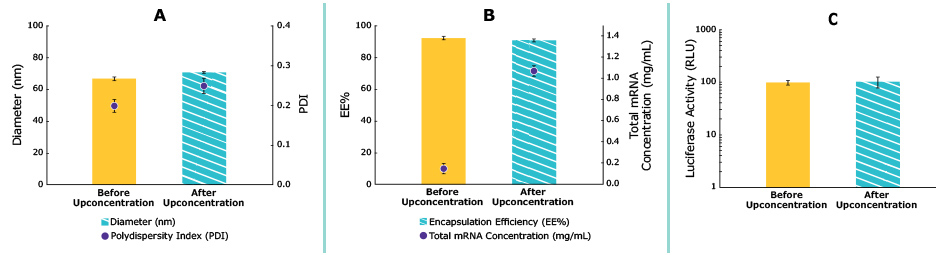
Figure 1.Analysis of mRNA-LNP recovery through measuring physicochemical properties before and after concentration. Concentration using Amicon® Ultra devices yielded consistent physicochemical properties of the mRNA-LNP particles. Graphs are as follows: (A) Particle size showing diameter and polydispersity index (PDI), (B) RNA concentration showing encapsulation efficiency (EE%) and total mRNA concentration (mg/mL), and (C) In vitro efficiency in muscle cells showing the luciferase activity (RLU) * 50 ng dose/96-well.
Summary
Lipid nanoparticles have become an important technology in the delivery of nucleic acid-based therapeutics. As research continues to evolve, so too does the need for scalable, efficient, and reliable purification methods to support development pipelines.
Amicon® Ultra devices offer a flexible and user-friendly solution for small-scale downstream processing of LNPs. Their ability to perform concentration and buffer exchange makes them well suited for early-stage optimization work and when necessary, due to sensitive formulations, they can be paired well with dialyzing devices before being used for concentration of the LNPs.
As shown in the case study, the use of Amicon® Ultra devices during the concentration process effectively maintained lipid nanoparticles properties and resulted in significant enrichment of the mRNA concentration with high recovery rates.
Incorporating Amicon® devices into pilot-scale LNP workflows, when paired with robust analytical characterization, can provide researchers with a powerful tool to accelerate the development of high-quality, stable LNP formulations.