
CP74

Anti-Vinculin Mouse mAb (V284 or VLN01)
liquid, Calbiochem®, from mouse
Synonym(s):
Anti-Vinculin antibody
Sign In to View Organizational & Contract Pricing.
Select a Size
Change View
About This Item
NACRES:
NA.41
UNSPSC Code:
12352203
Clone:
V284, monoclonal, VLN01, monoclonal
Species reactivity:
human
Application:
—
Citations:
48
biological source
mouse
Quality Segment
antibody form
purified antibody
antibody product type
primary antibodies
clone
V284, monoclonal, VLN01, monoclonal
form
liquid
contains
≤0.1% sodium azide as preservative
species reactivity
human
manufacturer/tradename
Calbiochem®
storage condition
do not freeze
dilution
(Immunoblotting (1 µg/mL, chemiluminescence)
Immunoprecipitation (2 µg/mL lysate)
Paraffin Sections (4-8 µg/mL, heat pre-treatment required))
isotype
IgG1
shipped in
wet ice
storage temp.
2-8°C
target post-translational modification
unmodified
Gene Information
human ... VCL(7414)
General description
This Anti-Vinculin Mouse mAb (V284 or VLN01) is validated for use in Immunoblotting, Immunoprecipitation, Paraffin Sections for the detection of Vinculin.
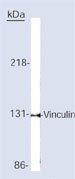
Protein G purified mouse monoclonal antibody generated by immunizing BALB/c mice with the specified immunogen and fusing splenocytes with mouse myeloma SP2/0 cells. Recognizes the ~130 (vinculin) and ~150 kDa (meta-vinculin) proteins.
Recognizes the ~130 (vinculin) and ~150 kDa (meta-vinculin) proteins in skin tissue.
Immunogen
Human
semi-purified, human vinculin
Application
Immunoblotting (1 g/ml, chemiluminescence)
Immunoprecipitation (2 g/ml lysate)
Paraffin Sections (4-8 g/ml, heat pre-treatment required)
Packaging
Please refer to vial label for lot-specific concentration.
Physical form
In 10 mM PBS, 0.2% BSA, pH 7.4.
Analysis Note
Negative Control
Normal mouse serum
Normal mouse serum
Positive Control
Skin cells or tissue
Skin cells or tissue
Other Notes
Palovuori, R., and Eskelinen, S. 2000 Eur. J. Cell Biol.79, 961.
Bakolitsa, C., et al. 1999 Cell99, 603.
Rudiger, M., et al. 1998 Bioessays20, 733
Tidball, J.G., et al. 1999 J. Biol. Chem.274, 33155
Goldmann, W.H., et al. 1996 J. Muscle Res. Cell Motil.17, 1.
Asijee, G.M., et al. 1990 Eur. J. Biochemistry189, 131
Otto, J.J. 1990 Cell Motil. Cytoskeleton16, 1.
Bakolitsa, C., et al. 1999 Cell99, 603.
Rudiger, M., et al. 1998 Bioessays20, 733
Tidball, J.G., et al. 1999 J. Biol. Chem.274, 33155
Goldmann, W.H., et al. 1996 J. Muscle Res. Cell Motil.17, 1.
Asijee, G.M., et al. 1990 Eur. J. Biochemistry189, 131
Otto, J.J. 1990 Cell Motil. Cytoskeleton16, 1.
This antibody is useful for studies of the role of vinculin in platelet activation. Vinculin (Ab-1) exhibits membrane and cytoplasmic staining when used in immunohistochemistry. For staining of formalin-fixed paraffin sections, boil in 10 mM citrate buffer, pH 6.0, for 10-20 min, followed by cooling at room temperature for 20 min. Antibody should be titrated for optimal results in individual systems.
Legal Information
CALBIOCHEM is a registered trademark of Merck KGaA, Darmstadt, Germany
Disclaimer
Toxicity: Standard Handling (A)
Still not finding the right product?
Try our Product Selector Tool to narrow your options
Storage Class
11 - Combustible Solids
WGK
WGK 1
Flash Point (°F)
Not applicable
Flash Point (°C)
Not applicable
Choose from one of the most recent versions:
Already Own This Product?
Find documentation for the products that you have recently purchased in the Document Library.