
ST1200

Anti-Ubiquitin Mouse mAb (FK2)
liquid, clone FK2, Calbiochem®
Synonym(s):
Mouse Anti-Ubiquitin, Ubiquitin Detection Antibody
Sign In to View Organizational & Contract Pricing.
Select a Size
Change View
About This Item
NACRES:
NA.41
UNSPSC Code:
12352203
Clone:
FK2, monoclonal
Species reactivity:
-
Application:
—
Citations:
53
biological source
mouse
Quality Segment
antibody form
unpurified
antibody product type
primary antibodies
clone
FK2, monoclonal
form
liquid
contains
≤0.1% sodium azide as preservative
species reactivity (predicted by homology)
all
manufacturer/tradename
Calbiochem®
storage condition
OK to freeze, avoid repeated freeze/thaw cycles
dilution
(ELISA
Immunoblotting (1:1000)
Immunoprecipitation (s and comments)
Immunofluorescence )
isotype
IgG1
shipped in
wet ice
storage temp.
−20°C
target post-translational modification
unmodified
General description
Mouse monoclonal antibody generated by immunizing Balb/c mice with the specified immunogen and fusing splenocytes with myeloma cells. Recognizes K29-, K48-, and K63-linked polyubiquitinylated and monoubiquitinylated proteins.
Recognizes K29-, K48-, and K63-linked polyubiquitinylated and monoubiquitinylated proteins, but not free ubiquitin, in Raji cells.
This Anti-Ubiquitin Mouse mAb (FK2) is validated for use in ELISA, Immunoblotting, Immunoprecipitation, Immunofluorescence for the detection of Ubiquitin.
Immunogen
human
unpurified polyubiquitinylated lysozyme
Application
ELISA (see application references)
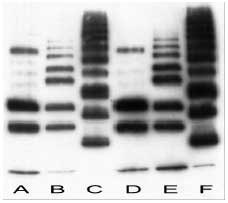
Immunoblotting (1:1000)
Immunoprecipitation (see application references and comments)
Immunofluorescence (see application references)
Packaging
Please refer to vial label for lot-specific concentration.
Physical form
In PBS.
Preparation Note
Following initial thaw, aliquot and freeze (-20°C). Store diluted antibody at 4°C for up to 1 month.
Raji cells
Other Notes
Does not recognize free ubiquitin. For immunoprecipitation, once the antibody is immobilized, it demonstrates affinity for free ubiquitin as well as for poly- and monoubiquitinylated proteins. Antibody should be titrated for optimal results in individual systems.
Matsumoto, M., et al. 2005. Proteomics 5, 4545.
Boname, J.N., et al. 2001. Immunity 15, 627.
Campbell, V., et al. 2001. Neuron 32, 1013.
Fujimuro, M., et al. 2003. FEBS Letts. 349, 173.
Boname, J.N., et al. 2001. Immunity 15, 627.
Campbell, V., et al. 2001. Neuron 32, 1013.
Fujimuro, M., et al. 2003. FEBS Letts. 349, 173.
Legal Information
CALBIOCHEM is a registered trademark of Merck KGaA, Darmstadt, Germany
Disclaimer
Toxicity: Standard Handling (A)
Still not finding the right product?
Try our Product Selector Tool to narrow your options
Storage Class
12 - Non Combustible Liquids
WGK
WGK 2
Flash Point (°F)
Not applicable
Flash Point (°C)
Not applicable
Choose from one of the most recent versions:
Already Own This Product?
Find documentation for the products that you have recently purchased in the Document Library.