
Ultrapure Water for LC-MS Analysis
High performance liquid chromatography-mass spectrometry (HPLC-MS, or more commonly LC-MS) is a powerful and versatile analytical technique that combines the physical separation capabilities of liquid chromatography with the mass analysis capabilities of mass spectrometry. Used for many applications, LC-MS relies on water free from contaminants for accurate analysis.

LC-MS applications
LC-MS offers very high sensitivity and specificity and is used to identify, quantify and characterize compounds in complex mixtures.
A wide variety of sample types are suitable for LC-MS analysis, such as chemical or pharmaceutical mixtures, and environmental, food, and biological samples. The versatility of LC-MS makes it essential for everything from single-cell analysis to drug development and food safety. However, its sensitivity means that these applications require ultrapure water as even trace contaminants could skew results.
LC-MS has also become central to many cutting-edge research areas like omics (proteomics, metabolomics, lipidomics), precision medicine and environmental exposomics, enabling deep insights into complex biological and chemical systems. Advancements in LC-MS include high throughput applications and increased miniaturization.
LC-MS principle
In LC-MS, the compounds present in a sample are first separated on a column by liquid chromatography based on their chemical properties (see article, Water for HPLC and UHPLC Analysis). The separated compounds are then introduced into the mass spectrometer (see Figure 1), where they are ionized and analyzed based on their mass-to-charge ratio (m/z), allowing for identification and quantification. LC-MS can also be configured as LC-MS/MS (tandem mass spectrometry) for enhanced sensitivity and specificity.
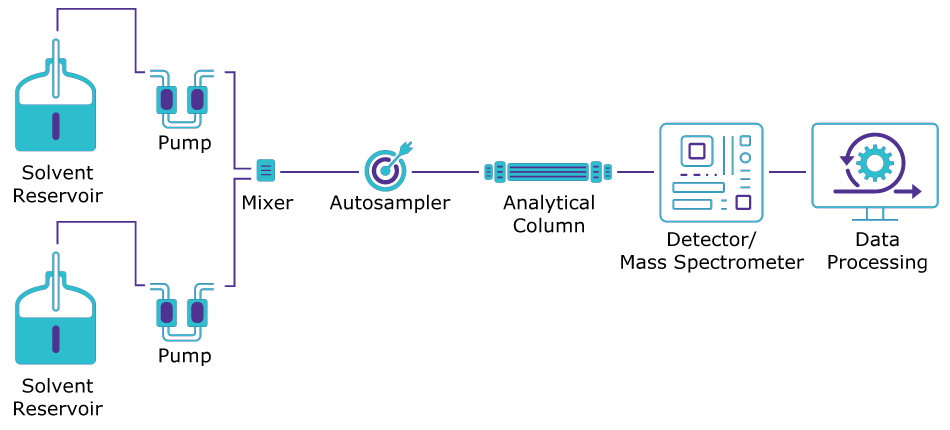
Figure 1.Schematic representation of an LC-MS instrument
Ionization options for mass spectrometry
In the mass spectrometer (MS) part of an LC-MS instrument, the process begins with the ion source, where the separated compounds from liquid chromatography are ionized. Common ionization techniques include electrospray ionization (ESI) and atmospheric pressure chemical ionization (APCI), which generate charged ions from the liquid sample:
- Electrospray ionization (ESI) - Ions are generated at atmospheric pressure by passing the analyte solution through a capillary (electrospray needle) with a high voltage (typically 2.5 to 4 kV) applied. This creates charged aerosol droplets containing solvent and analyte molecules, which eventually lose their solvent and are directed to the mass analyzer.
- Atmospheric pressure chemical ionization (APCI) - Ions are generated through ion/molecule reactions at atmospheric pressure. The analyte solution is introduced via a capillary into a nebulizer, desolvated in a heated quartz tube, and then ionized by electrons from a corona discharge. This process leads to efficient ionization of the analytes.
Mass analyzer options for mass spectrometry
The resulting ions are directed into the mass analyzer, which separates them based on their mass-to-charge ratio (m/z) using various methods such as quadrupole, time-of-flight (TOF) or ion trap:
- Quadrupole: This analyzer uses four rods to create an oscillating electric field that filters ions based on their mass-to-charge ratio (m/z). Quadrupole mass spectrometers are widely used for both targeted and quantitative analysis due to their stability and speed.
- Time-of-flight (TOF): In a TOF analyzer, ions are accelerated into a flight tube, where they travel a fixed distance. The time taken to reach the detector correlates with their m/z, allowing for high-resolution analysis of a wide mass range.
- Ion trap: This analyzer traps ions in a three-dimensional electric field and sequentially ejects them based on their m/z. Ion traps are versatile and can perform multiple stages of mass spectrometry [(MS/MS to multistage MS (MSn)] for detailed structural analysis.
Finally, the detector measures the abundance of each ion, generating a mass spectrum that provides information for identifying and quantifying the compounds in the sample.
Impact of water quality on LC-MS
Water is used throughout the LC-MS workflow. Water is usually used to prepare the mobile phase, to dilute standards, and as blanks. It is also often used to prepare samples. Water that enters the flow path should be of high purity, both to ensure analytical accuracy and to protect the instrument.
Since LC-MS is a very sensitive analytical technique, it is extremely sensitive to contaminants.1 Many water contaminants may impact the HPLC part of the LC-MS set-up, while others are more specific for the MS detection.
Contamination of the water used for LC-MS may affect analytical results and instruments in different ways:
Organics
Organic molecules from the water used to prepare the eluent may cause background noise. They may also interfere with the mass spectrometric detection by causing ion suppression or enhancement. This may lead to difficult identification and quantification.
They may accumulate on the surface of the column beads, slowing down the access of sample and solvent molecules to the binding sites. This causes mass transfer issues and results in a loss of resolution and sensitivity, and ultimately in a shorter column lifetime.
Organics may accumulate at the head of the column and later elute as extraneous or ghost peaks, causing interferences and difficult quantification.
If the level of organic contamination is very high, the contaminant(s) may cause a shift in retention time and distorted peak shape. This may lead to poor resolution, difficult identification and quantification.
For all these reasons, it is critical to accurately monitor the level of organics in water used for LC-MS analyses and this can conveniently be performed by an on-line TOC monitor.
Ions
Contamination of the water with metal ions (e.g., Na+, K+) leads to the formation of adducts with the molecules of interest, which could complexify automated peak picking or library matching, and make data interpretation challenging. Halogens, such as chloride or bromide may cause ion suppression in positive electrospray ionization (ESI+) mode or increase background noise in negative electrospray ionization (ESI-) mode by forming adducts or complexes with analytes.
The presence of ions in water can affect the overall performance of LC-MS analyses, impacting the detection limits and quantification of analytes.
Particles
Particles may damage HPLC pumps and injectors. They could also accumulate in the column and frits, causing an increase in back pressure.
Bacteria
Bacteria may accumulate in columns and frits. They may also release organic by-products.
Case Study: Impact of organic contamination on LC-MS sensitivity
To obtain reliable LC-MS data, it is important to be sure that the analytes detected truly originate from the samples, and not from the water used in the analytical workflow.
In this study, two types of water were evaluated:
- Tap water from the laboratory of one of our customers.
- Freshly dispensed ultrapure water from a Milli-Q® water purification system installed in that laboratory. The Milli-Q® system incorporated pretreatment using intelligent reverse osmosis, Elix® eletrodeionization and a bactericidal UV lamp, similar to the Milli-Q® IX pure water system. Following pretreatment, a Milli-Q® polishing system, similar to the Milli-Q® IQ 7000 system, was used to deliver ultrapure water.
The laboratory’s tap water was found to contain trace amounts of estradiol, the analyte of interest, making it unsuitable for analyzing estradiol in test samples. In comparison, after purification with the Milli-Q® water purification system, the ultrapure water obtained showed no detectable estradiol and was therefore appropriate for these sensitive analyses (Figure 2).
These results highlight that, even when tap water contains trace analyte contamination, purification with a Milli-Q® ultrapure system reliably produces water of sufficient quality for even the most demanding analytical applications. The level of total oxidizable carbon (TOC) provides a general indication of organic contamination. A TOC level below 5 ppb is recommended for LC-MS, which is achieved by Milli-Q® ultrapure water systems.
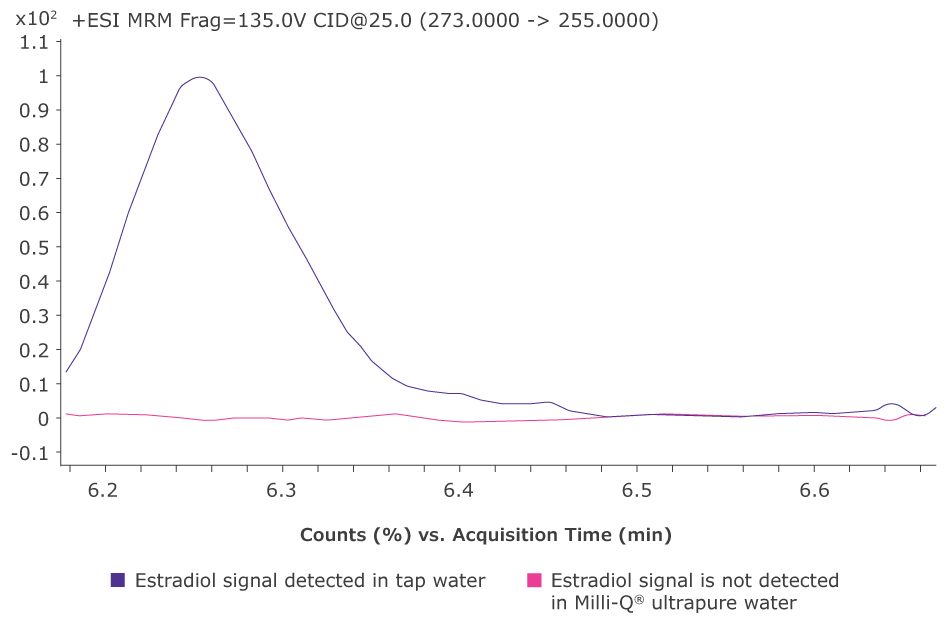
Figure 2.MRM chromatogram (ESI+) of estradiol in tap water and freshly dispensed Milli-Q® ultrapure water. Precursor ion 273 m/z and fragment ion 255 m/z were used for multiple reaction monitoring (MRM) ESI+ transition of estradiol. LC-MS analyses were performed on an Agilent® 1290 Infinity HPLC system coupled to an Agilent® 6420 Triple Quadrupole system (ESI+, MRM). A Purospher® STAR RP-18 endcapped (2 µm) Hibar® HR 50-2.1 column was used to separate the hormones under gradient elution conditions.
Long-term storage of purified water introduces contaminants in LC-MS analysis
Once ultrapure water is dispensed from a water purification system, it can quickly become contaminated by the lab environment and by the containers used to store it. For this reason, it is best to use freshly purified ultrapure water on demand whenever possible.
Plastic containers typically release organic compounds (e.g. plasticizers) and some ions, while glass bottles leach fewer organics but may still release ions. In addition, storing ultrapure water can promote bacterial growth over time, which can release organic contaminants. Figure 3 illustrates how storage after opening negatively affects the purity of LC-MS grade water.
To minimize these effects, water meant for LC-MS analysis should be stored in glass bottles (preferably borosilicate bottles) for the shortest time possible.
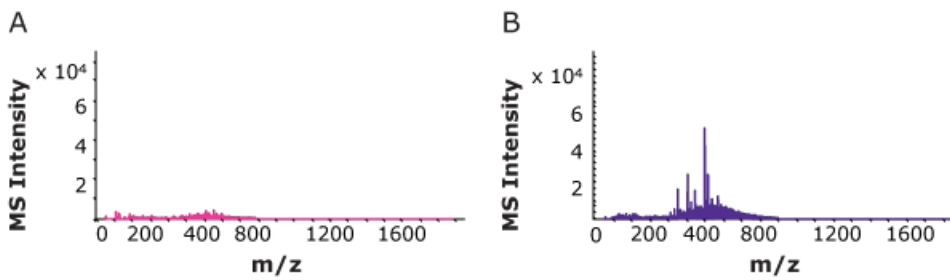
Figure 3.Comparison of mass spectra of (A) freshly produced Milli-Q® ultrapure water with Total Organic Carbon (TOC) below 5 ppb and resistivity of 18.2 MΩ·cm, produced from a Milli-Q® ultrapure water purification system with a 0.22 μm final filter (Millipak®) and (B) water from an opened bottle of LC-MS grade water from competitor B after four weeks of storage. The analyses were performed via direct injection of the solvents into the MS operated in ESI positive mode. Source: Four Ways to Better Water Quality in LC-MS.3
Specifications for LC-MS grade water
A range of water purification solutions adapted to the needs of scientists working with liquid chromatography – mass spectrometry is available.
Freshly purified ultrapure (Type 1) water, with a resistivity of 18.2 MΩ.cm and TOC below 5 ppb, is essential for achieving high analytical sensitivity and accuracy, as well as reliable and reproducible LC-MS results. Choosing a water purification system equipped with a TOC monitor or indicator ensures that the water used in LC-MS is free from organic contaminants, which can interfere with the analysis and affect data accuracy. The TOC value provides real-time assurance of water purity, allowing for corrective actions to be taken before analyses are compromised.
To deliver water suitable for LC-MS analysis of trace and ultra-trace organics, we developed the LC-Pak® polisher. This polisher contains granular C18 reversed phase silica and can be placed at the dispensing point of Milli-Q® Type 1 ultrapure water systems. It provides efficient and convenient access to freshly purified ultrapure water for LC-MS and LC-MS/MS.