
Water for Elemental Analysis by Inductively Coupled Plasma (ICP) Spectroscopy

Inductively Coupled Plasma (ICP) is a powerful analytical technique used to determine the elemental composition of a wide range of samples. ICP-based methods, such as inductively coupled plasma-optical emission spectroscopy (ICP-OES) and inductively coupled plasma-mass spectrometry (ICP-MS), are used to detect and quantify elements at low concentrations, ranging from parts-per-million (ppm) to parts-per-trillion (ppt). At these sensitivity levels, even minute elemental contaminants in reagent water can compromise accuracy and reproducibility. Consequently, ultrapure water is not merely recommended but essential for reliable ICP analyses.
Section overview
- Impact of water quality on ICP-OES and ICP-MS analyses
- Water quality guidelines for ICP analysis
- Beyond water: The impact of reagent grades and laboratory conditions on elemental analysis
- Case Study: Ultrapure water tailored for ultra-trace elemental analysis
- Ultrapure water for ICP-OES and ICP-MS
- Related products
Applications of ICP spectroscopy
ICP is widely utilized to analyze trace elements (heavy metals, etc.) in environmental and geological samples, semiconductors, metallurgy and mining ores, food and beverages, pharmaceuticals, cosmetics, and many other fields where precise elemental analysis is crucial.1,2 ICP is a high-throughput method, allowing the simultaneous analysis of many elements in a short time.
Comparison of ICP-OES, ICP-MS and AAS
Inductively coupled plasma-optical emission spectroscopy (ICP-OES) and inductively coupled plasma-mass spectrometry (ICP-MS) are both widely used elemental analysis techniques.
- ICP-OES is best suited for ppm to low ppb elemental levels, offers good robustness, and is preferred for routine analyses and complex matrices.
- ICP-MS provides a wider dynamic range with lower detection limits (ppb to ppt) than ICP-OES, making it the preferred choice for ultra-trace element and isotopic analyses.
- AAS is typically more suited for the analysis of single elements, while ICP is preferred for complex samples. ICP-MS generally offers higher sensitivity than an absorption spectroscopy (AAS).
Principle of inductively coupled plasma (ICP) spectroscopy
ICP analysis begins when liquid samples are nebulized into a fine aerosol into argon plasma. The extreme heat from the plasma desolvates, atomizes, and either excites or ionizes the elements for analysis. Analysis by ICP-MS or ICP-OES involves the following steps (Figure 1):
- Sample introduction: If the sample is in liquid form, it is first converted into an aerosol, typically by nebulization, creating a fine mist of tiny droplets. The aerosolized sample is then introduced into the plasma with a peristaltic pump.
- Plasma: When the torch is turned on, an intense magnetic field is generated. Argon gas is introduced, becomes ionized in this field, and generates extremely hot plasma (up to 10,000 °C).
- Ionization and Excitation: The high-energy plasma breaks down the sample molecules into atoms and ions. Some are excited to higher energy levels then return to their ground state, releasing energy in the form of light at specific wavelengths.
- Detection: In the case of ICP-OES, an optical emission spectrometer measures the intensity of the emitted light at specific wavelengths. The intensity of this emission is in direct correlation with the concentration of the element within the sample. In the case of ICP-MS, a mass spectrometer is used to identify and quantify the elements present.
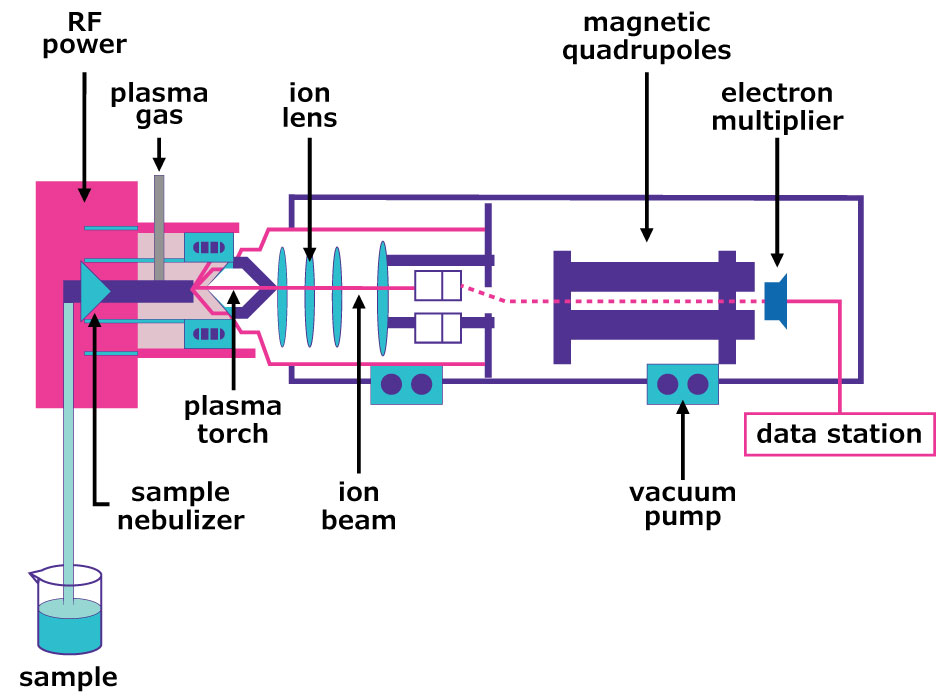
Figure 1.Schematic representation of the components of an ICP-MS instrument.
Impact of water quality on ICP-OES and ICP-MS analyses
As ICP instrumentation capabilities and sensitivity are continuously improving, the demands placed on every component of the analytical method, included reagent water, have grown accordingly. Water is a critical component in ICP analyses because it is used in virtually every stage of the workflow, including:
- Sample preparation (extraction, dilution)
- Preparation of calibration standards (dilution)
- Preparation of blanks
- Washing and rinsing sample and reagent containers
- Cleaning key instrument components
Any contamination introduced through water will propagate throughout the analysis, compromising the accuracy and repeatability of the results. In addition, contaminated reagent water may lead to the buildup of residues in the nebulizer, on the torch and other critical system components, reducing instrument performance and increasing the frequency and cost of maintenance.
Selecting the optimal water quality will avoid interferences, enable the instrument to run in optimal conditions, and ensure consistent, high-quality analytical results.
Water quality guidelines for ICP analysis
The purity of reagent water used for ICP must meet the following criteria:
Low ionic content
The presence of trace elements in water used to perform ICP analyses may cause inaccurate results, decrease the method’s sensitivity, and potentially cause memory effects, where residual analytes persist from previous samples and cause falsely high readings in subsequent samples. To avoid interference with the analytes, reagent water should be free of ions.
- A resistivity of 18.2 MΩ•cm ensures that no ions will be present in the water at a level that would interfere with ICP-OES analyses.
- For ultra-trace ICP-MS analyses, an additional purification unit, such as the Milli-Q® IQ Element, may be placed at the outlet of the water purification system to ensure that the water is totally free of ions.
Low particle content
Hard particles and colloids in water may deposit in the nebulizer or on the torch, causing inconsistent sample introduction, leading to noise, variability in the analytical results, and a need for frequent maintenance. In addition, some metals may stick to particulates and perturb the analysis.
Low bacterial count
Since bacteria behave as particles, they could spoil the nebulizer as well. In addition, bacteria can release metal ions in water, which may cause interferences with the elements tested.
Moderate to low organic content
Some large organic molecules found in water, such as lignin and humic and fulvic acids derived from the degradation of natural organic matter, could stick onto nebulizer surfaces. Organic molecules may also deposit on the torch, causing fluctuations in the plasma's stability and intensity, leading to inconsistent sample ionization and affecting analytical sensitivity. In addition, certain metals (e.g. platinum, mercury, tin and palladium) may form organometallic complexes with some organic moieties. To ensure low levels of these elements in reagent water, it is important to break down organometallic complexes and remove the metals.
Beyond water: The impact of reagent grades and laboratory conditions on elemental analysis
Achieving reliable ICP results depends not only on water purity, but on the broader analytical environment and the quality of every reagent and material involved.
- Clean room vs. standard laboratory: Working in a clean room instead of a standard laboratory environment significantly lowers achievable ICP-MS detection limits and Background Equivalent Concentrations (BEC).
- Acid grade: Other reagents, particularly nitric acid used for sample digestion, matrix stabilization and instrument cleaning, may be a source of contamination. The acid grade selected should match the sensitivity requirements of the analysis.
- Container material: Containers made of fluoropolymers (e.g. perfluoroalkoxy alkane (PFA)), or high‑purity polyethylene are preferred, as some materials may leach ions into the stored liquids.
- Container preparation: The selected containers must be optimally prepared for high-purity water sampling. Avoid using detergents and dedicate containers specifically for ICP spectroscopy analyses.
- The day before analysis: Rinse containers and caps 3 times with ultrapure water, then soak overnight in diluted nitric acid.
- On the day of analysis: Rinse 3 times with ultrapure water and allow to air dry before use.
Case Study: Ultrapure water tailored for ultra-trace elemental analysis
To meet the stringent requirements for ultra-trace elemental analysis, we designed the Milli-Q® IQ Element purification unit. It includes:
- A specific polishing cartridge to remove trace ions
- A semi-conductor grade 0.1 µm final filter to remove particulates
- A footswitch and dispenser that allow for hands-free water delivery
The Milli-Q® IQ Element unit, combined with a Milli-Q® IQ 7 series water purification system, was tested to ensure that it delivers analytical-grade ultrapure water (Table 1) that is suitable for trace and ultra-trace elemental analyses by ICP-MS.
DL: Detection limit
1. Data obtained courtesy of Agilent Technologies, Tokyo, Japan. © Agilent Technologies, Inc. Reproduced with Permission, Courtesy of Agilent Technologies, Inc.
2. Data obtained courtesy of UT2A, Pau, France.
* Si is known to be difficult to measure by ICP-MS. When measured by GF-AAS, concentration was < DL (0.5 ppb).
Table 1. ICP-MS analysis of ultrapure water from Milli-Q® IQ Element unit connected to a Milli-Q® IQ 7005 water purification system.
Ultrapure water for ICP-OES and ICP-MS
Ultrapure (Type 1) water is highly recommended for ICP-OES and ICP-MS to ensure accurate and reliable results. High resistivity, indicating that water is free of ions, can be achieved via several technologies, including reverse osmosis, electrodeionization and mixed-bed ion-exchange resins.
For even greater sensitivity ultra-trace ICP-MS analyses, an ion-exchange cartridge combined with a 0.1 µm filter (Milli-Q® IQ Element purification unit) may be used at the outlet of the ultrapure water system for additional purification.
A range of water purification solutions adapted to the needs of scientists working with ICP is available.