
후성유전학
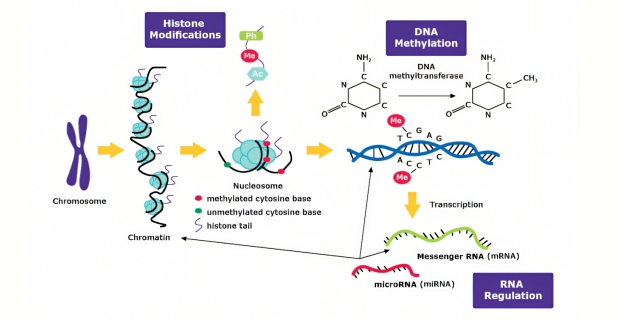
후성유전학적 기전
후성유전학 분야는 암, 신경퇴행성 질환, 중독 연구를 수행하는 과학자들에게 필수적인 연구 분야로 자리 잡았다. 후성유전학적 메커니즘은 유전자 발현을 일시적으로 활성화하거나 억제하는 과정을 포함한다. 흥미롭게도 이러한 변화는 DNA 서열을 영구적으로 변경하지는 않음에도 불구하고 대대로 전달될 수 있다. 후성유전학의 세 가지 주요 메커니즘은 DNA 메틸화, 히스톤 변형, 그리고 RNA 조절이다.
주요 카테고리


DNA 메틸화
DNA 메틸화는 후성유전학에서 가장 잘 알려진 기전입니다. 일반적으로 메틸트랜스퍼라제 효소가 관여하여 시토신(C)의 5위(C5)에 메틸기를 부착하는 과정을 돕습니다. 이러한 메틸기 부착은 주로 시토신-인산-구아닌(CpG) 이뉴클레오티드에서 발생합니다. 그러나 비-CpG 메틸화도 발생합니다. DNA 메틸화 분석은 유전자 발현을 이해하기 위해 자주 수행됩니다. 이러한 분석의 예로는 DNA를 분해한 후 HPLC, 질량 분석법을 통해 메틸화량을 정량하는 방법이나, 비설페이트 나트륨 변환을 거친 뒤 PCR 시퀀싱 및 분석을 수행하는 방법이 있습니다.
히스톤 변형
히스톤 변형은 또 다른 전형적인 후성유전학적 메커니즘이다. 여기에는 아세틸화, 메틸화, 인산화 및 유전자 발현에 영향을 미치는 기타 메커니즘을 통해 히스톤을 변화시키는 다양한 방식이 포함된다. 히스톤은 단백질로, DNA와 함께 뉴클레오솜을 구성합니다. 뉴클레오솜이 뭉쳐 염색질을 형성하며, 이 염색질이 염색체를 구성합니다. 일반적으로 히스톤 변형은 라이신이나 아르기닌 아미노산이 높은 비율을 차지하는 히스톤 N-말단 꼬리 부분에서 일어납니다. 이러한 후성유전적 조절을 연구하는 한 가지 방법은 염색질 면역침전(ChIP) 분석을 이용하는 것입니다.
RNA 조절
RNA 조절에 대해서는 다른 후성유전학적 기전들에 비해 알려진 바가 적습니다. RNA 신호 전달은 염색질 구조를 조절함으로써 후성유전학에 역할을 하는 것으로 여겨집니다. 연구자들은 mRNA, 특히 장쇄 비코딩 RNA(lncRNA)나 마이크로 RNA(miRNA)와 같은 비코딩 RNA가 유전자 발현을 어떻게 조절하는지 조사하고 있습니다. 또한, RNA 정제를 통한 염색질 분리(ChIRP) 또는 RNA 면역침전(RIP) 분석을 활용하여 염색질과 RNA 간의 관계 및 RNA가 후성유전학에서 수행하는 역할을 이해할 수 있습니다.

관련 기사
- 진핵생물과 원핵생물 모두에서 흔히 관찰되는 변형인 DNA 메틸화의 세부 사항을 검토한다. 일반적으로 메틸화는 시토신 C5 위치에 메틸기(–CH3)가 부가되는 것으로 특징지어진다.
- p53 regulates gene expression, cell cycle control and functions as a tumor suppressor. Inactivation of p53 is closely tied to cancer development.
- The Imprint DNA Modification Kit provides the reagents needed for bisulfite conversion and post-modification clean-up of DNA samples in less than 2 hours.
- Epigenetics is a term coined to describe changes that are not mutation based but can still be passed on from generation to generation. Genes that are activated or repressed without any change in DNA sequence are epigenetically controlled. Epigenetic modifications are stable, but potentially reversible alterations in gene expression that occur without permanent changes in DNA sequence.
- Cancer research has revealed that the classical model of carcinogenesis, a three step process consisting of initiation, promotion, and progression, is not complete.
- 모두 보기 (14)
관련 프로토콜
- The DIG Gel Shift Kit uses recombinant terminal transferase and digoxigenin (DIG)-11- dideoxyuridine triphosphate (ddUTP), which makes the labeling reaction flexible.
- The Imprint® Methylated DNA Quantification Kit provides a high-throughput, non-radioactive means of measuring global DNA methylation shifts.
- Chromatin Immunoprecipitation qPCR for studying gene regulation across conditions.
- Chromatin Isolation by RNA purification (ChIRP) protocol for isolating RNA-bound genome regions.
- The Sigma Imprint Chromatin Immunoprecipitation Kit uses a plate based system to allow rapid ChIP assays in a high throughput format
- 모두 보기 (5)
더 많은 기사와 프로토콜 찾아보기
도움이 필요하신가요?
궁금한 점이 있으시면 고객 지원 요청을
제출해 주시기 바랍니다. 또는 고객 서비스 팀에 문의해 주십시오:
이메일 custserv@sial.com
또는 전화 +1 (800) 244-1173