
Analysis of PFAS extractables in filtration products using ASTM D8421
ASTM D8421 for PFAS testing
Highly sensitive, LC-MS/MS-based analytical methods for measuring perfluoroalkylated substances (PFAS) in complex matrices such as wastewater are becoming more prevalent in today's regulatory landscape. To improve data quality and preserve both instrument and column lifetime, analysts should carefully consider their sample preparation workflow. Filtration with a disc-type membrane filter or syringe filter is a simple, cost-effective way to clean up both samples and mobile phases, and has been increasingly included in PFAS analytical methods for capture of particulates in liquid and air matrices. Whenever consumables such as filters are used in PFAS analytical methods, there are two major concerns about their use:
- Contamination of samples
- Loss of analyte due to unanticipated binding
However, there are many considerations when choosing the right filter for a particular analytical method.
ASTM D8421 is a PFAS testing method for aqueous matrices which can be used as a screening technique. This method enables testing of small sample volumes (5 mL), is intended to replace ASTM D7979, and significantly simplifies sample preparation compared with EPA 1633. Nevertheless, there are tradeoffs when comparing ASTM D8421 to EPA 1633. ASTM D8421 is a faster method with minimal cleanup and lower costs, but it is not as sensitive. Similar to ASTM D7979, ASTM D8421 calls for “polypropylene syringe-driven filter units (0.2 µm) or equivalent.” Thus, we conducted studies to determine if non-sterile Millex® syringe filters can be used in this method.
Testing Millex® Express® PLUS PES and glass fiber filter syringe filters using ASTM D8421
We evaluated Millex® syringe filters for PFAS extractables that could potentially interfere with results as well as recovery of PFAS compounds using C-13 labeled standards. Protocols, results, and conclusions are outlined below.
Materials and methods
To investigate PFAS extractables and PFAS recovery, Millex® syringe filter devices were tested according to ASTM D8421-22 in collaboration with Pace Analytical (Huntersville, NC). An overview of the method is described in the workflow below, with the LC-MS/MS conditions in Table 1. Briefly, a 5 mL PFAS-free deionized water sample was spiked with C-13 labeled surrogate standards and native standards (160 ng/L). Each sample was then mixed with 5 mL methanol for cosolvation, vortexed for ~2 minutes and the pH was adjusted to ~9 with ammonium hydroxide. To determine if sample filtration media contribute to PFAS contamination, the entire sample was passed through a Millex® Express® PLUS PES or Millex® glass fiber syringe filter with rinsing as required by the method. Prior to filtration, syringe barrels, plungers and filter media were rinsed with water, acetonitrile and methanol. The filtrate was collected, adjusted to a pH of ~3-4 using acetic acid, and an aliquot was analyzed by LC-MS/MS by internal standards.
The filters tested included: two lots of Millex® -GP syringe filters (non-sterile, 33 mm filter with 0.22 µm Express® PLUS PES membrane, Cat. No. SLGP033N) and two lots of Millex® glass fiber syringe filters (non-sterile, 25 mm filter with 1.0 µm glass fiber filter membrane, Cat. No. SLPBDZ5), with three replicate devices tested per lot.
Workflow for method used for ASTM D8421:
Workflow


Methanol cosolvation
Methanol is added to samples.

Filter and rinse
Samples are filtered using a Millex® syringe filter.
LC-MS/MS
Concentrated extracts are analyzed by LC-MS/MS.
Results
There were no detectable PFAS contaminants in any of the Millex® syringe filter replicates and lots above the reporting limit (RL) for the 44 compounds in any of the replicates and lots tested in 50:50 water:methanol (cosolvation) mixture (Table 2). However, pentafluoropropanoic acid (PFPrA) was detected at levels slightly above the minimum detection limit (MDL), but still below the RL in both the samples and the method blanks (MBs) demonstrated concentrations detected. The values in Table 2 represent the highest detection level observed for all three of the replicates tested, so it is important to note that in the case of 0.22 µm Millex® Express® PLUS PES syringe filters, only one out of the three replicates for each lot demonstrated levels of PFPrA.
It is notable that 6:2 FTS is not present in these samples, because 6:2 FTS is a commonly identified laboratory contaminant when performing ASTM 8421 and often appears in method and laboratory blanks. ASTM D8421 specific compounds HQ-115 and PFPrA are difficult-to-detect, ultra-short-chain PFAS compounds that are commonly found contaminants. Specifically, HQ-115 is of interest due to its relation to lithium battery manufacturing. In the case of PFPrA, this is one reason why the RL in the method is so high (200 ppb vs. 10-40 ppb for the other compounds). These results suggest that Millex® Express® PLUS PES and glass fiber syringe filters are reliable and appropriate to utilize in the sample filtration step of ASTM D8421 for the analysis of PFAS compounds.
Chemical extractables (apart from PFAS compounds listed in Table 2) were not tested in this study. To get the best possible data quality, researchers should always investigate the levels of chemical extractables that may come when certain membrane materials are exposed to organic solvents to make sure that they are at acceptable levels and do not interfere with data quality.
Recovery
For ASTM D8421, the percent recoveries of internal standards for Millex® Express® PLUS PES and Millex® glass fiber syringe filter devices were in the acceptable range of 70-130% for most compounds (Figure Fig. 1A & Fig. 1B, respectively), indicating that there were no major challenges with interferences or analyte losses due to non-specific binding of PFAS compounds to the filter material. Of note is that the acceptable recovery range for PFTeDA is 10-200% due to challenges recovering it in this method. However, recovery for both filter types was within range and even high. This strongly indicates that the filter material is not promoting hydrophobic and steric hindrances that long-chain perfluorocarboxylic acids (PFCAs) like PFTeDA are often susceptible to.
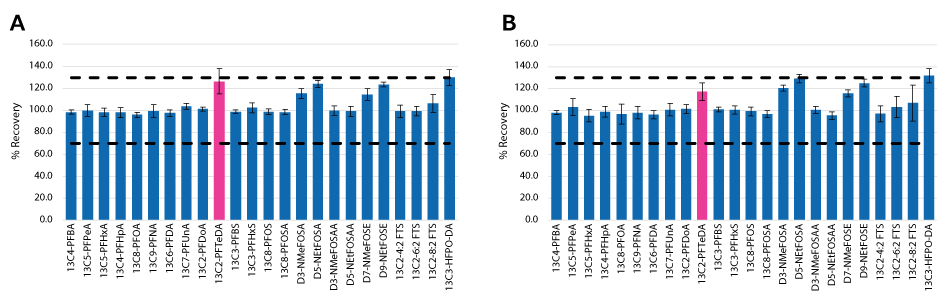
Figure 1.The average percent recovery (mean ± standard deviation (STDEV) of n=6 replicate devices over 2 lots) of C-13 labeled standards after filtration with Millex® Express® PLUS PES syringe filters (A) and Millex® glass fiber syringe filters (B). The 70-130% acceptable QC range (for all compounds except 13C2-PFTeDA, with range 10-200%) is demonstrated by the gray horizontal lines on each graph.
Testing Millipore® polypropylene membrane filters using ASTM D8421
Polypropylene syringe filters are suggested for use in ASTM D8421, similarly to its predecessor ASTM D7979. Polypropylene is a durable material compatible with a broad range of solvents and temperatures, demonstrates low extractables, and is not fluorine-containing, making it appropriate specifically for PFAS-related sample and mobile phase preparation.
A challenge with polypropylene is that it is naturally hydrophobic. For samples that have a significant aqueous component, hydrophobic filters are difficult to use, and a hydrophilic version is preferred. Unfortunately, most commercially-available polypropylene disc filters are hydrophobic and more appropriate for filtration of organic solvents like methanol, such as Millipore® polypropylene membrane filters (Cat. No. PPTG04700 and Cat. No. PPTH04700).
In a few cases, polypropylene can be found in a hydrophilic format (Millipore® hydrophilic polypropylene membrane filters, Cat. No. PPHG04700 and Cat. No. PPHH04700). These filters are well-suited to handle aqueous samples. Thus, realizing the potential for hydrophilic polypropylene to be used within the context PFAS workflows, including mobile phase filtration, we determined the level of PFAS extractables that these filter discs release.
Syringe filter devices are the most recommended and preferred format for filtering samples for LC-MS/MS analysis of PFAS due to ease of use and the range of volumes processed (10-100 mL). There are instances, however, when syringe filters may not be the best option for filtration; for example, when there are no commercially available syringe filters suitable for a specific application. In these instances, an alternative must be considered. A syringe filter-like device, such as a Swinnex® holder, is a viable alternative. This pressure-driven device holds any cut disc membrane filter of a specific size (13 mm or 25 mm diameter) and is operated in the same way as a traditional syringe filter, thus converting any membrane material into a syringe filter format.
Here, Swinnex® was used to test whether Millipore® hydrophilic polypropylene membrane filters (Cat. No. PPHG04700) are suited for sample preparation in PFAS analytical methods, specifically ASTM D8421. To do this, both PFAS extractable contamination of the filter media and non-specific analyte binding were assessed in the filtration step for ASTM D8421. Two lots of these filters were tested, with three replicate discs tested per lot.
Materials and methods
Swinnex® filter holder assembly
Hydrophilic Millipore® polypropylene (PP) membrane filters of 0.2 µm pore size were tested for PFAS extractable content. Swinnex® devices (25 mm diameter) were used to convert the disc membrane filters into a Luer-lock based syringe filter device, according to Figure 2. Once assembled, the Swinnex® device can be connected to a Luer-lock syringe barrel with the material to be filtered. Filtration was then performed as with other syringe filter devices. For every disc replicate, a new and clean Swinnex® device was used.

Figure 2A.O-ring placement

Figure 2B.Filter handling

Figure 2C.Filter placement
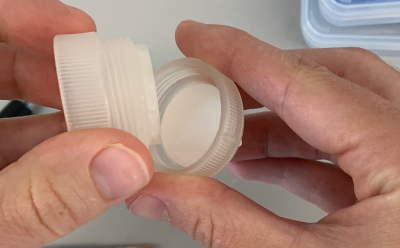
Figure 2D.Gasket fastening

Figure 2E.Assembled Swinnex® filter holder
Figure 2. Assembling Swinnex® device with a polypropylene cut disc membrane filter.
Once each cut disc membrane filter was placed securely into a Swinnex® device, aqueous samples were spiked with C-13 labeled surrogate standards and native standards, mixed with methanol for cosolvation, vortexed, pH adjusted, filtered, pH adjusted a second time, and collected for LC-MS/MS analysis by internal standards, according the procedure described in the workflow schematic for ASTM D8421 above. The work was performed in collaboration with Pace Analytical (Huntersville, NC).
Results
As was found for Millex® syringe filter devices, there were no detectable PFAS contaminants above the reporting limit (RL) for the 44 compounds in any of the hydrophilic polypropylene cut disc membrane filters tested according to ASTM D8421 (Table 3). However, PFPrA was detected at levels slightly above the minimum detection limit (MDL), but still below the RL in both the samples and the method blanks (MBs) demonstrated concentrations detected. Further, HQ-115 was detected between the MDL and RL for only one out of the three replicates tested in lot 2 (Table 3). Both compounds are ultra-short chain emerging PFAS compounds specific to ASTM D8421, and are recommended for testing due to their high prevalence as a contaminant in laboratory and method blanks. Specifically, HQ-115 is of interest due to its relation to lithium battery manufacturing. Their estimated concentrations are closer to the MDL than they are to the RL.
Notably, 6:2 FTS, another highly common interference compound, was also not detected in the filtrate or in the blanks.
Recovery
As with the tested Millex® syringe filters, the percent recoveries of internal standards for filtrates from Millipore® hydrophilic polypropylene filters were in the acceptable range of 70-130% for most compounds (Fig. 3), indicating that there were no major challenges with interferences or analyte losses due to non-specific binding of PFAS compounds to the filter material or Swinnex™ holder. Of note is that the acceptable recovery range for PFTeDA is 10-200% due to challenges recovering it in this method. In previous studies, we have observed losses of long-chain PFCAs like PFTeDA due to phobic interactions with polypropylene, especially in aqueous matrices and with phobic polypropylene. However, in this case, with 50% organic solvent, recovery was high and within range and did not appear to be similarly constrained.
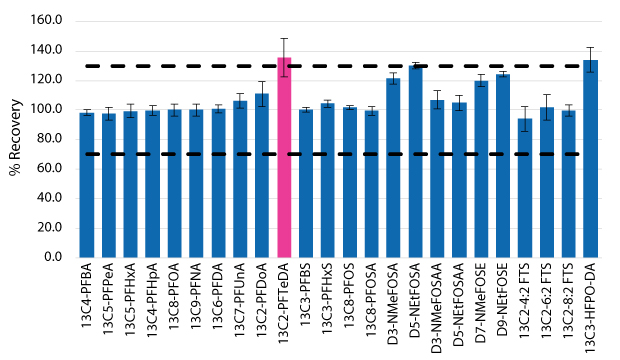
Figure 3.The average percent recovery (mean ± STDEV, n=6 replicates over 2 lots) of C-13 labeled standards after filtration with Millipore® hydrophilic polypropylene filter membranes. The 70-130% acceptable QC range (for all compounds except 13C2-PFTeDA, with range 10-200%) is demonstrated by the black horizontal lines on each graph.
Together, this indicates that polypropylene cut disc membrane filters can be paired with Swinnex® devices to offer an alternative sample filtration method to syringe filter formats in PFAS analytical methods. Additionally, for PFAS methods where the mobile phase needs to be filtered, these filters may be also used with the appropriate vacuum filter holder.
Influence of solvent on filtration
Adding a small amount of solvent was found to increase recovery for some PFAS compounds for both polyethersulfone (PES) and hydrophilic polypropylene filter materials (Fig. 4A-B). When comparing the filtration steps in EPA 1633 and ASTM D8421, they occur entirely in organic solvent and in 50% organic solvent, respectively. Having a mixture of solvents was shown to dramatically increase the recovery of long-chain PFAS compounds like PFTeDA. This is because having both non-polar and polar solvents allows for interactions with both polar fluorinated groups and carbon chains within PFCAs, while just water causes significant hydrophobic interactions.
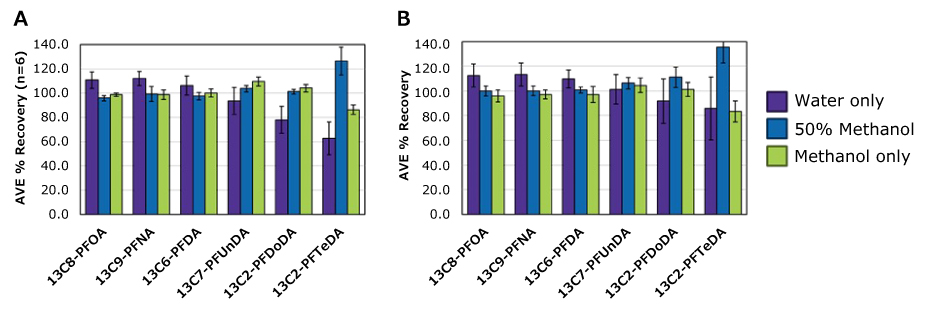
Figure 4.The influence of filtration solvent on percent recovery of select PFAS internal standards for polyethersulfone (PES) filter media (A) and hydrophilic polypropylene filter media (B). Note: data for water only and methanol only represent results from previous studies on EPA 537.1 and EPA 1633, respectively, so trends should be analyzed with caution.
Filters for ASTM D8421
ASTM D8421 is often a preferred, facile method of screening for a variety of PFAS compounds compared with more sample preparation intensive methods like EPA 1633. Since it is a screening method, it inherently has a lower sensitivity compared with other methods. Thus, for best results, careful consideration for sample preparation methods and tools must always be taken. This includes steps to reduce contamination with PFAS compounds (to ensure no false positives), and the possibility of non-specific binding of PFAS compounds onto consumables (to ensure no loss of analyte and false negatives). Because of the simplicity required for ASTM D8421, the key consumable of interest is choice of syringe filter.
In this article, Millex® syringe filters with Millipore Express® PLUS PES and glass fiber membranes, as well as Millipore® hydrophilic polypropylene membranes held in a Swinnex® devices, were shown to be reliable and appropriate to use in ASTM D8421, thus ensuring high-quality data. This includes:
- Levels of PFAS contaminants from filter extractables below the RL for all compounds tested, and below the MDL for the majority of the compounds, and
- Recovery values for PFAS compounds that fell within the QC range for the method, including difficult-to-recover long chain PFCAs like PFTeDA.