
AP1064

PhosphoDetect Anti-PDH-E1α (pSer³⁰⁰) Rabbit pAb
liquid, Calbiochem®
Synonym(s):
Anti-Pyruvate Dehydogenase pSer³⁰⁰ Rabbit pAb
Sign In to View Organizational & Contract Pricing.
Select a Size
Change View
About This Item
NACRES:
NA.41
UNSPSC Code:
12352203
Clone:
polyclonal
Species reactivity:
human
Application:
—
Citations:
32
biological source
rabbit
Quality Segment
antibody form
affinity isolated antibody
antibody product type
primary antibodies
clone
polyclonal
form
liquid
contains
≤0.1% sodium azide as preservative
species reactivity
human
manufacturer/tradename
Calbiochem®
storage condition
OK to freeze, avoid repeated freeze/thaw cycles
shipped in
wet ice
storage temp.
−20°C
target post-translational modification
phosphorylation (pSer300)
General description
Immunoaffinity purified rabbit polyclonal antibody. Recognizes the ~44 kDa PDH-E1α protein phosphorylated at Ser300.
Recognizes the ~44 kDa PDH-E1α protein phosphorylated at Ser300 in HEK293 cells.
This PhosphoDetect Anti-PDH-E1α (pSer³⁰⁰) Rabbit pAb is validated for use in Immunoblotting, Immunocytochemistry for the detection of PDH-E1α (pSer³⁰⁰).
Immunogen
Human
a synthetic phosphopeptide corresponding to amino acids surrounding the Ser³⁰⁰ phosphorylation site of human PDH-E1α
Application
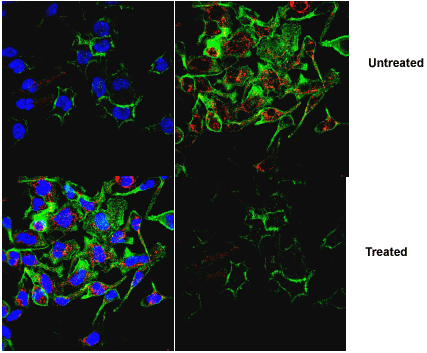
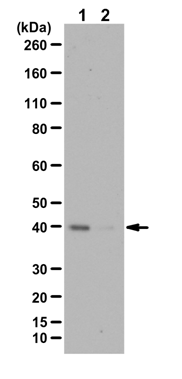
Immunoblotting (0.5 μg/ml)
Immunocytochemistry (1 μg/ml)
Packaging
Please refer to vial label for lot-specific concentration.
Physical form
In 150 mM NaCl, 100 mM Tris-Glycine, pH 7.4.
Preparation Note
Following initial thaw, aliquot and freeze (-20°C).
Analysis Note
Negative Control
HEK293 cells treated with dichloroacetate
HEK293 cells treated with dichloroacetate
Positive Control
HEK293 cells
HEK293 cells
Other Notes
Due to a high degree of sequence identity, this antibody is also expected to cross-react with mouse, rat, bovine, Zebra fish, and Xenopus phospho-PDH-E1α Antibody should be titrated for optimal results in individual systems.
Rardin M.J., et. al. 2009. Anal. Biochem.2, 157.
Seifert, F., et al. 2007. Biochemistry 21, 6277.
Lee, J., et al. 2007. Mol. Cell Prot. 4, 669.
Patel, M.S. and Korotchkina, L.G. 2006 Biochem. Soc. Trans.34, 217.
Korotchkina, L.G., et al. 2001. J. Biol. Chem. 40, 37223.
Seifert, F., et al. 2007. Biochemistry 21, 6277.
Lee, J., et al. 2007. Mol. Cell Prot. 4, 669.
Patel, M.S. and Korotchkina, L.G. 2006 Biochem. Soc. Trans.34, 217.
Korotchkina, L.G., et al. 2001. J. Biol. Chem. 40, 37223.
Legal Information
CALBIOCHEM is a registered trademark of Merck KGaA, Darmstadt, Germany
Disclaimer
Toxicity: Standard Handling (A)
Still not finding the right product?
Explore all of our products under PhosphoDetect Anti-PDH-E1α (pSer³⁰⁰) Rabbit pAb
— or —
Try our Product Selector Tool to narrow your options
Storage Class
12 - Non Combustible Liquids
wgk
WGK 1
flash_point_f
Not applicable
flash_point_c
Not applicable
Certificates of Analysis (COA)
Search for Certificates of Analysis (COA) by entering the products Lot/Batch Number. Lot and Batch Numbers can be found on a product’s label following the words ‘Lot’ or ‘Batch’.
Already Own This Product?
Find documentation for the products that you have recently purchased in the Document Library.