
Amsphere® A+ affinity chromatography resin - stability and resin life cycle
Protein A chromatography
Protein A affinity chromatography is the capture step in monoclonal antibody (mAb) purification and one of the most important steps in downstream processing.
Section overview
Typical considerations for Protein A resin selection include dynamic binding capacity (DBC), purification performance, operating flow rates, and caustic compatibility. Resin lifetime is a key consideration as it relates directly to resin volume and process costs; purification performance should be maintained over many cycles of cleaning in place (CIP) and regeneration. Visit our Affinity chromatography resin page for more information on our affinity chromatography portfolio.
Amsphere® A+ is a next-generation Protein A resin with top-tier binding capacity, superior impurity removal with a Protein A ligand that has been engineered to improve caustic stability. These performance characteristics are ideal for intensified high-titer processes demanding high productivity and process performance.
Key specifications of Amsphere® A+ resin:
- Base Bead: Methacrylic copolymer, average particle size (d50): ~60 µm
- Ligand: Recombinant Protein A expressed in Escherichia coli
- Dynamic binding capacity at 10% breakthough (DBC10%): ≥70 mg/mL at 6 min residence time (RT), ≥60 mg/mL at 4 min RT, ≥50 mg/mL at 2 min RT
- Caustic Stability: 94% DBC10% after 24 hours in 1 M NaOH, 91% DBC10% after 300 cycles with 0.1 M NaOH (15 min contact time)
This technical article evaluates the caustic stability of Amsphere® A+ resin as compared to other commercially available Protein A resins.
Experimental overview
Chromatography
Test material was a sterile-filtered clarified mAb harvest loaded onto a 0.5 cm internal diameter (ID) x 20 cm bed height (BH) column (4 mL column volume) at a RT of 4 min.
Analytics
For resin life cycle tests, samples were collected to assess DBC10% every 10 cycles.
Caustic stability
Stability during CIP and sanitization helps maintain performance during repeated cycles of use, extending resin lifetime and reducing long-term costs.
Caustic stability of Amsphere® A+ and Amsphere® A3 resins were assessed by measuring the DBC10% retention of a polyclonal human IgG (5.3 mg/mL) following a 24 h soak in either 0.5 M or 1 M NaOH. Relative DBC10% retention is expressed as a percentage of the initial DBC10%, Figure 1. Results confirmed the excellent caustic stability of Amsphere® A+ resin with DBC10% retention of 100% and 94% following exposure to either 0.5 M or 1 M NaOH, respectively.
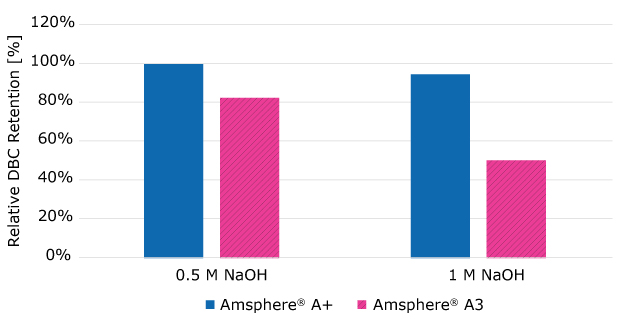
Figure 1.Relative DBC10% retention Amsphere® Protein A resins after a 24 h soak in 0.5 M or 1 M NaOH.
Figure 2 shows a similar comparison with other commercially available resins following a soak in 1 M NaOH. DBC10% retention of Amsphere® A+ resin was approximately 50% higher DBC than Amsphere® A3 and Competitor A resin, Figure 2. DBC10% retention of Amsphere® A+ resin was comparable with Competitor B. This enhanced caustic stability of Amsphere® A+ resin in 1 M NaOH enables efficient cleaning and sanitization for enhanced bioburden control.
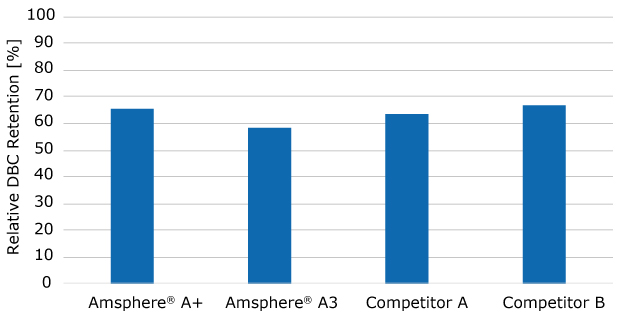
Figure 2.Relative DBC10% retention of market-leading Protein A resins after a 24 h soak in 1 M NaOH.
Life cycle performance
Life cycle performance was assessed using a clarified mAb harvest following the capture and CIP conditions described in the experimental overview; elution pool samples were collected throughout the study.
Performance of Amsphere® A+ resin was evaluated for 202 cycles, while the other resins were evaluated for 102 cycles. Results of sample analyses are summarized in Figure 3.
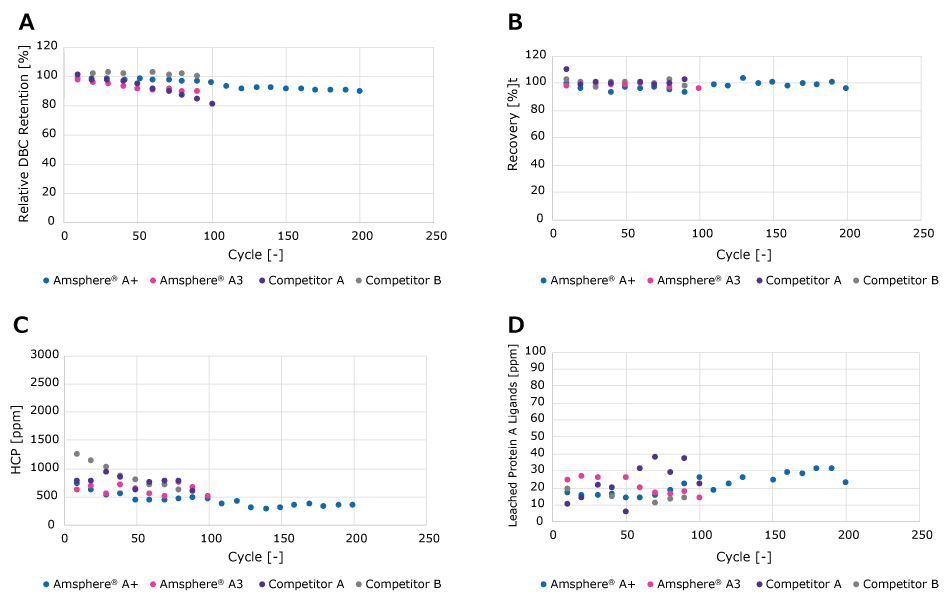
Figure 3.DBC10% retention, recovery, HCP levels and Protein A ligand leaching of Amsphere® A+ resin (202 cycles) and other market-leading agarose-based Protein A resins (102 cycles) after repeated cycles of loading and regeneration
Key takeaways Amsphere® A+ resin stability
Amsphere® A+ is a Protein A resin engineered for high DBC and improved caustic stability and is well suited for efficient mAb capture during high-titer and intensified mAb manufacturing processes. Key performance characteristics include:
- Excellent caustic stability: 94% DBC10% retention following a 24 h soak in 1 M NaOH which is approximately 50% higher than Amsphere® A3 resin and other market-leading resins. This caustic stability enables efficient cleaning and sanitization for enhanced bioburden control.
- Reliable life cycle performance: Greater than 90% DBC10% retention and approximately 99% recovery maintained over 200 CIP cycles.
Frequently asked questions
What do you mean by Amsphere® Protein A resins are now part of our portfolio?
The chromatography business of JSR has recently been acquired and we are in the process of integrating these well-established affinity resins into our Process Solutions portfolio, strengthening our Protein A chromatography capabilities with best-in-class products.
How can I order Amsphere® Protein A resins?
In the short term you can use the form on the website or reach out to your account representative.
What are Amsphere® Protein A resins used for?
Amsphere® Protein A resins are used for the affinity capture of monoclonal antibodies (mAbs) and their derivatives in biopharmaceutical manufacturing. Amsphere® A+ is designed for high-titer and intensified processes, including concentrated fed-batch and continuous bioprocessing, where maximum dynamic binding capacity at low residence times and long-term caustic stability are critical. Amsphere® A3 is an established platform resin suited for a broad range of mAb capture applications, offering a well-balanced productivity and cost-of-goods profile, and is a proven choice for dual sourcing strategies.
What is the difference between Amsphere® A3 and Amsphere® A+?
Both Amsphere® A3 and Amsphere® A+ are Protein A affinity resins designed for mAb capture, but they are optimized for different process strategies. Amsphere® A3 is an established platform resin offering consistent, reproducible performance across a broad range of mAbs and their derivatives, with a well-balanced productivity and cost-of-goods profile. It is well-suited for scalable platform processes and is a proven choice for dual sourcing strategies. Amsphere® A+ is optimized for maximum productivity in high-titer and intensified processes, delivering outstanding dynamic binding capacity at low residence times. Its exceptional caustic stability and long cycle lifetime make it the right choice for concentrated fed-batch and continuous bioprocessing platforms where process demands are high.
How do I choose between Amsphere® A3 and Amsphere® A+?
The choice between Amsphere® A3 and Amsphere® A+ depends on your specific process requirements. If you are running a standard mAb capture process and are looking for a reliable, scalable platform resin with a well-balanced productivity and cost-of-goods profile, Amsphere® A3 is the right choice. It is also well-suited for dual sourcing strategies, offering a qualifiable alternative that reduces single-supplier risk. If your process is high-titer or intensified, such as concentrated fed-batch or continuous bioprocessing, and maximum dynamic binding capacity at low residence times is a key requirement, Amsphere® A+ is the recommended option. Its exceptional caustic stability and long cycle lifetime further support the extended resin reuse demands of intensified and continuous manufacturing operations.
I’m thinking of intensified processing, which Protein A resin would you recommend?
For intensified processing, Amsphere® A+ is the recommended Protein A resin. It is specifically engineered to meet the process demands of high-titer and intensified manufacturing modes, including concentrated fed-batch and continuous bioprocessing, delivering outstanding dynamic binding capacity at low residence times. Its exceptional caustic stability and long cycle lifetime ensure reliable performance across extended resin reuse, which is a critical requirement in both intensified batch and continuous manufacturing operations.
For mAb capture in a standard batch process, which resin would you recommend?
For mAb capture in a standard batch process, Amsphere® A3 is the recommended choice. It is an established platform resin offering consistent, reproducible Protein A capture performance across a broad range of mAbs and their derivatives. Its well-balanced productivity and cost-of-goods profile makes it well-suited for platform process strategies that prioritize operational robustness and scalability. Amsphere® A3 is also a proven choice for dual sourcing strategies, providing supply security without compromising process performance.
Are Amsphere® resins supported by the Emprove® Program?
Amsphere® A+ and Amsphere® A3 will be included in the Emprove® Program soon. Until then, please reach out to your local Merck representative for comprehensive documentation packages and support with qualification, risk assessment, and regulatory activities.
Are Amsphere® resins used only for capture?
Yes. Amsphere® Protein A resins are specifically designed for the capture step in monoclonal antibody (mAb) purification. For downstream purification steps beyond capture, additional chromatography technologies such as mixed-mode resins and membrane-based solutions are used to address impurity removal and polishing requirements.
What is the advantage of Amsphere® resins compared to agarose-based Protein A resins?
Amsphere® Protein A resins use a rigid synthetic methacrylic copolymer base bead instead of a soft agarose matrix. This provides higher mechanical and chemical stability, enabling faster flow rates, taller bed heights, stable pressure drop, high dynamic binding capacity at short residence times and long resin lifetime, all of which lower the cost per gram of purified antibody.
What is dual sourcing and why should I consider it for my Protein A capture step?
Dual sourcing is a supply chain strategy in which two qualified resin suppliers are maintained for the same process step, ensuring that manufacturing can continue uninterrupted in the event of supply disruptions, quality issues, or regulatory holds with one supplier. For biopharmaceutical manufacturers, qualifying a second Protein A resin reduces single-supplier dependency and strengthens overall supply chain resilience, which is increasingly important in a global manufacturing environment. Amsphere® A3 is an established choice for dual sourcing qualification, offering consistent, reproducible Protein A capture performance across a broad range of mAbs and their derivatives, with a well-balanced productivity and cost-of-goods profile that supports straightforward process comparability.
Why is high caustic stability important for a Protein A resin?
Caustic stability refers to a resin's ability to withstand cleaning-in-place with sodium hydroxide (NaOH) solutions, which are the industry standard for sanitization between purification cycles. A resin with high caustic stability maintains its dynamic binding capacity and structural integrity across many cycles of NaOH exposure, ensuring consistent process performance over the resin lifetime. This is particularly critical in high-cycle processes such as continuous bioprocessing or intensified fed-batch manufacturing, where resins are subjected to frequent and aggressive cleaning regimens. High caustic stability directly translates into extended resin reuse, reduced resin replacement frequency, and lower cost-of-goods per gram of purified product.
How does Amsphere® improve cost of goods?
Amsphere® resins contribute to improved cost of goods through two key factors: high dynamic binding capacity and long resin lifetime. A high dynamic binding capacity at low residence times allows more product to be captured per cycle and per liter of resin, reducing the required resin volume and column size for a given production output. The exceptional caustic stability of Amsphere® resins supports extended resin reuse across many cycles with aggressive cleaning-in-place protocols, reducing the frequency of resin replacement and spreading the resin investment across a higher number of purification cycles. Together, these properties enable a more productive and cost-efficient capture step, contributing to a favorable cost-of-goods profile across the resin lifetime.
Why Merck: technical expertise, regulatory support
Our technical and application experts are ready to support your process development, implementation, and scale-up. The Emprove® Program provides comprehensive technical, regulatory, and supply information to help streamline qualification, risk assessment, and compliance.
Process development and manufacturing support
Partner with our process development scientists and MSAT team at the M Lab™ Collaboration Center to optimize and scale your chromatography operation. Either in person or virtual visit, we can help develop, test or troubleshoot without disrupting your manufacturing schedule. Customer Collaboration Labs for Bioprocessing Optimization
Stay ahead of the curve
Register to the Bio and Pharma Bulletin to access cutting-edge insights and resources that keep you at the forefront of pharma manufacturing.