
Virus concentration by ultrafiltration
Virus isolation and propagation methods are critical in research, vaccine production, diagnostic workflows, and public health monitoring. Early research labs use viral stocks to study viral biology and pathogenesis. Gene therapy and genome modification methods utilize viruses to deliver genetic material. Vaccine production requires small-scale and large-scale preparation of virus. Wastewater-Based Epidemiology (WBE) or wastewater surveillance can detect the presence of circulating pathogens like SARS-CoV-2, measles, and influenza before patients report to clinical care settings. And although most diagnostic laboratories now use non-culture approaches for viral disease diagnosis, virus isolation in cell culture remains a useful approach when viable isolates are needed, when viable and nonviable virus must be differentiated, and in cases where culture-based methods are able to provide results faster than non-culture methods. Ultrafiltration supports rapid concentration of virions and virus solutions for these applications.
Section overview
- Virus isolation, propagation, and characterization
- General methods for viral propagation
- Virus concentration for high titer virus stocks
- Virus concentration with Amicon® Ultra Centrifugal Ultrafiltration Devices
- Considerations for wastewater testing
- Considerations for AAV concentration
- Conclusions
- Related products
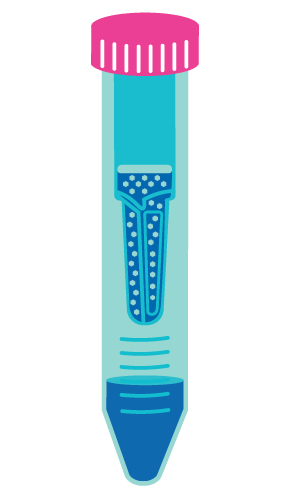
Figure 1.Ultrafiltration for concentration of virus. Fluid passes through the membrane filter, while large viral particles are retained.
Viruses can be propagated in cell culture to generate virus stocks. Cultured cells are inoculated with viral stock from seed virus, a commercial source, or infected tissue. After incubation, infected cells are lysed to harvest viral particles, or released virus is harvested directly from cell supernatants. The virus stock is then titered, aliquoted, and stored at −80 °C for later use.
Isolation of virus from clinical samples also exploits cell culture for viral propagation. Clinical samples are prepared by sample homogenization and extraction into a liquid medium, which is then centrifuged and used to inoculate cell cultures.
Wastewater monitoring does not typically require culturing of virus, but it does require concentration to enable detection of pathogens using molecular techniques such as sequencing.
In order to achieve high titer virus stocks, it is necessary to concentrate purified virus particles. Amicon® Ultra and Centricon® Plus centrifugal ultrafiltration devices with regenerated cellulose membranes can be used to concentrate virions and virus solutions (Figure 1). This protocol describes the use of Amicon® and Centricon® centrifugal ultrafiltration devices for the concentration of three common types of viruses: lentivirus, adenovirus, and adeno-associated virus (AAV). Considerations for concentration of viruses for wastewater testing will be discussed below.
General method for viral propagation
- Packaging cells: Host cells were plated to achieve 80–85% confluence.
- Transfection: Cells were infected with viable virus particles.
- Harvesting virus: Depending on the virus, either cell supernatant or pelleted cells, or both, were used to purify the recombinant virions. Four rounds of freeze/thaw cycles were applied to release virus from cells. Cell debris was then separated from cell lysate by centrifugation.
- Virus purification: Virus was purified from cell lysate by density gradient ultracentrifugation or column/membrane chromatography.
- Purified virus solutions were concentrated and buffer exchanged into an appropriate storage solution using either passive dialysis, diafiltration, or centrifugal ultrafiltration with Amicon® Ultra and Centricon® Plus 70 devices.
Virus concentration for high titer virus stocks
To produce high titer viral stocks, the purified virus can be concentrated using centrifugal ultrafiltration. The correct choice of device, membrane material, molecular weight limit or cut-off, centrifugation speed, centrifugation time and buffer composition are critical for high recovery of infective viral particles. Amicon® Ultra centrifugal ultrafiltration units have specified nominal molecular weight limits (NMWL) defined by their filter membrane. Amicon® Ultra centrifugal ultrafiltration devices with a 50 kDa NMWL Ultracel® were used to concentrate adenovirus and adeno-associated virus (AAV) solutions. For lentivirus concentration, devices with both 50 kDa and 100 kDa NMWL membranes were used.
Factors to consider when selecting an ultrafiltration method and membrane nominal molecular weight size:
- Viral particle size: Size can be estimated from published sources, or by measurement techniques such as microscopy, laser diffraction, and dynamic light scattering.
- Size of key separation targets in solution: The size of proteins, antibodies, drugs, chemicals, and other particles that need to be separated will affect membrane size selection.
- Sample volume: Processing volumes ranging from ≤0.5 mL to 70 mL are compatible with centrifugal ultrafiltration (cUF) devices.
To retain viral particles, the molecular weight cut-off of the filter membrane needs to be smaller than the particle (~2 times smaller than the molecular weight of the viral particle), but large enough to allow smaller undesired components to filter through (Table 1).
Virus concentration with Amicon® Ultra Centrifugal Ultrafiltration Devices
Table 2 shows results for concentration of adenovirus, AAV, lentivirus, and SARS-CoV-2 from crude cell lysate, virus purified by chromatography, or environmental samples. Viral particles were effectively concentrated to high titers with high recoveries using Amicon® Ultra centrifugal ultrafiltration devices.
It is important to remember that most of the viruses cannot be efficiently concentrated and stored in low salt buffers. Centrifugal concentration of the virus in < 250 mM salt solutions leads to virus aggregation and decreased infectivity.
Concentrated viral stock can be filter-sterilized through 0.22 µm filters. Ultrafree®-MC GV filter units can be used for volumes of < 0.5 mL.
Considerations for wastewater testing
For wastewater testing, you must first prepare the collected sample prior to ultrafiltration. Heat inactivation at 60 °C for 90 min before spinning in an initial tube (4500 x g for 30 seconds at 4 °C) will increase the biosafety of the experiment, as well as remove the suspended particles from the raw wastewater sample to ensure that proper ultrafiltration of the viral particles can occur. After you discard the pellet, you can load the supernatant into the Amicon® Ultra device and proceed with downstream detection and quantification of your virus of choice.1
For routine wastewater testing targeting SARS-CoV-2 or influenza, the 50 kDa MWCO membrane may offer higher viral recovery than the traditional 10 kDa choice. The 10 kDa MWCO membrane may be preferable for dilute surface water or river water samples, and is the standard for UK/Scotland’s national program.2 While SARS-CoV-2 surveillance drove the rapid adoption of Amicon® Ultra devices in wastewater workflows, the method is applicable across the full spectrum of wastewater surveillance targets. However, performance and protocol adaptations may vary by analyte class.
Considerations for AAV concentration
Several factors may impact recovery of AAV particles following concentration or buffer exchange using Amicon® devices. Note that, while some Amicon® devices may withstand higher speeds during centrifugation, using lower centrifugal force typically improves recovery. We recommend 1500 x g as a starting point, increasing speed gradually as necessary. In addition, the starting titer of the sample may impact recovery, with higher titer samples yielding higher recovery.
Finally, addition of the nonionic surfactant Poloxamer 188 (P188) to samples during concentration or buffer exchange can increase recovery by reducing adsorption to surfaces. We observe meaningful improvement in recovery at a final P188 concentration of just 0.001% w/v with further increases in recovery at higher concentrations up to 0.05% (Figure 2). However, the presence of surfactants may interfere in downstream analytical methods such as mass photometry or mass spectroscopy. Therefore, carefully consider downstream applications before incorporating P188, especially at high concentrations.
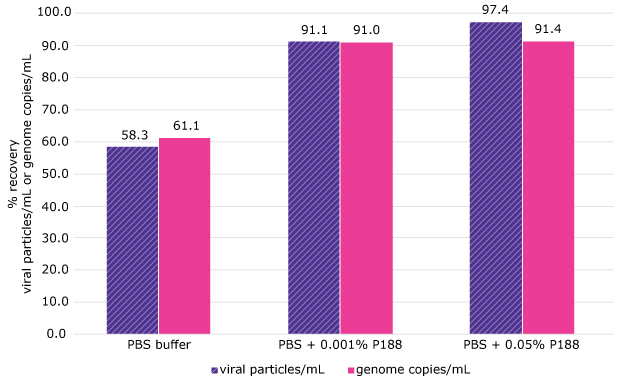
Figure 2.Recovery of AAV9 particles following concentration and buffer exchange using Amicon® Ultra devices with 100 kDa MWCO and Pluronic 188 (P188). Recovery was measured both by immunoassay (viral particles/mL) and by molecular methods (genome copies/mL).
Conclusions
We developed a method to validate ultrafiltration using Amicon® Ultra and Centricon® Plus centrifugal devices as a fast and cost-effective means for achieving high titers of viruses. This method can be used to concentrate viruses from cell culture supernatants, cell lysates, and other sources. After concentration, viral stock can be filter-sterilized using Ultrafree® filter units. For highest recovery of infective viral particles, it is critical to select the proper ultrafiltration device, membrane filter, molecular weight cut off (MWCO), centrifugation speed, and centrifugation time.