
AIDDISON™ Explorer: AI Drug Discovery Software
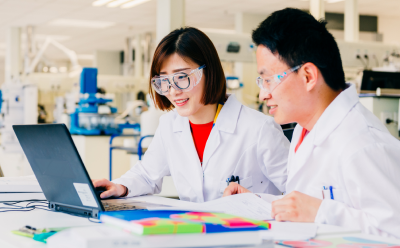
Generative AI-guided molecular design and candidate prioritization
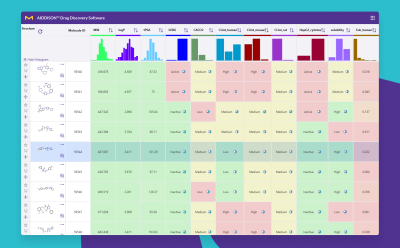
Early-stage drug discovery depends on selecting the right molecules to make under competing constraints. AIDDISON™ Explorer enables targeted exploration of chemical space, generating candidate structures and ranking them based on multi-parameter optimization across potency, ADMET, and synthetic feasibility.
Models are trained on more than 30 years of pharmaceutical R&D data, including both successful and failed compounds, to support more rapid and realistic early-stage decision-making.
From design criteria to ranked candidates
Define your target profile and design constraints. AIDDISON™ Explorer proposes novel candidate molecules, evaluates them against defined scoring criteria, and ranks results — helping researchers focus experimental effort on the most promising structures from the start.
Core capabilities for medicinal chemists
Generative molecular design
Generate novel molecular structures using reinforcement learning–guided models derived from the REINVENT 4.0 framework. Exploration is guided by defined design constraints to identify candidates beyond known scaffolds.
Multi-parameter optimization (MPO)
Balance potency, physicochemical properties, and developability considerations simultaneously. Multi-objective scoring helps identify candidates that best satisfy project criteria.
Predictive ADMET modeling
Evaluate predicted ADMET properties early using machine-learning models trained on decades of pharmaceutical experimental data. Prediction outputs include confidence indicators and explainable AI metrics to support interpretation of results.
Synthesis-aware candidate design
Evaluate synthetic accessibility scores and generate viable retrosynthetic routes using SYNTHIA® API integration, including route feasibility, step count, and building block availability.
AI-guided molecular design in the discovery workflow
AIDDISON™ Explorer complements existing computational and experimental discovery tools. Candidate molecules generated by the platform can be exported directly into docking, synthesis planning, and experimental workflows using standard file formats (CSV, SDF, RD). Output includes ranked candidate molecules with predicted ADMET profiles, physicochemical properties, and synthetic accessibility assessments.
Cloud-native deployment with ISO 27001-certified data security supports use in enterprise research environments.
Applications in small molecule discovery
Generate diverse de novo candidate molecules aligned to defined target profiles.
Explore chemical space around prioritized scaffolds and identify new structural variants.
Balance potency, ADMET, and synthetic feasibility during lead refinement.
Models informed by real discovery data
Predictive ADMET models are trained on both successful and failed compounds from more than 30 years of pharmaceutical R&D data from data from our Healthcare business, covering endpoints such as CACO2 permeability, cardiotoxicity (hERG), intrinsic clearance (Clint), and more. By incorporating both successful and unsuccessful compounds, the models capture real-world discovery outcomes and support more reliable early-stage candidate prioritization.
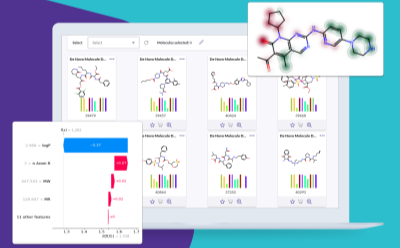
Explainable AI outputs, confidence indicators, and feature contribution visualizations provide transparency into model predictions and help researchers interpret results with greater confidence.
Related resources
- Application Note: Empowering Drug Discovery with AI/ML and CADD Tools in a Secure, Web-Based SaaS Platform
By seamlessly integrating generative models, ADMET property predictions, searches in vast chemical spaces, and molecular docking, AIDDISON™ provides a sophisticated platform for modern drug discovery.
- White Paper: Using AI-Powered Software to Accelerate and Optimize Novel Drug Design
AIDDISON™ uses a scientific approach to first generate thousands of viable candidate molecules as the starting point in an analysis.
- White Paper: Building a Next-Generation Toolbox for AI-powered Drug Discovery
Machine learning, deep learning, and generative AI can help scientists generate structures for new drug candidates and explore protein-ligand binding before starting any experiments in a wet lab.
- White Paper: How to Build Your AI-Enabled Drug Discovery Program
This playbook provides a comprehensive guide to integrating AI into existing drug discovery programs.
- Article: Quality is Key: Turnkey AI Solution Powered by Robust Big Data
As our access to more diverse chemical space expands, fueled by advances in combinatorial chemistry, navigating this space becomes ever more sophisticated and essential for drug discovery.
- Article: Harnessing Generative AI to Revolutionize Drug Discoveries
Our AI-powered drug discovery platform will help drug designers explore vast chemical space and design successful drug candidates in minutes.
- Article: Merck KGaA, Darmstadt, Germany Launches the First Ever AI Solution to Integrate Drug Discovery and Synthesis
AIDDISON™ software-as-a-service platform bridges the gap between virtual molecule design and real-world manufacturing.
- Article: Fast-Tracking Drug Discovery with an AI Boost
Before the new AI-powered drug discovery platform hit the market, it took trials, tribulations and a napkin.
- Flyer: AIDDISON™ AI Powered Drug Discovery
AIDDISON™ combines the power of artificial intelligence (AI) and computer-aided drug design (CADD) tools into a single integrated platform for virtual screening, scaffold hopping, hit identification, and lead optimization in medicinal chemistry.