
Single-use assemblies for final sterile filtration
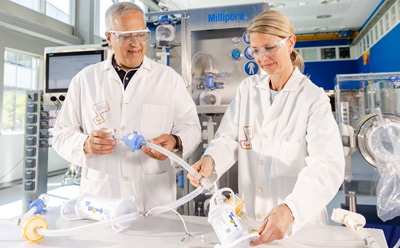
Single-use systems offer many benefits to pharma and biopharma manufacturers, including improved flexibility and speed and a reduced risk of product and process contamination.
For final filtration, these benefits are compelling but designing single-use assemblies for these operations is complex. Each tubing connection, sampling event, and operator interaction can impact product quality, sterility, and ultimately, patient safety.
This page outlines key considerations for developing an integrated single-use final filtration assembly to improve process consistency, simplify implementation, and support reliable aseptic manufacturing.
Explore how an automated PUPSIT system addresses the requirements of Annex 1 and assures successful drug product filtration.
Learn more by reading through the article:
- Assembly design process
- Sterile filtration: the challenges
- Aseptic final filtration: considerations for contamination control strategy
- Sterile connectors and sampling
- Well-designed single-use assemblies improve final filtration performance
- Automated PUPSIT simplifies final filtration
- Frequently asked questions
Assembly design process
Designing a single-use final filtration process encompasses both process requirements and patient safety criteria. Assembly design is tailored to individual URS. A typical workflow includes:
- Prototypes are created based on URS
- Prototype is evaluated for suitability: dry leak test limits, dilution profile and hold-up volume
- The final design is qualified for the intended use
- Additional testing as needed to ensure patient safety (potential leachables, bacterial retention, particulates)
This design and evaluation process is lengthy and can take one to two years. While assembly design can be customized, customization extends timelines and makes it challenging for suppliers of single-use technologies to develop standardized designs that meet final filtration needs and enable rapid implementation.
The introduction of automated systems to streamline PUPSIT and filtration operations is changing this. These automated systems minimize manual operations and include recipe-driven workflows that reduce errors, lower contamination risks and improve consistency. Although automated PUPSIT systems offer flexibility in the arrangement of filtration assemblies, they also create an opportunity to move towards standardized filtration assembly designs.
Sterile filtration: the challenges
The updated EU GMP Annex 1 provides expectations on the design, validation, monitoring, and documentation for manufacturing sterile drug products.1 For sterile filtration, the guidance expects PUPSIT to be performed before product filtration. In some circumstances, PUPSIT may be replaced by alternate controls, but this approach needs to be justified.
Single-use filtration assemblies may contain a redundant sterilizing-grade filter to mitigate the risk of batch loss in case the primary filter fails post use integrity testing or becomes plugged during processing.2 This filter arrangement reduces risk but adds complexity, costs and increases product loss: multiple operational steps need to be carried out on both the primary and secondary filters without compromising sterility of the flow-path. These include:
- Filters may need to be flushed due to the presence of the redundant filter and doubling of potential leachable levels
- Filters must be drained to remove the wetting fluid waste
- The assembly needs to be vented to equilibrate pressure
- Sterilized filters must be integrity tested before product filtration
Designing any single-use assembly for final filtration needs to accommodate these steps in the context of the filters, process conditions and limitations of the single-use components. The interconnected drug product filtration system must be considered holistically in the assembly design. For information on selecting membrane filters for critical final filtration applications, read our Sterilizing filters for final sterile filtration technical article.
Figure 1 shows a simplified schematic of one final filtration assembly configuration; each assembly component can be customized based on type and volume of product to be filtered, process parameters, and manufacturer preference.
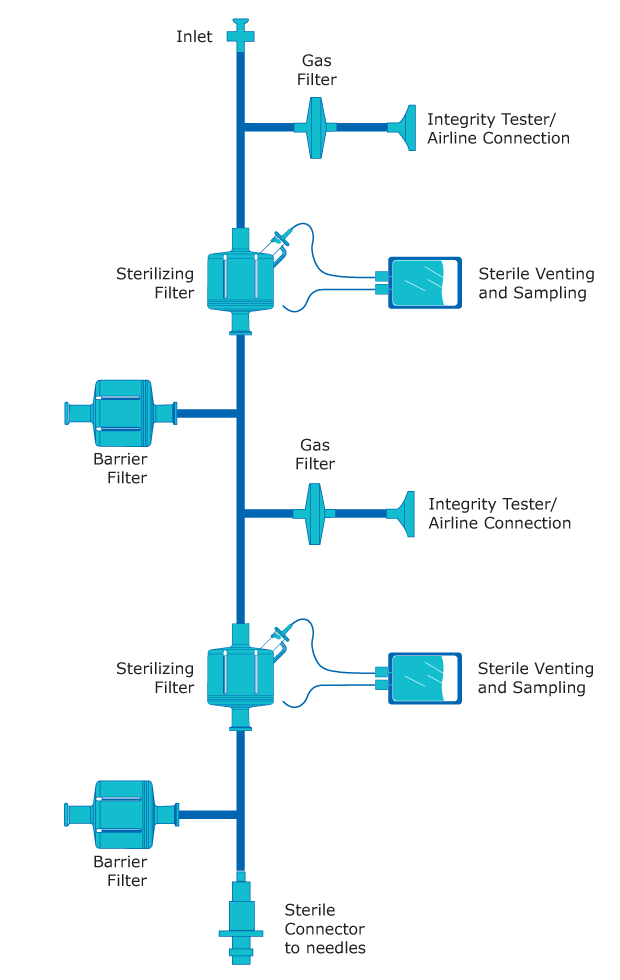
Figure 1.Simplified schematic of a final filtration assembly.
Our Millipore® single-use and filter validation services team can help you select, test, and validate your filters, assemblies, and single-use systems for drug manufacturing. You can rely on our experience to avoid regulatory observations and delays in your approval process.
Designing a single-use assembly for final sterile filtration?
Watch our on-demand webinar to learn how integrated single-use assemblies can help support contamination control, PUPSIT readiness, product recovery, and EU GMP Annex 1 requirements while simplifying implementation and reducing operational risk.
Aseptic final filtration: considerations for contamination control strategy
While filtration assembly design is centered on the filters, there are other equally important considerations:
- Filter configuration: If the process includes an intermediate hold tank following formulation, sterilizing-grade filters would also be placed before and after the hold tank. These filters are distinct from the sterilizing-grade filters in the assembly, which should be placed as close as possible to the filling line.1
- Filter type and filtration area: Single-use filter capsules containing pleated membranes typically have higher product hold-up volumes than filters containing stacked membrane disks, which are more suited to smaller volume processes. Product loss can be mitigated by filter and transfer line blow-down procedures. Filtration areas can be determined using Vmax methodology; the smallest filter area is recommended with an appropriate safety factor.
- Filter wetting, draining and venting: Before processing, the sterilizing-grade liquid filters must be properly wet, with vent bags placed directly off the filter to collect air during wetting. Filters can be wet with water for injection (WFI) or drug product, and wetting fluid must be flushed out on a separate line and removed from the filtration assembly. Determining how to collect the flush volume—in a container, through a flush filter, or using a filter containing both hydrophilic and hydrophobic membranes—and how to vent the assembly and filters, needs to be determined before assembly design, Figure 2.
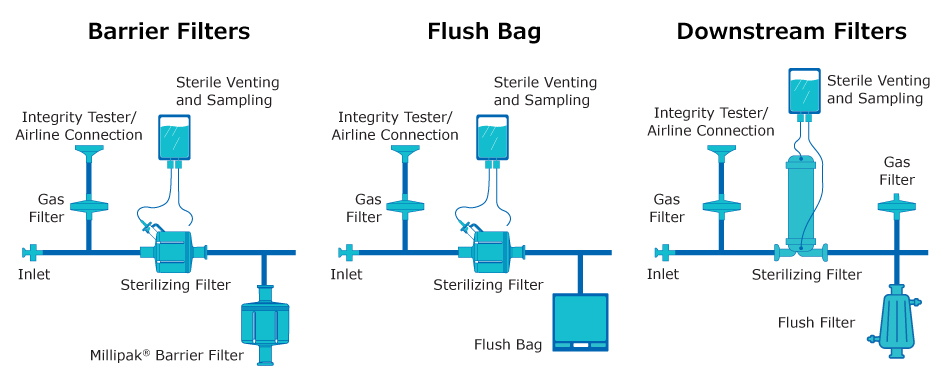
Figure 2.Different draining/venting arrangements.
- Gas/vent filters. These filters create the sterile boundary and protect the product flowpath from microbial ingress during integrity testing and processing. Gas/vent filters are typically present on the flush lines and on the lines used for filter integrity testing. These filters must be sized appropriately for sterilizing-grade liquid filters in the single-use assembly and the required flush volumes.
- Integrity testing. Integrity testing correlates the results of the physical test to the bacterial retention capabilities of the membrane filter. Common approaches for confirming integrity include bubble point and diffusive/forward flow testing. Tubing and connection devices in the assembly must be designed around elevated pressures applied during integrity testing.
- Product recovery. A considerable volume of drug product will be held up in the single-use assembly. Dependent on the product volume and type, this loss could have significant economic impacts. Maximizing recovery by gravity draining or by applying sterile pressurized gas to blow-down the assembly improves recovery but the additional steps increase the risk of compromising sterility, Figure 3.
For more information on the benefits of product recovery, read our Improved Product Recovery using Blow-down and Millipak® Final Fill Filters tech brief.
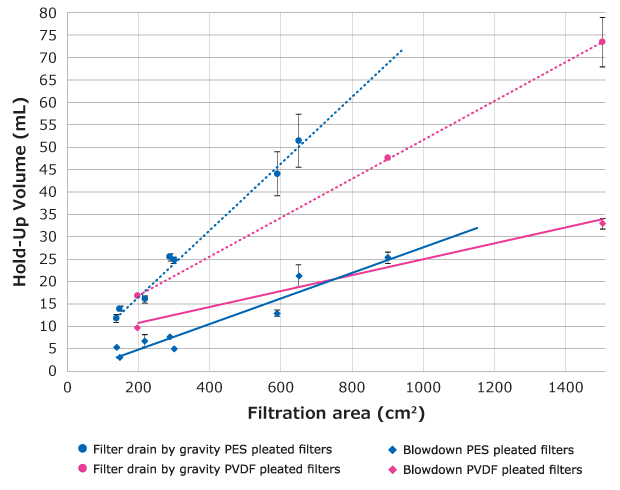
Figure 3.Filter hold-up volume after drain or blow-down. Demonstrating the increase in product recovery after blow-down step versus a gravity-drain step.
Sterile connectors and sampling
Sterile fluid connection devices provide a critical link between disposable fluid paths and various steps in the aseptic process, whether that is transferring bulk drug products, integrating filtration assemblies, or connecting filling equipment. These devices increase system flexibility but also increase contamination risk. While minimizing the number of devices reduces the risk of contamination, it makes it more challenging to handle final filtration assemblies. For this reason, connection devices are often used to create smaller assembly modules to simplify handling and installation.
Different types of connection technology are available; suppliers should have information on the sterility assurance of their devices, including results of aerosolized bacterial challenge testing. Any connection device used downstream of sterile filtration must maintain the highest level of sterility.
The overall drug product manufacturing process depends on a robust contamination control strategy to minimize bioburden in the unfiltered drug product. After sterile filtration, the manufacturing process is considered sterile, and all manipulations are performed to avoid sterility being compromised. Closed sterile sampling enables drug manufacturers to collect representative samples and monitor their process. In final filtration assemblies, samples are collected before filtration to assess product and process impurities, product quality attributes as well as bioburden, and endotoxin testing.
Sampling assemblies and sterile connection devices should be designed into final filtration assemblies and tailored to specific process needs.
Well-designed single-use assemblies improve final filtration performance
The best assembly is the one that delivers the required process with minimal complexity. Every tubing path, connection device, filter, and sampling point affects overall performance. Optimizing an assembly means designing for the manufacturing process rather than selecting components in isolation. Included in that design are the proper controls to mitigate contamination risks. Thoughtful design strengthens contamination control by:
- Maintaining closed fluid pathways
- Streamlining tubing connections
- Minimizing manual manipulation
- Supporting validated operating procedures
- Standardizing critical process steps
These principles align with the contamination control strategy emphasized throughout EU GMP Annex 1, where equipment design, validated processes, documentation, and operator practices work together to maintain product quality.
Supporting documentation is an important part of this strategy. Comprehensive qualification documentation, such as the Emprove® Advanced Qualification Dossiers (AQD), consolidates information for all components in a single-use assembly to simplify material selection, support risk assessments, and streamline regulatory readiness throughout the lifecycle of a single-use system.
Automated PUPSIT simplifies final filtration
PUPSIT is a central consideration for most sterile filtration operations, but the multiple manual steps of filter wetting, venting, flushing, and integrity testing are complex and relies heavily on well-trained operators. Adding a product recovery step to the standard workflow may reduce product loss but adds further complexity which can increase operator errors or elevate contamination risk.
Integrating PUPSIT, post use integrity testing and product recovery into an automated workflow like the Mobius® iPUPSIT system an standardize complex activities, recover product, enable repeatable execution of validated procedures and circumvent operator error. This automated system offers flexibility to drug manufacturers with customizable recipes to fit different process requirements and offers a compact footprint and automation that can be tailored from local recording to a fully automated solution.
Developing Mobius® standardized assemblies for use in the iPUPSIT system ensures validated URS and process configurations are consistently reproduced. Moving towards standardization of single-use assembly design reduces implementation time for drug manufacturers and makes it easier to replicate manufacturing processes across facilities and production campaigns.
Reliable sterile final filtration depends on integrating filtration, automation, contamination control, fluid transfer, sampling, product recovery, and supporting documentation into a standardized assembly design that results in faster implementation, reduced variability, improved recovery, and more consistent aseptic execution.
Explore the aseptic processing ecosystem
Single-use assemblies are just one component of a successful aseptic manufacturing strategy. Explore the Aseptic Processing Ecosystem to learn how formulation mixing, sterile filtration, fluid management, validation services, and regulatory support work together to help reduce risk throughout the final fill workflow.
Need help designing your final filtration assembly?
Connect with our experts to discuss assembly design, contamination control strategies, PUPSIT implementation, product recovery, and other considerations for your sterile filtration process.
Frequently asked questions
How does automation support Annex 1 expectations?
Automation helps standardize critical operations such as filter wetting, flushing, venting, integrity testing, and documentation. By reducing manual intervention, automated systems can support broader contamination control and process control strategies described in EU GMP Annex 1.
What is PUPSIT?
The pre-use post sterilization integrity test (PUPSIT) verifies the integrity of sterilizing-grade filters following sterilization before product filtration. Integrating PUPSIT into an automated single-use filtration system can simplify implementation while reducing operator errors and supporting consistent process execution.
How do sterile connection devices support contamination control?
Sterile connection devices enable fluid transfers while maintaining a closed process. They help reduce contamination risk during product transfer and support flexible manufacturing operations.
What are the advantages of ready-to-use assemblies?
Ready-to-use assemblies arrive preconfigured and sterilized, helping manufacturers reduce setup time, simplify implementation, improve consistency across manufacturing campaigns, and support technology transfer between facilities.