Accéder au contenu
Merck

NE1004

Anti-Apolipoprotein E Mouse mAb (E6D7)

liquid, clone E6D7, Calbiochem®

Synonyme(s) :

Anti-ApoE

Se connecter pour consulter les tarifs organisationnels et contractuels.

Sélectionner une taille de conditionnement


A propos de cet article

NACRES:
NA.41
UNSPSC Code:
12352203
Clone:
E6D7, monoclonal
Species reactivity:
human
Application:
Citations:
6
Service technique
Besoin d'aide ? Notre équipe de scientifiques expérimentés est là pour vous.
Laissez-nous vous aider
Service technique
Besoin d'aide ? Notre équipe de scientifiques expérimentés est là pour vous.
Laissez-nous vous aider

biological source

mouse

antibody form

culture supernatant

antibody product type

primary antibodies

clone

E6D7, monoclonal

form

liquid

does not contain

preservative

species reactivity

human

should not react with

mouse, rabbit

manufacturer/tradename

Calbiochem®

storage condition

OK to freeze, avoid repeated freeze/thaw cycles

dilution

(ELISA
Immunoblotting (1:100-1:1000)
Immunoprecipitation
Frozen Sections (1:100-1:10,000)
Paraffin Sections (1:100-1:10,000, formic acid or heat pre-treatment required))

isotype

IgG1

shipped in

wet ice

storage temp.

−20°C

target post-translational modification

unmodified

Quality Level

Gene Information

human ... APOE(348)

General description

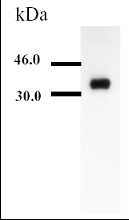
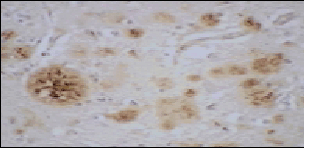
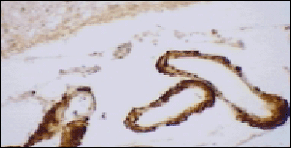
Anti-Apolipoprotein E, mouse monoclonal, clone E6D7, recognizes the ~35 kDa Apo E2, E3, and E4 in human serum and brain. It is validated for ELISA, WB, IP, and paraffin and frozen sections.
Mouse monoclonal antibody supplied as diluted culture supernatant. Recognizes the ~35 kDa E2, E3, and E4 isoforms of apolipoprotein E.
Recognizes the ~35 kDa E2, E3, and E4 isoforms of apolipoprotein E in human serum and brain.

Immunogen

Human
a synthetic peptide corresponding to amino acids surrounding the polymorphic amino acid position 158 of ApoE

Application


ELISA (see comments)
Immunoblotting (1:100-1:1000)
Immunoprecipitation (see comments)
Frozen Sections (1:100-1:10,000)
Paraffin Sections (1:100-1:10,000, formic acid or heat pre-treatment required)

Packaging

Please refer to vial label for lot-specific concentration.

Physical form

Culture supernatant diluted in PBS.

Preparation Note

Following initial thaw, aliquot and freeze (-20°C).

Analysis Note

Positive Control
Brain tissue, serum

Other Notes

Recognizes the ~35 kDa E2, E3, and E4 isoforms of apolipoprotein E in human serum, but multiple bands are seen when used with brain tissue samples. Staining of formalin-fixed paraffin-embedded tissues may be enhanced by the pre-treatment of tissue with 70% formic acid for 10-30 min at room temperature or by heat pre-treatment using citrate buffer, pH 6.0. This antibody has also been reported to work for immunoprecipitation and ELISA. Antibody should be titrated for optimal results in individual systems.
Golabek, A.A., et al. 1996. J. Biol. Chem.271, 10602.

Legal Information

CALBIOCHEM is a registered trademark of Merck KGaA, Darmstadt, Germany

Disclaimer

Toxicity: Standard Handling (A)

Vous ne trouvez pas le bon produit ?  

Essayez notre Outil de sélection de produits.

Classe de stockage

11 - Combustible Solids

wgk

WGK 1

flash_point_f

Not applicable

flash_point_c

Not applicable


Certificats d'analyse (COA)

Recherchez un Certificats d'analyse (COA) en saisissant le numéro de lot du produit. Les numéros de lot figurent sur l'étiquette du produit après les mots "Lot" ou "Batch".

Déjà en possession de ce produit ?

Retrouvez la documentation relative aux produits que vous avez récemment achetés dans la Bibliothèque de documents.

Consulter la Bibliothèque de documents

Abraham Kuot et al.
Clinical & experimental ophthalmology, 47(8), 1028-1042 (2019-06-18)
Fuchs endothelial corneal dystrophy (FECD) is a progressive and potentially a sight threatening disease, and a common indication for corneal grafting in the elderly. Aberrant thickening of Descemet's membrane, formation of microscopic excrescences (guttae) and gradual loss of corneal endothelial
Dale J Christensen et al.
Journal of immunology (Baltimore, Md. : 1950), 186(4), 2535-2542 (2011-02-04)
The molecular mechanism by which apolipoprotein E (apoE) suppresses inflammatory cytokine and NO production is unknown. Using an affinity purification approach, we found that peptide mimetics of apoE, derived from its receptor binding domain residues 130-150, bound to the SET
Veena Theendakara et al.
The Journal of neuroscience : the official journal of the Society for Neuroscience, 36(3), 685-700 (2016-01-23)
A major unanswered question in biology and medicine is the mechanism by which the product of the apolipoprotein E ε4 allele, the lipid-binding protein apolipoprotein E4 (ApoE4), plays a pivotal role in processes as disparate as Alzheimer's disease (AD; in
Jing Zhang et al.
FASEB journal : official publication of the Federation of American Societies for Experimental Biology, 33(6), 7748-7757 (2019-03-22)
Aging and apolipoprotein E4 (ApoE4) can increase the risk of cognitive impairment and neurodegenerative disorders, including Alzheimer's disease (AD), and patients with type 2 diabetes mellitus are highly susceptible to cognitive dysfunction. Recent research has indicated that metformin, a prescribed
Xia Hu et al.
Frontiers in neuroanatomy, 11, 45-45 (2017-06-24)
Genetic variations in the vacuolar protein sorting 10 protein (Vps10p) family have been linked to Alzheimer's disease (AD). Here we demonstrate deposition of fragments from the Vps10p member sortilin at senile plaques (SPs) in aged and AD human cerebrum. Sortilin

Notre équipe de scientifiques dispose d'une expérience dans tous les secteurs de la recherche, notamment en sciences de la vie, science des matériaux, synthèse chimique, chromatographie, analyse et dans de nombreux autres domaines..

Contacter notre Service technique