
Residual Solvents Testing By Gas Chromatography
Introduction
Residual solvent testing is a critical component of pharmaceutical quality control, helping ensure that drug substances, excipients, and finished drug products meet established safety and quality requirements. Organic solvents used during synthesis, purification, extraction, and crystallization may remain as trace impurities in the final product if not adequately removed. Because these residual solvents can pose toxicological risks, guidelines such as ICH Q3C(R9) and USP <467> establish acceptable limits for their presence. Gas chromatography (GC), particularly with headspace sampling, is the preferred analytical technique for monitoring residual solvents due to its sensitivity, selectivity, and suitability for volatile compounds.
Classification of residual solvents
To ensure patient safety, the ICH Q3C(R9) guideline classifies residual solvents according to their potential toxicological risk and establishes acceptable exposure limits based on the Permitted Daily Exposure (PDE).1 This risk-based approach helps manufacturers select appropriate solvents during process development while ensuring that residual solvent levels in pharmaceutical products remain within acceptable limits.¹
The guideline categorizes residual solvents into three classes:
- Class 1: Solvents to be avoided due to unacceptable toxicity or environmental hazards.1
- Class 2: Solvents to be limited because of their inherent toxicity.1
- Class 3: Solvents with low toxic potential that present minimal risk at the specified exposure limits.¹
How key regulatory guidelines define residual solvents
ICH Q3C(R9)
"Residual solvents in pharmaceuticals are defined as organic volatile chemicals that are used or produced in the manufacturing of drug substances or excipients, or in the preparation of drug products."1
USP <467>
"For pharmacopeial purposes, residual solvents in pharmaceuticals are defined as organic volatile chemicals that are used or produced in the manufacturing of drug substances, excipients, or dietary ingredients, or in the preparation of drug products or dietary supplement products."2
Why residual solvent testing is essential
Regulatory guidance consistently emphasizes three key principles for residual solvents:
- Residual solvents do not contribute to the therapeutic efficacy of a drug product.
- Residual solvent levels should be minimized through appropriate manufacturing processes whenever practical.
- Residual solvent concentrations should not exceed safety-based limits established from toxicological risk assessments.¹,²
Residual solvent testing is therefore an integral part of pharmaceutical quality control, helping manufacturers demonstrate compliance with regulatory requirements while ensuring patient safety and product quality.
Risks associated with inadequate residual solvent control
Failure to adequately monitor and control residual solvents can have significant implications for both patient safety and pharmaceutical manufacturers. Excess residual solvent levels may increase toxicological risk, lead to product quality concerns, result in regulatory observations or product recalls, and delay product approval or release. Table 1 summarizes reported incidents involving residual solvents and the resulting regulatory or enforcement actions.
Regulatory framework overview
ICH Q3C(R9)
The International Council for Harmonisation (ICH) Q3C(R9) guideline, adopted at Step 4 on 24 January 2024, is the primary global standard for controlling residual solvents in pharmaceuticals.
The 2024 revision introduces an important update to Section 3.4 (Analytical Procedures), which states that the volatility of the residual solvent should be considered during analytical method validation. This update reinforces the need to select analytical methods that are appropriate for the physicochemical properties of the target solvents and highlights the importance of optimizing GC methods for reliable residual solvent analysis.¹
ICH Q3C(R9) classifies residual solvents into three risk-based categories:
Class 1 residual solvents
Class 1 solvents are known or strongly suspected human carcinogens, and environmental hazards. Their use should be avoided whenever possible. But if their use is unavoidable, residual levels must be controlled within the limits specified in ICH Q3C(R9).¹
Class 2 residual solvents
Class 2 solvents include non-genotoxic animal carcinogens and agents of irreversible toxicity, such as neurotoxicity and teratogenicity. These solvents are controlled using permitted daily exposure (PDE) limits.¹
Class 3 residual solvents
Class 3 solvents have PDE values of ≥50 mg/day and are considered to have low toxic potential. They include solvents such as ethanol, acetone, ethyl acetate, isopropanol, and heptane. When only Class 3 solvents are present at ≤0.5%, a non-specific method, such as loss on drying, may be appropriate. However, gas chromatography is recommended to confirm solvent identity and quantify residual solvent levels.¹
Representative Class 3 solvents: Acetic acid, acetone, anisole, 1-butanol, 2-butanol, butyl acetate, tert-butyl methyl ether, dimethyl sulfoxide, ethanol, heptane, isobutyl acetate, isopropyl acetate, methyl acetate, 3-methyl-1-butanol, methyl ethyl ketone, 2-methyl-1-propanol, 2-methyltetrahydrofuran, and pentane.¹
GC workflow for residual solvent analysis
Residual solvent analysis by gas chromatography involves a series of interconnected steps to ensure accurate and reliable results. A typical GC workflow includes:
- Sample preparation and introduction, typically using headspace sampling
- Calibration and method verification using primary or secondary reference materials
- Separation and analysis by gas chromatography
Sample preparation techniques
Two sample preparation techniques are commonly used for residual solvent analysis, each suitable for different sample types and analytical requirements.
Headspace GC (HS-GC)
Headspace GC is the preferred technique for residual solvent analysis and is recommended in USP <467>. The sample is equilibrated in a sealed vial at an elevated temperature, allowing volatile solvents to partition into the headspace. An aliquot of the headspace vapor is then injected onto the GC column for analysis.
Best suited for:
- Class 1 and Class 2 volatile solvents
- Highly volatile analytes that require no pre-concentration
- Low-concentration samples requiring increased sensitivity via trap-and-release
Direct injection
In direct injection, a liquid sample or a pharmaceutical formulation dissolved in a suitable solvent is injected directly into the GC inlet for chromatographic separation.
Recommended for:
- Solvents with limited headspace partitioning
- When pre-concentration steps are not needed
- DMSO-based matrices, where DMSO is the standard diluent for water-insoluble formulations in USP <467>¹
GC column selection for USP <467> procedures
USP <467> specifies three GC-based analytical procedures (Procedures A, B, and C) for the identification and quantification of residual solvents. Each procedure recommends a specific USP GC phase and corresponding column chemistry to achieve the required separation.¹
Selecting the appropriate USP <467> procedure
- Begin with Procedure A for initial screening. If all residual solvent levels are below the specified limits, no further analysis is required.
- If co-eluting peaks or reportable residual solvents are detected, perform Procedure B for confirmation and identification.
- Once solvent identity is confirmed, use Procedure C for quantification, where applicable.
- For Class 3 solvents only, identification is not required if the total solvent content is ≤0.5%; if it exceeds 0.5%, the solvents should be identified and quantified.¹
USP stationary phases for residual solvent analysis
- G43 stationary phase ((Figures 1 and 2A): The G43 stationary phase provides intermediate polarity and enables the separation of most Class 1 and Class 2 residual solvents in a single analysis. Certain solvent pairs, such as toluene and methyl isobutyl ketone (MIBK), intentionally co-elute on this phase. These compounds are subsequently resolved using Procedure B with a G16 column.¹
- G16 stationary phase (Figure 2B): The G16 stationary phase is a high-polarity polyethylene glycol (PEG)-based wax phase (e.g., Supelcowax® 10). It is used in USP <467> Procedure B to resolve solvent pairs that co-elute on the G43 phase, particularly toluene and methyl isobutyl ketone (MIBK).
The complementary selectivity of the G16 and G43 phases enables comprehensive analysis of Class 1 and Class 2 residual solvents.¹ Laboratories performing residual solvent analysis should therefore ensure they have access to both G43 and G16 column chemistries to support compendial testing.¹
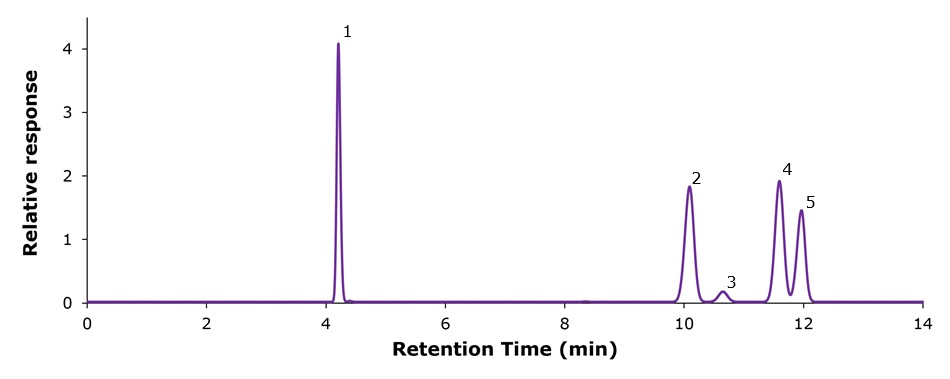
Figure 1.GC-FID chromatograms of Residual Solvents Mixture – Class I certified reference material (PHR1063) illustrating the chromatographic separation on A) SPB™-624 capillary column (25430) Peak assignments are as follow: 1) 1,1-Dichloroethene, 2) 1,1,1-Trichloroethane, 3) Carbon Tetrachloride, 4) Benzene, and 5) 1,2-Dichloroethane.
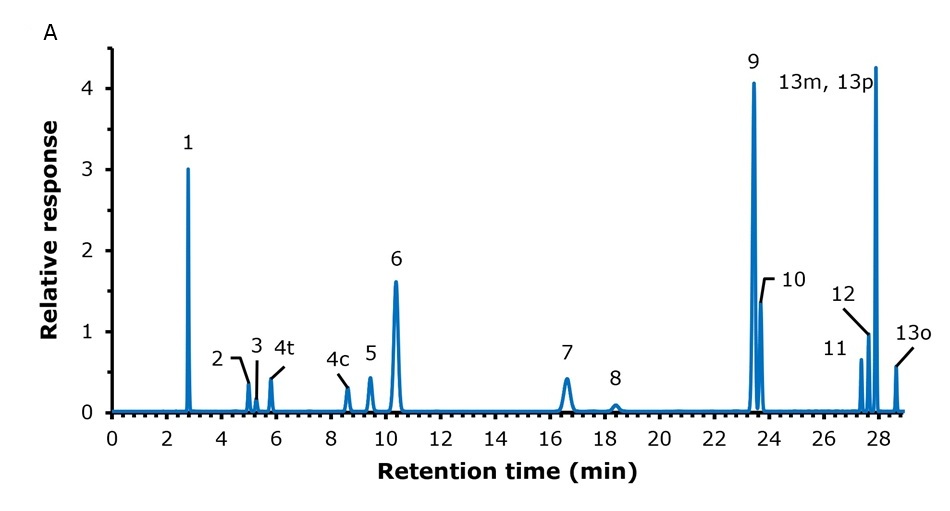
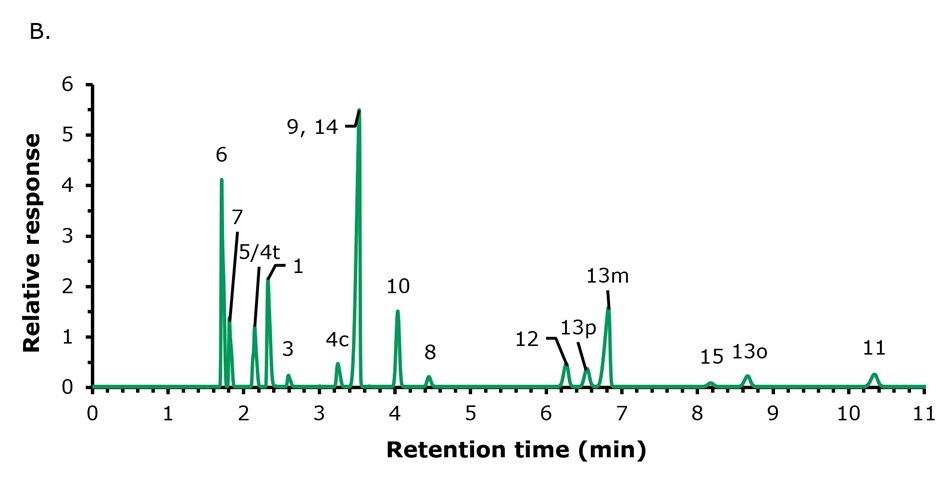
Figure 2.GC-FID chromatograms of Residual Solvents Mixture – Class IIA certified reference material, (PHR1064) illustrating the stationary phase selectivity differences between A) SPB™-624 capillary column (25430) and B) Supelcowax™-10 capillary column (24080-U). Four Class IIA solvents are highlighted in chromatograms A and B. No single column is capable of chromatographically resolving all residual solvents; therefore, the use of orthogonal stationary phases is necessary for confirmatory identification of potential contaminants. Peak assignments are as follows: 1) Methanol, 2) Acetone, 3) Methylene Chloride, 4t) trans-1,2-Dichloroethene, 4c) cis-1,2-Dichloroethene, 5) Tetrahydrofuran, 6) Cyclohexane, 7) Methylcyclohexane, 8) 1,4-Dioxane, 9) Methylisobutylketone, 10) Toluene, 11) Chlorobenzene, 12) Ethylbenzene, 13m) m-xylene, 13p) p-xylene, 13o) o-xylene, 14) acetonitrile, and 15) cumene.
Our solutions for residual solvent testing GC workflows
GC columns
The selection of an appropriate GC column is essential for achieving the selectivity required by USP <467>. Procedure A utilizes a G43 stationary phase for primary screening, while Procedure B employs a G16 stationary phase for confirmation to resolve co-eluting solvent pairs. Table 5 lists representative GC columns suitable for these compendial procedures.
Explore our complete portfolio of USP-designated GC columns.
Guard columns for USP <467>
Guard columns are short lengths of deactivated, uncoated fused silica tubing installed between the GC inlet and the analytical column. They protect the analytical column from nonvolatile sample matrix residues, involatile contaminants, and accumulated column bleed that could otherwise deposit on and degrade the stationary phase. Periodic trimming or replacement of the guard column can extend analytical column lifetime and help maintain chromatographic performance. Guard columns are typically 2–10 m in length.
In headspace GC applications, the headspace matrix is primarily in the gas phase, which minimizes the risk of introducing involatile contaminants. But the deactivated surface must still be chemically compatible with both the analytical column stationary phase and the analyte solvent classes being analyzed.
Selection criteria for guard columns
The guard column's internal diameter should match that of the analytical column. An I.D. mismatch, particularly a larger-to-smaller step-down, can introduce dead volume at the connection, disrupt carrier gas flow, and cause peak broadening and tailing that may compromise system suitability. Hence a guard column with the same I.D. as the analytical column must be selected whenever possible.
Note: Procedure B (G16/WAX): A polar, PEG-type deactivated tubing is ideal for use as a guard column with a WAX/G16 analytical column. For static headspace GC, intermediate-polarity deactivation is also acceptable because the matrix is in the gas phase and analytes are present at trace concentrations.
Column connection hardware: Siltite µ-Union kits and replacement ferrules
Reliable, low-dead-volume connections between the guard and analytical columns are essential for maintaining chromatographic performance, particularly system suitability parameters such as resolution and peak symmetry. The Siltite µ-Union system provides a chemically deactivated stainless steel FingerTite connection designed to minimize dead volume and prevent leaks during GC thermal cycling, without requiring re-tightening after installation.
Replacement packs provide ferrules for maintaining or replacing connections in the Siltite µ-Union system. Ferrules are supplied separately without unions or installation tools, making these packs suitable for routine maintenance and replacement of worn or damaged ferrules.
Solvents for residual solvent analysis
SupraSolv® solvents for headspace GC
Headspace GC relies on high-purity solvents as sample diluents, making solvent quality crucial for minimizing background interference and supporting accurate quantification of residual solvents. The SupraSolv® solvents for headspace GC (HS-GC) are optimized for the quantitative analysis of residual solvents in drug substances, excipients, and drug products in accordance with ICH Q3C guidelines. The solvents are application-tested to ensure low intrinsic volatile impurities and batch-to-batch consistency, helping improve the reliability of residual solvent analysis.
SupraSolv® solvents for HS-GC
SupraSolv® solvents for GC-MS
SupraSolv® solvents for GC-mass spectrometry (GC-MS) are designed to provide the high purity and MS compatibility required for residual solvent analysis. Their low impurity profile helps optimize ionization efficiency while minimizing matrix effects and spectral interferences across the MS detection range, supporting reliable mass spectral identification and reproducible quantification. Batch release testing includes GC-MS performance criteria to help ensure consistent signal-to-noise ratios and retention-time stability across analyses.
Water, dimethyl sulfoxide (DMSO), and dimethylformamide (DMF) are commonly used diluents for residual solvent analysis, depending on sample solubility. According to USP <467> Section 8.3, DMSO is the recommended diluent for water-insoluble formulations, while water is used for water-soluble formulations. Other solvents commonly used in residual solvent analysis include dichloromethane (DCM), n-hexane, and methanol.
SupraSolv® solvents for GC-MS
Reference materials
Accurate residual solvent testing requires a well-structured, traceable reference material (RM) program to support method development, calibration, system suitability, and routine quality control. USP <1467> recommends that standard solutions used for verification demonstrate defined analytical performance, including 80–120% recovery and ≤20% relative standard deviation (RSD), helping ensure the accuracy and precision of residual solvent measurements.¹
Refer to Choosing the correct reference material quality grade for additional information.
Our portfolio includes both compendial primary reference standards and pharmaceutical secondary Certified Reference Materials (CRMs) to support residual solvent testing in accordance with pharmacopeial and regulatory requirements.
Primary reference standards
Our portfolio includes USP primary reference standards for residual solvent testing, providing the official compendial materials specified for method verification and applications where pharmacopeial reference standards are required.
USP primary reference standards
Pharmaceutical secondary standards (CRMs)
Our pharmaceutical secondary standards are Certified Reference Materials (CRMs) that provide documented traceability to currently valid USP, Ph. Eur., and BP primary reference standards, making them suitable for routine analytical applications.
Key features
- Traceable to current pharmacopeial primary reference standards throughout the product shelf life
- Certified values with expanded uncertainty documented in the Certificate of Analysis (CoA)
- Purity assigned by orthogonal characterization using multiple independent analytical techniques
- Produced under ISO 17034 and tested in accordance with ISO/IEC 17025
- Monthly CoA batch updates available
- Designed for use alongside pharmacopeial primary reference standards as part of a comprehensive reference material program
Pharmaceutical secondary standards (CRMs)
High-purity gas solutions for GC
High-purity carrier and detector gases are essential for reliable residual solvent analysis, as they directly influence baseline stability, detector performance, sensitivity, and GC column lifetime. Maintaining a consistent supply of clean, contaminant-free gases helps ensure robust chromatographic performance throughout routine testing.
Parker ChromGas™ gas generators
Our portfolio includes Parker ChromGas™ gas generators, which provide a continuous on-demand supply of high-purity hydrogen, nitrogen, and zero air for GC applications. By eliminating the need for compressed gas cylinders, they help improve laboratory safety, reduce operating costs, and provide a consistent gas supply for routine GC analyses.
Gas purification products
Even when high-purity gases are used, trace contaminants such as hydrocarbons, moisture, and oxygen can adversely affect chromatographic performance. Appropriate gas purification helps protect GC columns and detectors while improving baseline stability and analytical reproducibility.
Carrier gases (He, N₂, or H₂) should be free of hydrocarbons, moisture, and oxygen before entering the GC system.
OMI®-2 indicator tube
The OMI®-2 indicator tube is an oxygen and moisture indicating purifier containing a color-change resin that provides a visual indication when the purifier is saturated and requires replacement. This enables timely replacement while helping prevent undetected contamination of the GC gas supply.
Gas purification products for GC
Headspace vials
Headspace GC is the preferred technique for residual solvent analysis due to its suitability for volatile compounds and reduced matrix interference. Selecting the appropriate headspace vial is therefore essential to ensure compatibility with the GC system and maintain reliable, reproducible analytical performance.
We offer a comprehensive range of headspace vials engineered for GC headspace analysis and compatible with leading autosampler platforms (Perkin-Elmer, Agilent/HP, CTC Combi PAL, Carlo Erba, Shimadzu, Tekmar, and Varian). Vials are manufactured from Type I borosilicate glass and are available in multiple closure styles, volumes, bottom geometries, and glass tints. Tables below summarise all current Supelco headspace vial SKUs by product family.
Choosing the right vial
- Flat bottom: Maximizes heating uniformity on heated trays or blocks used with Carlo Erba, Agilent, and Shimadzu instruments.
- Rounded-bottom: Preferred for robotic-arm autosamplers that lift vials from a tray, including PerkinElmer, Tekmar, Varian, and CTC PAL systems.
- Beveled top: Reduces the sealing contact area with the crimp seal, helping improve seal integrity under pressure.
- Long-neck/flat-top: Suitable for instruments that grip the vial at the neck, as commonly found on Carlo Erba and Shimadzu platforms.
- Amber glass: Protects light-sensitive analytes, while clear glass allows visual inspection of the sample.
- Screw-top: Features an 18 mm thread and requires magnetic screw caps, sold separately.
Beveled-top, flat-bottom vials for 20 mm crimp seals
Standard flat-bottom vials with a beveled finish that reduce the crimp-seal and are compatible with most autosamplers using 20 mm crimp seals.