
Eshmuno® AAV9 resin for high-capacity AAV9 capture
This technical article summarizes the advantages of this innovative resin for AAV9 purification and provides case studies that highlight the benefits for more efficient, cost-effective viral vector purification workflows.
Section overview
- Challenges of Adeno-associated virus production
- Key benefits of Eshmuno® AAV9 resin
- Experimental details
- Cycling study: High binding capacity and reusability
- Benchmarking: High binding capacity vs. competition
- Residence times: High binding capacity at short residence times
- Elution window: Mild pH maintains infectivity and impurity clearance
- Key takeaways
- Frequently asked questions
- Related products
Challenges of Adeno-associated virus production
Adeno-associated virus serotype 9 (AAV9) is a commonly used vector for viral gene therapy production. Current manufacturing (Figure 1) is constrained by slow processing, low upstream virus titers, high feed complexity, and high cost of goods (COGs). Additionally, downstream purification of AAV9 vectors remains a critical manufacturing bottleneck.1, 2
Developing a robust, scalable production system for AAV9 therapies relies on technologies that provide the binding capacity, virus recovery, flow rate and caustic stability for high productivity and cost-effective purification.
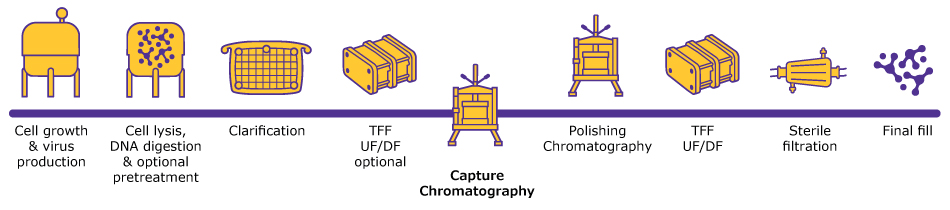
Figure 1.AAV manufacturing process
Eshmuno® AAV9 is an affinity chromatography resin tailored for efficient capture of wild-type AAV9 capsids and a wide range of engineered AAV9 capsid variants. This highly selective resin contains caustic and acid stable Nanofitin® affinity ligands coupled to an Eshmuno® base bead (Figure 2).3 Eshmuno® AAV9 resin improves virus capture, enables high flow rates and binding capacity, with enhanced recovery at mild elution pH, and offers caustic stability over multiple cycles of reuse. Key resin specifications are listed in Table 1.
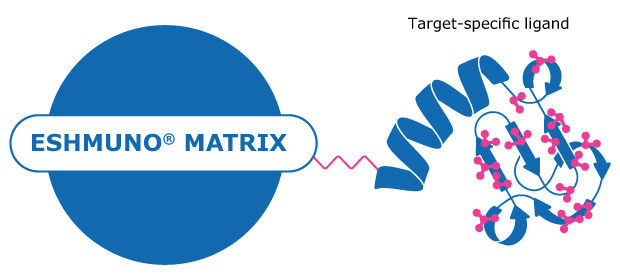
Figure 2.Combination of Eshmuno® base bead and AAV9-specific Nanofitin® ligand
Key benefits of Eshmuno® AAV9 resin
- High dynamic binding capacity (DBC) ≥ 8E+14 vp/mL column volume (CV) at 10% breakthrough (BT) for wild-type and a wide range of AAV9 capsid variants at short residence times (RT) ≤ 1 min, enabling intensified, high-throughput processing
- High and consistent recovery ≥ 80% when eluting between pH 2-4; minimizing aggregation and preserving capsid integrity at milder elution pH
- Effective impurity clearance, log reduction values (LRV) of ≥ 4 for host cell proteins (HCP) and ≥ 3 for host cell DNA (hcDNA), even under mild elution conditions
- Caustic stability up to 0.5 M sodium hydroxide, improving sanitization and reuse as well as reducing costs
- Easy packing, robust pressure-flow behavior and seamless scalability, facilitating a direct workflow from process development to manufacturing scale
- Comprehensive documentation from the Emprove® Program to streamline compliance
Experimental details
Prior to first use, columns containing Eshmuno® AAV9 resin were sanitized with 0.5 M NaOH for 10-30 min and then equilibrated with PBS (10 mM phosphate, 3 mM KCl, 140 mM NaCl, pH 7.4) for 6 CV.
The AAV9 containing cell culture material was lysed, clarified and sterile filtered prior to loading onto the column. The DBC10% is dependent on the specific AAV9 lysate conditions, presence of additives as well as the flow rate. The required volume of clarified AAV9 lysate was calculated based on the viral capsid titer, the column volume and the target load (depending on the case study ~80-120% DBC10%).
Clarified AAV9 lysate was applied to columns at target load volume at a constant flow rate of 1.0 CV/min, corresponding to a residence time of 1 minute. After loading, columns were washed with PBS for 5 CV and bound virus eluted in step mode using 50 mM glycine, 150 mM NaCl, 0.01% Poloxamer 188 (pH 3) for 6 CV. An alternate milder elution at pH 4 using 100 mM citrate, 250 mM NaCl, 0.01% Poloxamer 188 for 6 CV, was also evaluated. All elution fractions were immediately neutralized on collection with 550 mM BIS-TRIS propane, 0.01% Poloxamer 188 (pH ~10) at 10–20% of the fraction volume.
The columns were stripped with 0.1 M TRIS, 2 M NaCl (pH 10.2) for 5 CV, followed by a cleaning-in-place (CIP) step using 0.5 M NaOH for 10 CV with an optional 20-minute incubation and then pre-equilibrated with PBS supplemented with 1 M NaCl (pH ~7) for 5 CV, before final re-equilibration with PBS (pH 7.4) for 5 CV. Between runs, columns were stored in 150 mM NaCl with 20% ethanol. Prior to each step, a pump wash was conducted. For small column volumes (e.g., 0.2 mL CV), the chromatography method was adjusted to account for the system’s hold-up volume.
Cycling study: High binding capacity and reusability
The cycling performance of Eshmuno® AAV9 resin was evaluated over five cycles using the clarified lysate (capsid titer: 3.9E+12 vp/mL) of a recombinant AAV9 containing a green fluorescent protein (GFP) gene (AAV9-eGFP). The lysate was loaded onto a pre-packed 0.2 mL OPUS® MiniChrom® column at 1 min RT. Each cycle included a PBS wash, elution at pH 3.0, a high-salt strip, and CIP with 0.5 M NaOH for 30 min.
The impact of alternative cleaning solutions including 0.1 M phosphoric acid, 6 M guanidine hydrochloride, 1.5 M acetic acid, or 20% dipropylene glycol on AAV9 binding to Eshmuno® AAV9 resin was assessed. In addition, the impact of detergents like Tween® 20 or Deviron®, and the presence of up to 500 mM NaCl in clarified harvest solution was evaluated.
Figure 3 and Table 2 summarize the cycling study results with Eshmuno® AAV9 resin:
- The DBC at 10% breakthrough (DBC10%) exceeded 1E+15 vp/mL CV ± 4% and remained consistently high throughout all 5 cycles
- Product recovery was maintained at 88% ± 4%
- Impurity clearance showed no measurable change over the 5 cycles evaluated; HCP LRV ≥ 4 and hcDNA LRV ≥ 2.5 maintained across all cycles
- Cleaning solutions including 0.1 M phosphoric acid, 6 M guanidine hydrochloride, 1.5 M acetic acid, or 20% dipropylene glycol did not impact AAV9 binding capacity
- Presence of detergents or salt up to 500 mM in clarified harvest material did not impact AAV9 binding to the resin
The demonstrated caustic stability supports a multi-cycle strategy, reducing resin requirements which should lower COGs.
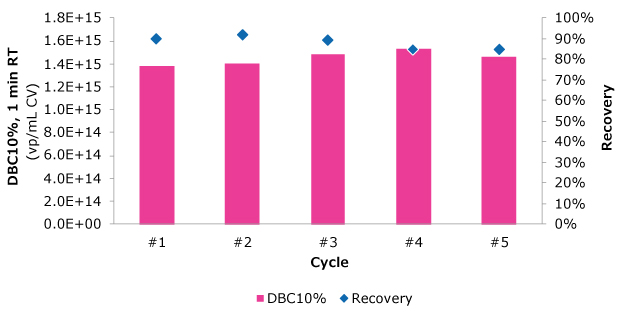
Figure 3.Binding capacity and recovery on Eshmuno® AAV9 resin over 5 cycles with CIP (0.5 M NaOH, 30 min)
Benchmarking: High binding capacity vs. competition
Binding capacity and caustic stability of Eshmuno® AAV9 resin were compared to two commercially available AAV affinity resins (Competitor A and Competitor B). All resins were tested under identical conditions at 1 min residence time over 5 cycles with CIP (0.5 M NaOH, 30 min per cycle). Initial cleaning and elution were performed according to the manufacturer’s recommendations.
Eshmuno® AAV9 resin achieved the highest DBC10% (> 1E+15 vp/mL CV), which was consistent across all 5 cycles. Competitor A had at least 2× lower binding capacity, while Competitor B showed more than 10× lower capacity (Figure 4). Additionally, Competitor B was unable to demonstrate any caustic stability under the given test conditions, losing more than 95% DBC10% in cycle #2.
The combination of high binding capacity and caustic stability directly translates into a substantial productivity advantage for Eshmuno® AAV9 resin. For a representative 50 L AAV9 batch (example titer: 5.8E+12 vp/mL; load: 2.9E+17 vp; 80% DBC loading), the performance benefits of Eshmuno® AAV9 resin result in:
- Reduced resin requirements: Eshmuno® AAV9 resin requires only 0.26 L of resin, compared to 0.53 L for Competitor A and 3.63 L for Competitor B.
- Reduced costs: Lower volumes of resin reduce costs, shrink process footprint and lower buffer and WFI consumption. Further benefits could be realized if a multi-cycle strategy was implemented.
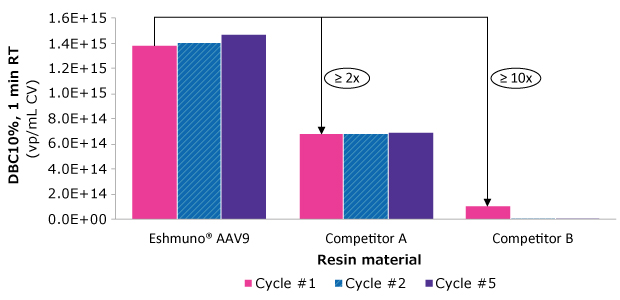
Figure 4.Binding capacity of Eshmuno® AAV9 vs. Competitor A and Competitor B over 5 cycles with CIP (0.5 M NaOH, 30 min)
Residence times: High binding capacity at short residence times
To assess suitability for more intensified processes, binding studies were performed at short residence times of 30 s and 1 min using AAV9 clarified lysate (capsid titer: 1E+12 vp/mL) on a 1 mL column (5 x 50 mm).
The DBC10% on the Eshmuno® AAV9 resin was dependent on the applied flow rate. At a RT of 30 s, DBC10% was reduced to ~1E+15 vp/mL however impurity clearance remained comparable to 1 min. RT (Figure 5). Despite the reduction in binding capacity at a shorter residence time, it remains competitively high, supporting higher throughput, shorter cycle times, and potential column size reduction, which are key levers for improved process efficiency and reduced COGs. Overall, the performance of the Eshmuno® AAV9 resin affords the flexibility to balance processing speed against maximum binding capacity based on specific process priorities.
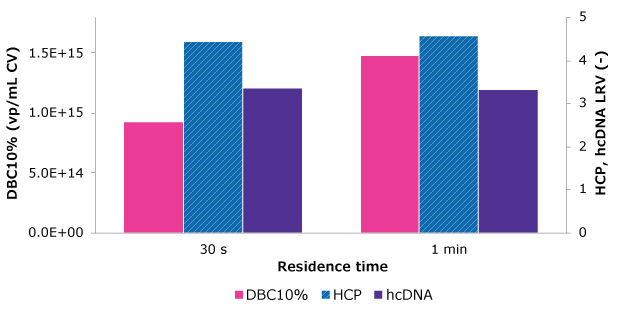
Figure 5.Binding capacity and impurity clearance (LRV) on Eshmuno® AAV9 resin at 30 s vs. 1 min residence time
Elution window: Mild pH maintains infectivity and impurity clearance
AAV vectors are sensitive to acidic conditions, and exposure to low pH during processing should be minimized to preserve functional efficacy.4 Elution at mild pH preserves therapeutic efficacy by minimizing structural and functional damage caused by acidic conditions. To determine the elution flexibility of the Eshmuno® AAV9 resin, three columns were independently loaded with AAV9-eGFP lysate to approximately DBC10% at 1 min RT and then eluted at pH 2.0, 3.0, or 4.0 using glycine/citrate-based buffers. Fractions were neutralized immediately post-elution. Infectivity was assessed as log10 (genome copies/transducing units).
Figure 6 shows infectivity and impurity clearance across the different elution conditions. Across all pH conditions, full AAV9 capsid recovery and infectivity remained consistently high. HCP and hcDNA clearance were effective under all conditions. Mild elution pH maintained viral recovery and infectivity and impurity clearance performance, providing flexibility for the end-user to customize elution conditions for their specific process requirements.
Optimal buffer conditions vary depending on the composition of the AAV9 lysate and the nature of the viral capsid and should be determined experimentally for each process. Different buffer systems, such as PBS or TBS, can be used for equilibration with conductivity and pH selected based on the AAV9 feed composition. If required, additional buffer wash with e.g., high salt can be used for impurity removal or optional clean-in-place (CIP) steps for column regeneration. Alternatively, different elution pH with varying buffer composition or salt concentrations can be utilized with additives like arginine or trehalose to improve virus stability. Studies with arginine and trehalose in elution buffer resulted in comparable yield or improved recoveries (data not shown) and could be further evaluated to maximize efficiency.
The exceptional performance of the Eshmuno® AAV9 resin under a range of pH and buffer conditions, provides flexibility and the opportunity for process optimization without compromising recovery or impurity removal.
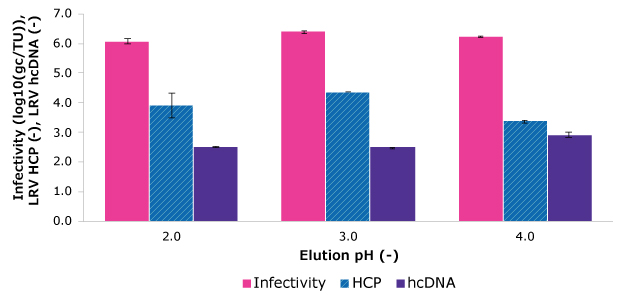
Figure 6.AAV9 infectivity and impurity clearance (HCP and hcDNA) in the elution from Eshmuno® AAV9 resin at different elution pH (glycine/citrate buffers; n=2).
Key takeaways Eshmuno® AAV9 resin
Eshmuno® AAV9 is an affinity chromatography resin designed for efficient capture of AAV9 wild-type capsids and a broad range of engineered AAV9 capsid variants. The resin offers high selectivity for virus capture with effective impurity removal, supports high flow rates and binding capacity, delivers high recovery at mild elution pH, and demonstrates caustic stability which helps improve re-usability and reduce manufacturing costs.
- Eshmuno® AAV9 chromatography resin enables users to:
- Increase productivity by providing high binding capacities at short residence times for wild-type AAV9 and a wide range of engineered AAV9 capsid variants
- Improve downstream process efficiency through high virus recovery and effective impurity clearance at the first purification step
- Minimize the risk of AAV9 aggregation while preserving capsid integrity at milder elution pH
- Reduce manufacturing costs through caustic stability, which enables efficient sanitization and multiple reuse cycles
- Seamlessly scale from process development to manufacturing, supported by easy column packing, and robust pressure-flow behavior
- Streamline implementation with a comprehensive documentation package supported by the Emprove® Program
Frequently asked questions
Will affinity resins for other serotypes also be made available?
Yes, additional serotypes can be addressed through our Eshmuno® Fit platform, which supports the development of dedicated ligands for specific serotypes..
Does Eshmuno® AAV9 resin bind to other serotypes?
Eshmuno® AAV9 is designed to be specific to wild-type AAV9 capsids and AAV9-derived engineered capsid variants.
Will a viral clearance study be available?
Yes, a viral clearance study will be available soon.
Do you provide an analytical assay for leached ligand detection?
For ligand leakage detection, please reach out to your Account Manager or our Technical service.
Is the performance of Eshmuno® AAV9 resin impacted by the presence of high amounts of sodium chloride in the AAV feed stream?
Yes, Eshmuno® AAV9 is compatible with a variety of detergents including e.g. Tween® 20 and Deviron®.
Does Eshmuno® AAV9 resin require high levels of salt in the elution buffer to achieve high recoveries?
The recommendation is to add 150-250 mM sodium chloride to the elution buffer. The optimal concentration for maximized recovery should be evaluated with your specific buffer and process conditions.