Sign In to View Organizational & Contract Pricing.
Select a Size
Change View
About This Item
NACRES:
NA.41
UNSPSC Code:
12352203
Clone:
RPA70-9, monoclonal
Species reactivity:
human, yeast
Application:
—
Citations:
23
biological source
mouse
Quality Level
antibody form
purified antibody
antibody product type
primary antibodies
clone
RPA70-9, monoclonal
form
liquid
contains
≤0.1% sodium azide as preservative
species reactivity
human, yeast
manufacturer/tradename
Calbiochem®
storage condition
do not freeze
dilution
(Frozen Sections (2.5 µg/mL)
Immunoblotting (1-5 µg/mL)
Immunofluorescence (2.5 µg/mL)
Immunoprecipitation (1 µg/reaction)
Paraffin Sections (2.5 µg/mL, no pre-treatment required))
isotype
IgG2a
shipped in
wet ice
storage temp.
2-8°C
target post-translational modification
unmodified
Gene Information
human ... RPA1(6117)
General description
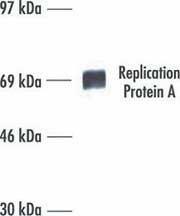
Purified mouse monoclonal antibody generated by immunizing BALB/c mice with the specified immunogen and fusing splenocytes with the NS1 myeloma cell line. Recognizes the ~70 kDa Replication Protein A.
Recognizes the ~70 kDa subunit of replication protein A in HeLa and u293 cells and colon carcinoma tissue.
This Anti-Replication Protein A (Ab-1) Mouse mAb (RPA70-9) is validated for use in Frozen Sections, Immunoblotting, IF, IP, Paraffin Sections for the detection of Replication Protein A (Ab-1).
Immunogen
Epitope: Within the p70 subunit of replication protein A
Human
replication protein A purified from U293 cells
Application

Frozen Sections (2.5 g/ml)
Immunoblotting (1-5 g/ml)
Immunofluorescence (2.5 g/ml)
Immunoprecipitation (1 g/reaction)
Paraffin Sections (2.5 g/ml, no pre-treatment required)
Packaging
Please refer to vial label for lot-specific concentration.
Physical form
In 0.05 M sodium phosphate buffer, 0.2% gelatin.
Analysis Note
Positive Control
HeLa or U293 cells or colon carcinoma tissue
Other Notes
Din, S., et al. 1990. Genes Dev.4, 968.
Brill, S.J. and Stillman, B., 1989. Nature342, 92.
Stillman, B., 1989. Annu. Rev. Cell. Biol.5, 197.
Tsurimoto, T. and Stillman, B., 1989. EMBO J.8, 3883.
Wobbe, C.R., et al. 1987. Proc. Natl. Acad. Sci. USA84, 1834.
Brill, S.J. and Stillman, B., 1989. Nature342, 92.
Stillman, B., 1989. Annu. Rev. Cell. Biol.5, 197.
Tsurimoto, T. and Stillman, B., 1989. EMBO J.8, 3883.
Wobbe, C.R., et al. 1987. Proc. Natl. Acad. Sci. USA84, 1834.
Specific for the p70 subunit of replication protein A. This antibody can be used as a marker for proliferation. Antibody should be titrated for optimal results in individual systems.
Legal Information
CALBIOCHEM is a registered trademark of Merck KGaA, Darmstadt, Germany
Disclaimer
Toxicity: Standard Handling (A)
Still not finding the right product?
Try our Product Selector Tool to narrow your options
Storage Class
11 - Combustible Solids
wgk
WGK 1
flash_point_f
Not applicable
flash_point_c
Not applicable
Certificates of Analysis (COA)
Search for Certificates of Analysis (COA) by entering the products Lot/Batch Number. Lot and Batch Numbers can be found on a product’s label following the words ‘Lot’ or ‘Batch’.
Already Own This Product?
Find documentation for the products that you have recently purchased in the Document Library.
Laurent Miccoli et al.
Molecular and cellular biology, 25(9), 3814-3830 (2005-04-16)
The human stress-activated protein kin17 accumulates in the nuclei of proliferating cells with predominant colocalization with sites of active DNA replication. The distribution of kin17 protein is in equilibrium between chromatin-DNA and the nuclear matrix. An increased association with nonchromatin
Francis Rodier et al.
Journal of cell science, 124(Pt 1), 68-81 (2010-12-02)
DNA damage can induce a tumor suppressive response termed cellular senescence. Damaged senescent cells permanently arrest growth, secrete inflammatory cytokines and other proteins and harbor persistent nuclear foci that contain DNA damage response (DDR) proteins. To understand how persistent damage
S Buchsbaum et al.
Oncogene, 26(35), 5132-5144 (2007-02-22)
The mouse int6 gene is a frequent integration site of the mouse mammary tumor virus and INT6 silencing by RNA interference in HeLa cells causes an increased number of cells in the G2/M phases of the cell cycle, along with