
PC205L

Anti-Calcitonin Gene Related Peptide (CGRP) Rabbit pAb
lyophilized, Calbiochem®
Synonym(s):
Anti-CGRP
Sign In to View Organizational & Contract Pricing.
Select a Size
Change View
About This Item
NACRES:
NA.43
UNSPSC Code:
12352203
Clone:
polyclonal
Species reactivity:
rat, mouse
Application:
—
Citations:
54
biological source
rabbit
Quality Level
antibody form
serum
antibody product type
primary antibodies
clone
polyclonal
form
lyophilized
contains
≤0.1% sodium azide as preservative
species reactivity
rat, mouse
manufacturer/tradename
Calbiochem®
storage condition
OK to freeze
dilution
(Free Floating Sections
Frozen Sections (1:2000-1:4000, ABC detection)
Immunofluorescence (1:100-1:200,
Paraffin Sections (s; heat pre-treatment required; ))
isotype
IgG
shipped in
ambient
storage temp.
−20°C
target post-translational modification
unmodified
Gene Information
mouse ... Calca(12310)
General description
Anti-CGRP, rabbit polyclonal, recognizes the α-CGRP in rat amygdala and spinal cord. It is validated for immunofluorescence, & for use with frozen, paraffin, and free-floating sections.
Rabbit polyclonal antibody supplied as undiluted serum. Recognizes the α-CGRP protein.
Recognizes the α-calcitonin gene related peptide in rat amygdala and spinal cord.
Immunogen
rat α-calcitonin gene related peptide (α-CGRP)
Application
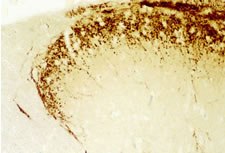
Free Floating Sections (see application references)
Frozen Sections (1:2000-1:4000, ABC detection)
Immunofluorescence (1:100-1:200, see application references)
Paraffin Sections (see application references; heat pre-treatment required; see comments)
Preparation Note
Reconstitute the lyophilized antibody with 100 µl sterile distilled H₂O. Carefully reconstitute the entire contents of the vial; during shipment and handling portions of the lyophilized pellet may have become dislodged and may not be in the bottom of the vial. Following reconstitution, aliquot and freeze (-20°C). Stock solutions are stable for up to 6 months at -20°C. Dilute with sterile PBS or Tris buffer at dilutions no higher than 1:10. Avoid freeze/thaw cycles of solutions.
Analysis Note
Positive Control
Rat amygdala or spinal cord
Rat amygdala or spinal cord
Other Notes
Antibody specificity was examined in the rat amygdala and spinal cord. Staining is completely eliminated by pre-treatment of antibody with 10-5M rat α-CGRP and partially eliminated by preabsorption with rat β-CGRP. Preabsorption with calcitonin resulted in no loss of immunostaining. For staining paraffin sections, heat sections to 80°C in 40 mM sodium citrate buffer, pH 8.5. Antibody should be titrated for optimal results in individual systems.
Legal Information
CALBIOCHEM is a registered trademark of Merck KGaA, Darmstadt, Germany
Disclaimer
Toxicity: Standard Handling (A)
Still not finding the right product?
Try our Product Selector Tool to narrow your options
Storage Class
10 - Combustible liquids
wgk
WGK 1
flash_point_f
Not applicable
flash_point_c
Not applicable
Certificates of Analysis (COA)
Search for Certificates of Analysis (COA) by entering the products Lot/Batch Number. Lot and Batch Numbers can be found on a product’s label following the words ‘Lot’ or ‘Batch’.
Already Own This Product?
Find documentation for the products that you have recently purchased in the Document Library.
D J Van Daele et al.
Neuroscience, 162(2), 501-524 (2009-05-12)
The present study investigated the central connections of motor neurons innervating the thyroarytenoid laryngeal muscle that is active in swallowing, respiration and vocalization. In both intact and sympathectomized rats, the pseudorabies virus (PRV) was inoculated into the muscle. After initial
Stuart M Brierley et al.
Gastroenterology, 134(7), 2059-2069 (2008-03-18)
Although there are many candidates as molecular mechanotransducers, so far there has been no evidence for molecular specialization of visceral afferents. Here, we show that colonic afferents express a specific molecular transducer that underlies their specialized mechanosensory function: the transient
Min-Hee Oh et al.
Journal of immunology (Baltimore, Md. : 1950), 191(11), 5371-5382 (2013-10-22)
Chronic debilitating pruritus is a cardinal feature of atopic dermatitis (AD). Little is known about the underlying mechanisms. Antihistamines lack efficacy in treating itch in AD, suggesting the existence of histamine-independent itch pathways in AD. Transient receptor potential ankyrin 1