Custom Premix Selecting "Custom Premix" option means that all of the beads you have chosen will be premixed in manufacturing before the kit is sent to you.
Catalogue Number
Ordering Description
Qty/Pack
List
この品目はお気に入りに追加されました。
動物種
パネルタイプ
選択したキット
数量
カタログ番号
注文内容
Qty/Pk
価格
96-Well Plate
数量
カタログ番号
注文内容
Qty/Pk
価格
その他の試薬を追加 (MAPmatesとともに使用するにはバッファーおよび検出キットが必要です)
数量
カタログ番号
注文内容
Qty/Pk
価格
48-602MAG
Buffer Detection Kit for Magnetic Beads
1 Kit
Space Saver Option(チェックを入れると箱詰めから袋詰めに変更となりますのでご注意ください) Customers purchasing multiple kits may choose to save storage space by eliminating the kit packaging and receiving their multiplex assay components in plastic bags for more compact storage.
The field of Oncology is largely concerned with elucidating how cancers develop and how best to develop therapies to treat them. Oncologists commonly employ microscopy not only to identify and classify cancer cells, but also to identify the fragmented nuclei of apoptotic cells treated with a chemotherapeutic drug, or to visualize the binding and subsequent internalization and trafficking of therapeutic monoclonal antibodies. Amnis® imaging flow cytometry is ideally suited to these types of studies, and gives the added benefit of combining immunophenotyping with quantitative morphometric measurements that can be applied to identifying rare sub-populations of potentially metastatic cells, including circulating tumor cells (CTC).
Co-Localization of an Antibody-Drug Conjugate to Endosomes or Lysosomes
In this experiment we use the capabilities of the Imagestream®x system to measure the transit of a fluorescently labeled antibody-drug conjugate (ADC) through the cellular endocytic pathway. The high spatial resolution afforded by the Imagestream®x system allowed accurate measurement of ADC co-localization to endosomes and lysosomes. See the application note for more details.
Apoptotic Index Using the ImageStream
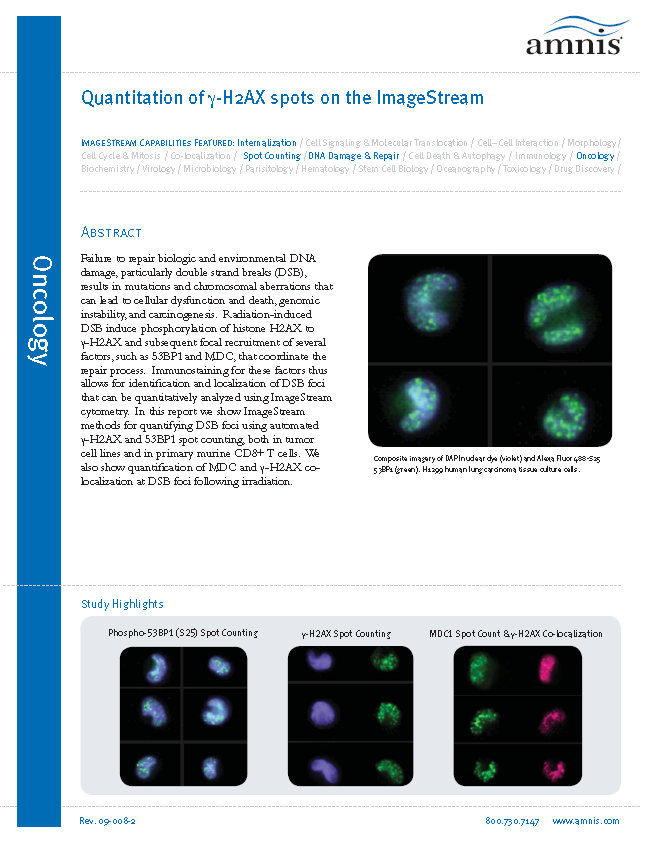
DNA condensation and fragmentation are hallmarks of apoptosis. By measuring the area and the intensities of the brightest portions of the nuclear image, the bright, punctate nuclear imagery of apoptotic cells can be distinguished from the evenly stained nuclear imagery of a normal, healthy nucleus. This makes possible the automated identification of apoptotic cells. When cells begin to dye by apoptosis there is fragmentation and condensation of the DNA. By measuring the area and the intensities of the brightest portions of the nuclear image, the bright, punctate nuclear imagery of apoptotic cells can be distinguished from the evenly stained nuclear imagery of a normal, healthy nucleus. This makes possible the automated identification of apoptotic nuclear morphology. See the application note for more details.


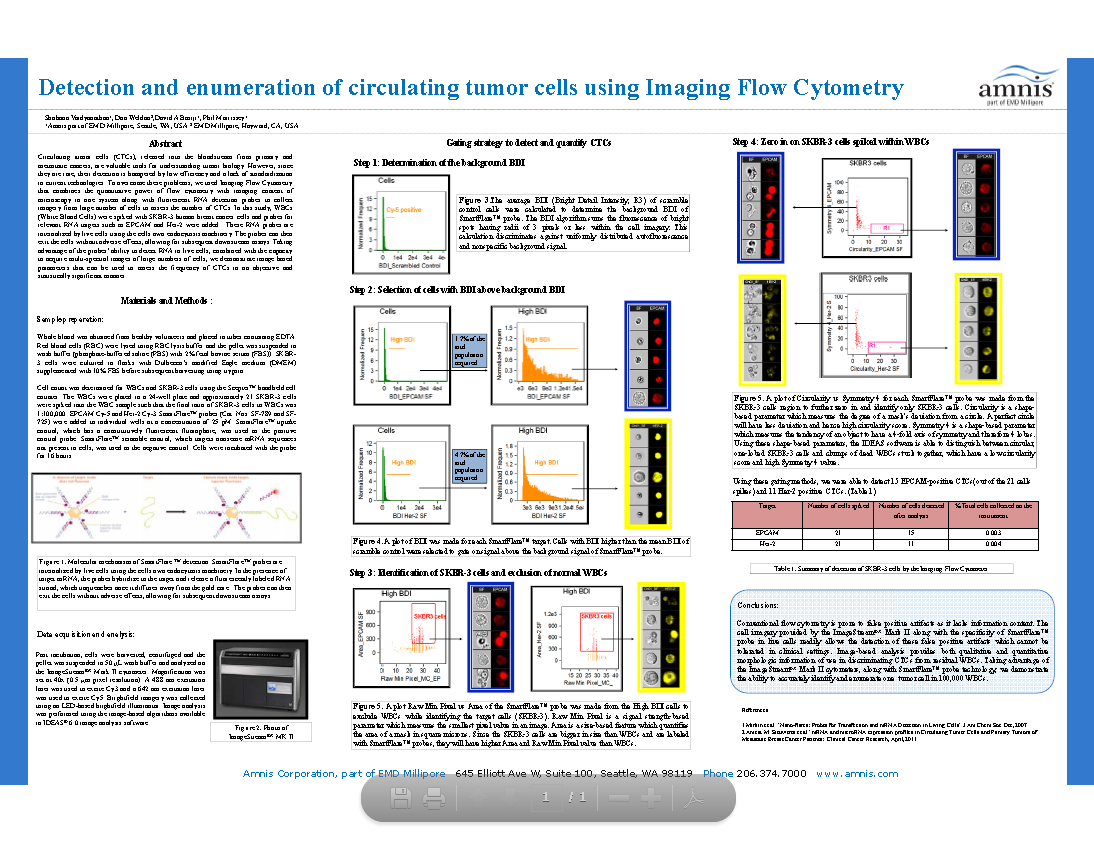

 The field of Oncology is largely concerned with elucidating how cancers develop and how best to develop therapies to treat them. Oncologists commonly employ microscopy not only to identify and classify cancer cells, but also to identify the fragmented nuclei of apoptotic cells treated with a chemotherapeutic drug, or to visualize the binding and subsequent internalization and trafficking of therapeutic monoclonal antibodies. Amnis® imaging flow cytometry is ideally suited to these types of studies, and gives the added benefit of combining immunophenotyping with quantitative morphometric measurements that can be applied to identifying rare sub-populations of potentially metastatic cells, including circulating tumor cells (CTC).
