
User Requirement Specification in Pharma
As biopharmaceutical manufacturing grows more complex, user requirements specifications (URS) remain essential for ensuring equipment, automation systems, and manufacturing processes are compliant, scalable, and effective. In single-use environments, manufacturers must also ensure interconnected unit operations, including buffer preparation, chromatography, virus filtration, TFF, and formulation, function reliably across the process train, as even small requirement gaps can lead to operational issues, validation delays, or product quality risks.
A well-developed URS helps biomanufacturers align process, quality, automation, engineering, and operational expectations before procurement and implementation begin. It also serves as the foundation for qualification, validation, and long-term manufacturing success.
Read our case study on how our MSAT delivered a URS-supporting test plan that verified the performance requirements for the tech transfer of a TFF unit operation, managing the interdependence between the production system operating parameters and cassette loading capacities.
Key takeaways
|
- What is a user requirements specification (URS)?
- What should a URS include?
- Why URS documents are critical in GMP manufacturing
- Regulatory expectations for a URS in pharmaceutical manufacturing
- Managing interdependencies across unit operations
- Best practices for writing a URS documents
- How we support URS development and feasibility assessment
- Case study: defining the URS and technical feasibility
- Building practical, compliant, and scalable manufacturing systems
- Frequently asked questions
What is a user requirements specification (URS)?
A user requirements specification (URS) defines the functional, operational, quality, and regulatory requirements for equipment, systems, facilities, or automation before procurement or development begins. The URS establishes what a system must accomplish, without defining how it should be designed or engineered.
In pharmaceutical manufacturing, a URS may encompass:
- Individual unit operations
- Automation systems
- Manufacturing execution systems (MES)
- Integrated process trains
- Facility-wide manufacturing infrastructure and support systems
An effective URS ensures that the equipment, systems, or facilities meet both business and compliance needs while reducing risks during validation, qualification, and routine operation. The URS also serves as the central reference document for vendors, engineering teams, process developers, automation specialists, manufacturing groups, and quality organizations throughout the project lifecycle.
Importantly, a URS should define intended use clearly and unambiguously. In GMP manufacturing, this is critical because qualification and validation activities ultimately demonstrate that the system consistently performs according to those intended requirements.
What should a URS include?
A properly written URS typically includes process, performance, quality and validation, interfaces and integration, and safety and environmental requirements (Table 1).
Rather than prescribing engineering solutions, the URS defines the required performance outcome. For example, a requirement may specify a target throughput within a defined timeframe, leaving the vendor responsible for determining how that performance will be achieved.
Why URS documents are critical in GMP manufacturing
A comprehensive URS protects the investment project itself by establishing a clear framework for design, procurement, qualification, validation, operational readiness, and regulatory compliance. It helps organizations avoid ambiguity, align stakeholders, and reduce costly redesigns later in the project lifecycle.
In GMP bioprocessing environments, the URS helps define requirements that support:
- Product quality protection
- Data integrity
- Process reproducibility
- Scalable manufacturing
- Risk mitigation
- Patient safety
Small deviations in process performance can directly affect critical quality attributes (CQAs). By clearly defining operating requirements, process controls, and automation expectations, the URS helps ensure systems can monitor and control the critical process parameters (CPPs) needed for consistent product quality.
A well-developed URS also reduces downstream project risk. Issues introduced in the requirements phase frequently surface later, when corrective actions become significantly more expensive and time-consuming.
Regulatory expectations for URS in pharmaceutical manufacturing
Although regulatory agencies do not prescribe a specific URS format, their frameworks establish the expectation that systems must be suitable for their intended use and validated accordingly. For example, FDA 21 CFR 211.63 states:
“Equipment used in the manufacture, processing, packing, or holding of a drug product shall be of appropriate design, adequate size, and suitably located to facilitate operations.”1
To support this, the URS documents must define the intended use and the requirements needed to demonstrate that equipment is of appropriate design for its manufacturing application.
European guidance states the role of the URS more explicitly: EudraLex Volume 4 Annex 15 states that "specifications for equipment, facilities, utilities, or systems should be defined in a URS and/or functional specifications”.2
As a result, a URS is considered foundational for:
- Qualification and validation activities
- Compliance documentation
- Traceable verification
- Demonstration of intended use
The URS serves as the starting point for the broader validation lifecycle that includes the functional specification, design specification, IQ/OQ/PQ, and validation reports. The ISPE (International Society for Pharmaceutical Engineering) Validation V-model (Figure 1) visually represents this relationship, connecting user requirements and design specifications with downstream qualification and validation activities.3
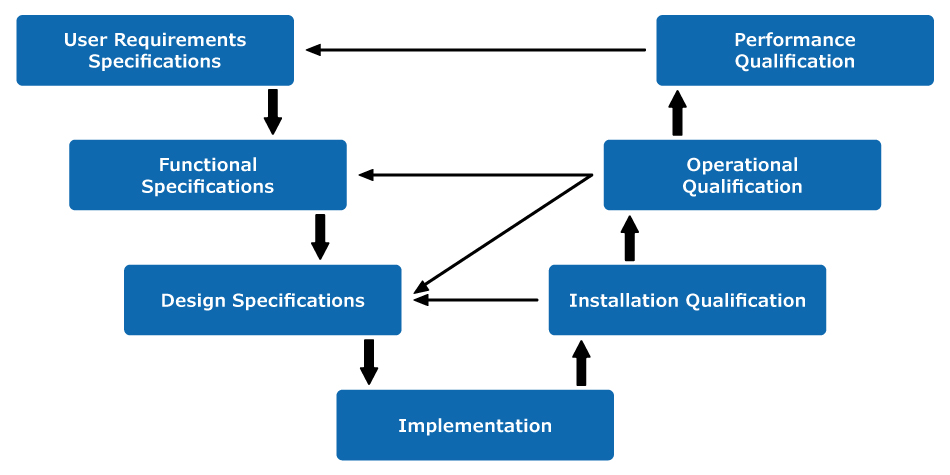
Figure 1.Diagram of the ISPE Validation V-model showing the relationship between URS, functional and design specifications, and implementation.
Managing interdependencies across unit operations
In single-use bioprocessing, systems cannot be evaluated in isolation. Unit operations are highly interconnected, and variability introduced upstream can significantly affect downstream performance.
For example:
- TFF output concentrations affect formulation volumes
- Process hold times influence downstream scheduling
- Buffer preparation impacts chromatography performance
- Mixing performance affects sterility and product integrity
- Automation architecture influences data continuity across operations
As a result, many biomanufacturers structure projects around integrated “packages,” such as downstream processing packages that group chromatography, virus filtration, and TFF systems together.
URS development must account for incoming and outgoing process conditions across the process train. Operating ranges, material transfer requirements, process recipes, and automation interdependencies all need to be evaluated holistically. Evaluating systems independently without considering upstream and downstream impacts can create operational bottlenecks, variability, or scalability limitations. This becomes especially important when scaling processes, introducing new technologies, or transferring processes between manufacturing sites.
Best practices for writing URS documents
Several best practices can help organizations improve URS quality and reduce project risk.
Use clear, structured requirements
Requirements should be written in measurable, non-ambiguous language and organized line-by-line by discipline or functional area. This improves clarity for vendors and simplifies qualification testing later in the project.
Include cross-functional stakeholders
Successful URSs require input from:
- Process development
- Engineering
- Automation
- Manufacturing
- QA
- Regulatory
- MSAT teams
Failing to include all relevant stakeholders often creates downstream gaps or operational conflicts.
Avoid rushing the process
Insufficient planning time is one of the most common URS challenges in GMP projects. Allowing adequate time for collaboration, review, and refinement reduces ambiguity and downstream rework.
Leverage industry frameworks and templates
Organizations frequently use frameworks from ISPE, BioPhorum, and BPSA (Bio-Process Systems Alliance) to standardize URS development and streamline communication between end users and suppliers.
How we support URS development and feasibility assessment
Our Manufacturing Science and Technology (MSAT) teams bridge the gap between process development, engineering, and manufacturing execution. Our MSAT team can provide support throughout URS development and implementation which can include:
- Comparing customer URSs against existing system capabilities
- Identifying capability gaps
- Evaluating process feasibility
- Supporting process calculations and modeling
- Conducting scale-down and process development studies
- Assessing system integration across unit operations
- Supporting qualification strategy and performance testing during FAT
In some cases, the pharmaceutical company may engage our MSAT team prior to finalizing their URS in order to better understand available new technologies and process capabilities. These early technical discussions can help refine user requirements and improve deliverability later in the project lifecycle.
Our MSAT team also helps validate whether requirements are practically achievable within real manufacturing environments. For example, process development studies may evaluate whether filters can sustain higher loading conditions, whether mixing systems can support anticipated operating ranges, or whether process scalability targets are realistic.
During qualification activities, our MSAT team may also help design and execute factory acceptance testing strategies that demonstrate compliance with process-specific URS requirements early in the project timeline.
Beyond implementation, our MSAT team support extends into operational readiness, training, and technology transfer activities that help manufacturing teams successfully execute processes in GMP production environments.
Case study: defining the URS and technical feasibility
A recent Mobius®TFF 80 system and Pellicon® 3 cassette tech transfer study performed by our MSAT team highlights the importance of ensuring that URS requirements are not only technically defined, but also achievable at manufacturing scale. In the study, process development and scale-down modeling were used to evaluate whether increased membrane loading and membrane re-use could meet defined throughput and operational targets without negatively affecting process performance or product quality. The work demonstrated interdependence between the TFF operating parameters and membrane loading capacities and optimized performance of the unit operation across multiple loading conditions and scales. Operational constraints were also assessed, along with cleaning effectiveness, and process economics.
From a URS perspective, the case study illustrates how process characterization, scalability assessments, and qualification studies can help confirm that system requirements, including throughput targets, pressure limitations, cleaning procedures, and reusability expectations, are feasible and deliverable within real-world GMP manufacturing environments.
Building practical, compliant, and scalable manufacturing systems
In pharmaceutical manufacturing, the URS is far more than just a document. It establishes the foundation for system design, validation, process integration, and operational success.
As manufacturing environments become more interconnected and automated, successful URS development requires both technical rigor and a holistic understanding of process interdependencies across the full manufacturing workflow.
By leveraging a cross-functional team from process development, engineering, automation, manufacturing, QA, and regulatory and engaging with our MSAT team, biomanufacturers can develop URS that are not only compliant but also practical, scalable, and readily implemented in GMP manufacturing operations.
Need support to design your process? Contact our MSAT team.
Frequently asked questions
What is a URS?
User requirements specification (URS) defines the functional, operational, quality, and regulatory requirements for equipment, systems, or processes before procurement or development, without prescribing how they should be designed.
What unit operations should a URS cover in single-use bioprocessing?
Cell culture/bioreactors, purification (e.g., Protein A chromatography), TFF, virus filtration, formulation, buffer preparation, CIP/SIP, temperature/pH control, mixing, and containment.
How does a URS support data and systems integration?
The URS defines data exchange, interfaces, and interoperability across SCADA, MES, data historians, automation layers, and ERP, ensuring data continuity.
What regulatory references should appear in a URS?
Key regulatory requirements and guidance, including 21 CFR Part 210/211, 21 CFR Part 11, EudraLex Volume 4 Annex 11 and 15, ICH guidelines and general GMP expectations, ISPE GAMP guidance.
What are URS writing best practices?
Write clear, measurable, unambiguous requirements; list each URS requirement individually in line-by-line structure; involve cross-functional stakeholders; allow sufficient time for development and review; leverage industry templates (ISPE, BioPhorum, BPSA).
Continue exploring the investment project journey
No one-size-fits-all solution exists for process and plant layout. Evaluate the different options for future-ready manufacturing.

Review CSV requirements and redefine computer validation in biopharma, from documentation effort to risk and intended use approach.

Learn how we’re expanding our single-use manufacturing network to ensure reliable, high-quality regional production.