Saltar al contenido
Merck

IM1014

Anti-Matriptase/MT-SP1 Rabbit pAb

liquid, Calbiochem®

Sinónimos:

Anti-Membrane-Type Serine Protease 1, Anti-Suppressor of Tumorgenicity 14

Iniciar sesión para ver los precios por organización y contrato.

Seleccione un Tamaño


About This Item

NACRES:
NA.41
UNSPSC Code:
12352203

Nombre del producto

Anti-Matriptase/MT-SP1 Rabbit pAb, liquid, Calbiochem®

biological source

rabbit

antibody form

affinity isolated antibody

antibody product type

primary antibodies

clone

polyclonal

form

liquid

contains

≤0.1% sodium azide as preservative

species reactivity

human

manufacturer/tradename

Calbiochem®

storage condition

OK to freeze

dilution

(Immunoblotting (1:500-1:2000)
Immunoprecipitation (5-20 µg/mg lysate))

isotype

IgG

shipped in

wet ice

storage temp.

2-8°C

target post-translational modification

unmodified

Quality Level

Gene Information

human ... ST14(6768)

Analysis Note

Positive Control
MCF-7 cells

Application


Immunoblotting (1:500-1:2000)
Immunoprecipitation (5-20 g/mg lysate)

Disclaimer

Toxicity: Highly Toxic (H)

General description

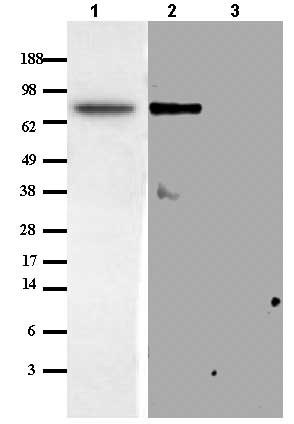
Immunoaffinity purified rabbit polyclonal antibody. Recognizes the ~75 kDa matriptase protein.
Recognizes the ~75 kDa matriptase protein in MCF-7 cells.
This Anti-Matriptase/MT-SP1 Rabbit pAb is validated for use in Immunoblotting, Immunoprecipitation for the detection of Matriptase/MT-SP1.

Immunogen

Human
a synthetic peptide corresponding to amino acids near the C-terminus of human matriptase

Other Notes

Antibody should be titrated for optimal results in individual systems.
Santin, A.D., et al. 2003. Cancer98, 1898.
Takeuchi, T., et al. 2000. J. Biol. Chem.275, 26333.
Lin, C.Y., et al. 1999. J. Biol. Chem.274, 18231.
Takeuchi, T., et al. 1999. Proc. Natl. Acad. Sci. USA96, 11054.

Packaging

Please refer to vial label for lot-specific concentration.

Physical form

In Tris-citrate/phosphate buffer, pH 7.0-8.0.

Preparation Note

Following initial use, aliquot and freeze (-20°C) for long-term storage. Avoid freeze/thaw cycles.

Legal Information

CALBIOCHEM is a registered trademark of Merck KGaA, Darmstadt, Germany

¿No encuentra el producto adecuado?  

Pruebe nuestro Herramienta de selección de productos.

Clase de almacenamiento

10 - Combustible liquids

wgk

WGK 1

flash_point_f

Not applicable

flash_point_c

Not applicable


Certificados de análisis (COA)

Busque Certificados de análisis (COA) introduciendo el número de lote del producto. Los números de lote se encuentran en la etiqueta del producto después de las palabras «Lot» o «Batch»

¿Ya tiene este producto?

Encuentre la documentación para los productos que ha comprado recientemente en la Biblioteca de documentos.

Visite la Librería de documentos

Sine Godiksen et al.
PloS one, 8(10), e77146-e77146 (2013-11-10)
Matriptase is a member of the family of type II transmembrane serine proteases that is essential for development and maintenance of several epithelial tissues. Matriptase is synthesized as a single-chain zymogen precursor that is processed into a two-chain disulfide-linked form
Jennifer M Milner et al.
Arthritis and rheumatism, 62(7), 1955-1966 (2010-05-28)
Increasing evidence implicates serine proteinases in pathologic tissue turnover. The aim of this study was to assess the role of the transmembrane serine proteinase matriptase in cartilage destruction in osteoarthritis (OA). Serine proteinase gene expression in femoral head cartilage obtained
Sine Godiksen et al.
The Biochemical journal, 413(2), 251-259 (2008-04-12)
HAI-1 [HGF (hepatocyte growth factor) activator inhibitor-1] is a Kunitz-type transmembrane serine protease inhibitor that forms inhibitor complexes with the trypsin-like serine protease, matriptase. HAI-1 is essential for mouse placental development and embryo survival and together with matriptase it is
Erik W Martin et al.
Oncotarget, 6(32), 33534-33553 (2015-09-24)
The membrane-anchored serine proteases are a unique group of trypsin-like serine proteases that are tethered to the cell surface via transmembrane domains or glycosyl-phosphatidylinositol-anchors. Overexpressed in tumors, with pro-tumorigenic properties, they are attractive targets for protease-activated prodrug-like anti-tumor therapies. Here
Ke-Hung Tsui et al.
Journal of molecular endocrinology, 49(2), 153-163 (2012-08-09)
Growth differentiation factor-15 (GDF15), a member of the transforming growth factor-β superfamily, is associated with human cancer progress. We evaluated the role GDF15 plays in tumorigenesis of prostate carcinoma PC-3 cells. Results from real-time RT-PCR and ELISA revealed that expression

Nuestro equipo de científicos tiene experiencia en todas las áreas de investigación: Ciencias de la vida, Ciencia de los materiales, Síntesis química, Cromatografía, Analítica y muchas otras.

Póngase en contacto con el Servicio técnico