
ST1042

Anti-PKD2 Rabbit pAb
liquid, Calbiochem®
Sinónimos:
Anti-Protein Kinase D2
Iniciar sesión para ver los precios por organización y contrato.
Seleccione un Tamaño
Cambiar Vistas
Acerca de este artículo
NACRES:
NA.41
UNSPSC Code:
12352203
Clone:
polyclonal
Species reactivity:
human
Application:
—
Citations:
5
Servicio técnico
¿Necesita ayuda? Nuestro equipo de científicos experimentados está aquí para ayudarle.
Permítanos ayudarlebiological source
rabbit
Quality Level
antibody form
affinity isolated antibody
antibody product type
primary antibodies
clone
polyclonal
form
liquid
contains
≤0.1% sodium azide as preservative
species reactivity
human
manufacturer/tradename
Calbiochem®
storage condition
OK to freeze
dilution
(Immunoblotting (1:500-1:5000)
Immunoprecipitation (1-4 µg/mg lysate))
isotype
IgG
shipped in
wet ice
storage temp.
2-8°C
target post-translational modification
unmodified
Gene Information
human ... PKD2(5311)
General description
Immunoaffinity purified rabbit polyclonal antibody. Recognizes the ~105 kDa PKD2 protein.
Recognizes the ~105 kDa PKD2 protein in HEK293 cells.
This Anti-PKD2 Rabbit pAb is validated for use in Immunoblotting, Immunoprecipitation for the detection of PKD2.
Immunogen
Human
a synthetic peptide corresponding to amino acids near the C-terminus of human PKD2
Application
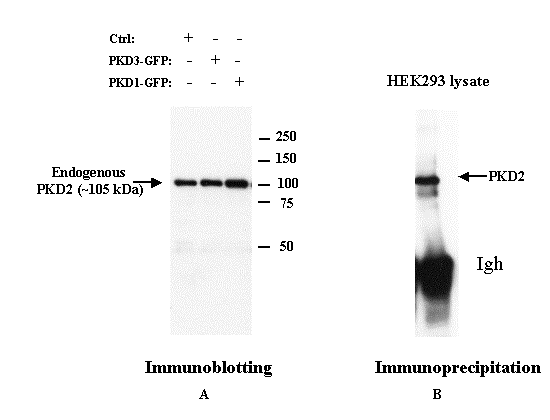
Immunoblotting (1:500-1:5000)
Immunoprecipitation (1-4 g/mg lysate)
Packaging
Please refer to vial label for lot-specific concentration.
Physical form
In PBS.
Preparation Note
Following initial use, aliquot and freeze (-20°C) for long-term storage. Avoid freeze/thaw.
Analysis Note
Positive Control
HEK 293 cells
HEK 293 cells
Other Notes
Rey, O., et al. 2003. Biochem. Biophys. Res. Commun.302, 817.
Sturany, S., et al. 2002. J. Biol. Chem.277, 29431.
Sturany, S., et al. 2001. J. Biol. Chem.276, 3310.
Sturany, S., et al. 2002. J. Biol. Chem.277, 29431.
Sturany, S., et al. 2001. J. Biol. Chem.276, 3310.
This antibody does not cross-react with PKD1 or PKD3. Antibody should be titrated for optimal use in individual systems.
Legal Information
CALBIOCHEM is a registered trademark of Merck KGaA, Darmstadt, Germany
Disclaimer
Toxicity: Highly Toxic (H)
Still not finding the right product?
Pruebe nuestra Herramienta de selección de productos para limitar sus opciones
Clase de almacenamiento
12 - Non Combustible Liquids
wgk
nwg
flash_point_f
Not applicable
flash_point_c
Not applicable
Certificados de análisis (COA)
Busque Certificados de análisis (COA) introduciendo el número de lote del producto. Los números de lote se encuentran en la etiqueta del producto después de las palabras «Lot» o «Batch»
¿Ya tiene este producto?
Encuentre la documentación para los productos que ha comprado recientemente en la Biblioteca de documentos.
Clara Aicart-Ramos et al.
The Journal of biological chemistry, 291(45), 23516-23531 (2016-09-25)
Protein kinase D (PKD) isoforms are protein kinase C effectors in signaling pathways regulated by diacylglycerol. Important physiological processes (including secretion, immune responses, motility, and transcription) are placed under diacylglycerol control by the distinctive substrate specificity and subcellular distribution of
Jianfen Guo et al.
The Journal of biological chemistry, 286(8), 6500-6509 (2010-12-16)
Protein kinase D (PKD) exists as a family of structurally related enzymes that are activated through similar phosphorylation-dependent mechanisms involving protein kinase C (PKC). While individual PKD isoforms could in theory mediate distinct biological functions, previous studies identify a high
Tim Eiseler et al.
The Journal of biological chemistry, 291(1), 462-477 (2015-10-29)
Vesicle formation and fission are tightly regulated at the trans-Golgi network (TGN) during constitutive secretion. Two major protein families regulate these processes: members of the adenosyl-ribosylation factor family of small G-proteins (ARFs) and the protein kinase D (PKD) family of