
Analysis of Four Aromatic Carboxylic Acids using Different Phosphorylcholine Type HILIC Columns and UV Detection
Section Overview
Introduction
Aromatic carboxylic acids are characterized by the presence of an aromatic ring covalently bonded to a carboxylic acid functional group. The carboxylic acid moiety contributes significantly to the overall polarity of these compounds. Due to their inherent polarity, aromatic carboxylic acids can be effectively separated using hydrophilic interaction liquid chromatography (HILIC) mode in high-performance liquid chromatography (HPLC).
The objective of this study is to assess and compare the separation efficiency of four aromatic carboxylic acids (Figure 1) using a fully porous particle (FPP) ZIC®-cHILIC column and a newly developed superficially porous particle (SPP) ZIC®-cHILIC column (Figure 2). The compounds investigated were benzoic acid, 3-hydroxybenzoic acid, 3,4-dihydroxybenzoic acid (protocatechuic acid), and gallic acid. The ZIC®-cHILIC columns are characterized by a grafted zwitterionic poly(phosphorylcholine) modification of the stationary phase, which contributes to the chromatographic retention and separation of the analytes under investigation.
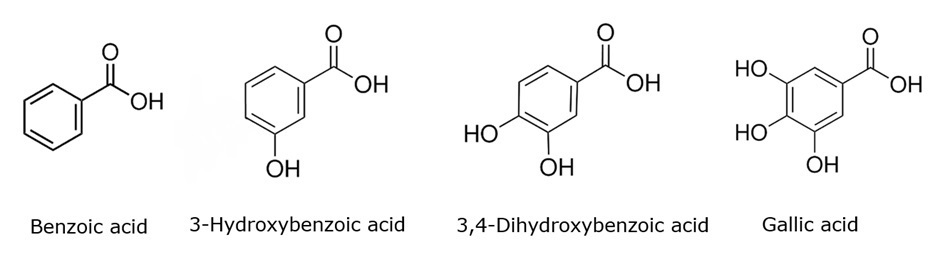
Figure 1.Aromatic carboxylic acids in this study.

Figure 2.Illustration of FPP SeQuant® ZIC®-cHILIC (left) and SPP Ascentis® Express ZIC®-cHILIC column material (right).
Experimental
A standard mixture containing four aromatic carboxylic acids at concentrations ranging from 74 to 109 µg/mL was prepared in the mobile phase (Table 1). The mixture was analyzed using a fully porous particle (FPP) SeQuant® ZIC®-cHILIC column and a superficially porous particle (SPP) Ascentis® Express ZIC®-cHILIC column. The chromatographic conditions are summarized in Table 1.
Results and Discussion
A standard mixture of four aromatic carboxylic acid was analyzed under identical conditions using a SeQuant ZIC®-cHILIC column (Figure 3, Table 2) and an Ascentis® Express ZIC®-cHILIC column (Figure 4, Table 3). The compounds eluted in order of increasing number of hydroxyl groups in the molecules. The elution order of the analytes remaines unchanged on both columns, as anticipated, reflecting the similar ZIC®-cHILIC surface chemistry.
Using the superficially porous particle (SPP) Ascentis® Express ZIC®-cHILIC column resulted in a significant reduction in retention time (approximately 30-55%) and improved chromatographic performance. This improvement was demonstrated by an increase in separation efficiency (plate count ~1.4 to 2-fold). The higher separation efficiency resulted in peaks with greater heights, thereby improving analyte detectability.
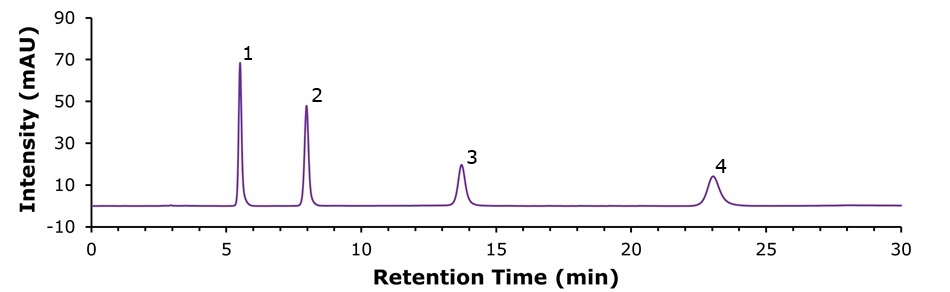
Figure 3.Separation of aromatic carboxylic acids on SeQuant® ZIC®-cHILIC 100 Å, 3 µm, 150 x 2.1 mm.
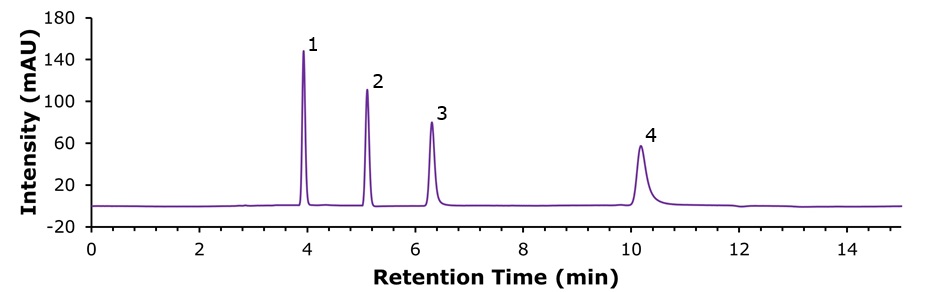
Figure 4.Separation of aromatic carboxylic acids on Ascentis® Express 160 Å ZIC®-cHILIC, 2.7 µm, 150 x 2.1mm.
Conclusion
The superficially porous particle Ascentis® Express ZIC®-cHILIC column was evaluated using a mixture of aromatic carboxylic acids and compared with a fully porous particle SeQuant® ZIC®-cHILIC column. Under the chromatographic conditions employed, the elution order remained consistent on both columns, as expected, owing to their similar ZIC®-cHILIC surface chemistry. The effect of particle architecture was evident in a significant reduction in retention time (approximately 30-55%) and a substantial increase in separation efficiency (plates), resulting in higher peak heights and improved analyte detectability/method sensitivity.