
Water for HPLC and UHPLC analysis
High-performance liquid chromatography (HPLC) is an established, reliable technique that has become the workhorse of many laboratories. Robust as it may be, HPLC is greatly affected by the quality of reagents used. One of the most important reagents in HPLC is water as it is often a major component of the HPLC mobile phase, especially in reversed-phase HPLC. Any impurity in water can directly affect HPLC results and instrument performance.
Overview of HPLC
HPLC is one of the most powerful tools in analytical chemistry. HPLC can separate, identify and quantify compounds over a wide range of polarity that are present in a wide variety of samples that can be dissolved in a liquid. The technique is sensitive and versatile as it can be applied to just about any sample type, such as pharmaceutical, environmental, clinical, forensic, food, nutraceutical, and industrial chemical samples.
Principle
In HPLC, separation is achieved through the distribution of the analytes between a stationary phase packed in a column and a liquid mobile phase that is pumped through the column. Components in the sample interact differently with the stationary phase and are separated based on their polarity, charge, size, or affinity. As molecules exit the column, they are detected by UV, fluorescence, mass spectrometry, or other detectors.
An HPLC system is composed of six basic modules that are connected by appropriate tubing and fittings: solvent reservoir(s), pump(s), injector, column, detector, and data system (Figure 1).
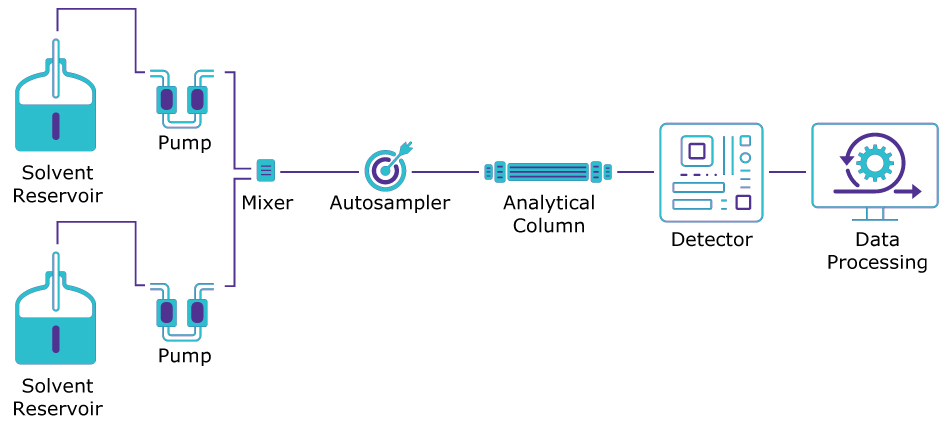
Figure 1.Schematic representation of an HPLC instrument
Ultra high-performance liquid chromatography (UHPLC)
Ultra high-performance liquid chromatography (UHPLC) utilizes smaller stationary phase particles (< 2 µm for UHPLC vs. 3-5 µm commonly used for HPLC) and higher pressures (up to 1500 bar for UHPLC vs. 300-600 for HPLC) to achieve faster analysis times, higher sensitivity, higher resolution, and better reproducibility than HPLC. In addition, UHPLC consumes less solvent per sample since equilibration and run times are shorter. This technique is the method of choice for high-throughput testing, for the analysis of complex samples, or when sample size is limited. It is also increasingly used in green chemistry, as it enables faster separations and lower solvent consumption compared to HPLC. Because of the need for higher pressure, UHPLC requires equipment capable of handling high system pressures.
Use this HPLC Method Transfer Calculator to determine the saving in run time and solvent consumption when transferring a method from HPLC to UHPLC conditions.
HPLC separation modes
HPLC separations can be performed based on the sample’s physico-chemical characteristics:
Normal phase chromatography (NP-HPLC)
In normal-phase HPLC, the stationary phase is polar, e.g., silica, and the mobile phases used are relatively non-polar (e.g., hexane, ethyl acetate). This classical mode of chromatography is commonly used to separate natural products, lipids, sugars and other polar compounds. In this chromatographic mode, water is generally not used.
Reversed phase chromatography (RP-HPLC)
Reversed-phase HPLC is the opposite of normal phase. It is more common than normal-phase, accounting for over 75% of separations. In reversed phase HPLC, the column is packed with hydrophobic particles, for example a C18 bonded silica. The mobile phase is any miscible combination of water (or water modified with acid or base, or buffers) and an organic solvent like methanol and acetonitrile. This technique is very versatile and is widely used for separating nonpolar or moderately polar compounds, such as small drug molecules, peptides, nucleotides (DNA/RNA fragments), pesticides or preservatives.
Ion-exchange chromatography (IEX-HPLC)
Ion-exchange chromatography is a powerful technique used to separate charged molecules based on ionic interactions with the stationary phase. The stationary phase can be either cation-exchange or anion-exchange resins that have fixed charges and attract ions of opposite charge. The mobile phase is usually an aqueous solution or buffer. Separation depends on the strength of attraction of the analyte to the resin, which in turn is based on the charge and charge density of the analyte.
Size exclusion chromatography (SEC)
Size-exclusion chromatography, also called gel permeation chromatography, is a technique used to separate molecules based on their size in solution. The column contains porous beads (e.g. agarose) with a defined pore size. Because larger molecules can't enter the pores of the beads, they travel shorter distances and reach the detector before smaller molecules, which travel longer distances through the pores. This method is used to separate molecules such as proteins, polymers, virus particles or nanoparticles.
Affinity chromatography
Affinity chromatography is a very selective technique used to purify specific molecules from complex mixtures based on biological interactions. It can also be used for receptor studies. The column contains agarose beads coated with analyte-specific or group-specific affinity ligands. The analyte recognizes and binds to the ligand in a very specific manner. The target molecules are then eluted by changing the pH, ionic strength, or adding a competitive ligand.
Hydrophobic interaction chromatography (HIC)
HIC is used to purify proteins and protein complexes while maintaining their biological activity. Molecules are separated based on their hydrophobicity. The sample is applied in a high-salt buffer and molecules are eluted by gradually decreasing the salt concentration. It separates analytes based on the degree of interaction between hydrophobic analyte moieties and hydrophobic stationary phase ligands.
Impact of water contaminants on HPLC
One of the most common problems in HPLC is related to the quality of solvents/mobile phase. (Find tips and tricks in this article.) Water is often a major component of HPLC mobile phase, especially in reversed-phase HPLC, therefore it must be carefully selected. It is also used as a blank, for sample preparation and to prepare standard curves.
Water contaminants could affect HPLC analyses or HPLC instruments in several ways.
Organics
Organic contamination of the water used in HPLC may affect chromatographic separations different ways:
They may cause noisy or drifting baselines, or co-elute with compounds of interest, making identification and quantification more difficult. As a result, the sensitivity of an analytical chromatography method can be reduced by the presence of organics in the water used for chromatographic separations.
Organics may accumulate at the head of the column, then elute as contaminants or ghost peak(s).
If the level of organic contamination is very high, it may cause a shift in retention time, distorted peak shapes, and peak tailing. This would lead to a loss of resolution and cause difficult identification and quantification. It would also affect experimental reproducibility.
Accumulation of organic material in the column may cause mass transfer issues, resulting in a loss of resolution and ultimately a shorter column lifetime.
For all these reasons, it is critical to monitor accurately the level of organics in water used for HPLC applications and this can conveniently be performed by a TOC monitor or a TOC indicator.1
Particles
Particles may damage the pump and injector. They could also plug the column and frits, causing an increase in back pressure. Particulates may also behave as a secondary solid phase which could bind sample constituents.
The effect of particles becomes more significant in UHPLC, with its smaller particle sizes, lower interstitial void volumes, decreased column diameters, and higher flow rates. Columns filled with very small particles are more susceptible to premature plugging by particulates compared to their HPLC column counterparts with larger particles.
Colloids
Colloids may adsorb irreversibly on the stationary phase, thereby losing its original separation efficiency of the column.
Bacteria
Bacteria may invade columns and frits and release organic byproducts (see effects of organic contamination).
Ions
Ion contamination may also affect chromatographic separations. A modification of the ionic strength of the solution may affect some separations, and if the ionic contaminant is UV-absorbing ions (e.g., nitrates, nitrites), it will come out as peak and make data analysis difficult.
Study: Importance of water quality for reproducible UHPLC analysis
In UHPLC, water is used for sample dilution, standard solutions and mobile phase preparation. Using low-quality water for UHPLC may have immediate and long-term negative effects on data quality and system performance. Organic contaminants are the impurities that may affect the quality of UHPLC chromatograms the most, and cause ghost peaks, noisy baselines or poor reproducibility. They may also cause gradual changes in retention time or loss of resolution.
To demonstrate that Milli-Q® ultrapure water is suitable for UHPLC analyses, a mixture of seven compounds was repeatedly analyzed by gradient elution (from 80% water / 20% acetonitrile to 10% water / 90% acetonitrile in 3 min, then isocratic hold for 1 min, then back to initial conditions).
A Milli-Q® pure and ultrapure system similar to the Milli-Q® IQ 7003 ultrapure water system, fitted with a Millipak® final filter, was used.
Across 600 consecutive injections, stable retention times, peak areas, and shapes were observed, indicating the ultrapure water did not introduce detectable organic contaminants. Figure 2 illustrates this robustness by comparing chromatograms from the 1st run and the 600th run, which are nearly identical.
These results confirm that freshly purified Milli-Q® ultrapure water helps to ensure reliable and reproducible UHPLC performance.2
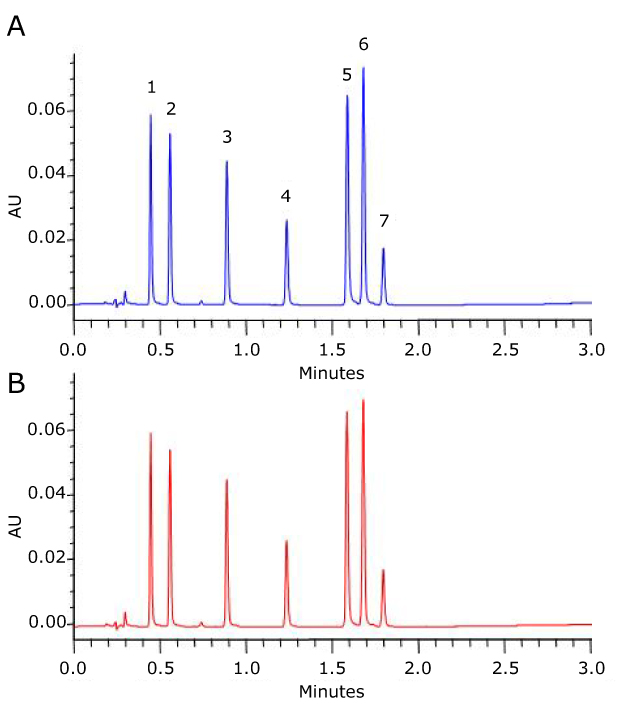
Figure 2. UHPLC chromatograms of a mixture of seven compounds at 254 nm. A: first run; B: 600th run. (1: 2-acetyl furan, 2: acetanilide, 3: acetophenone, 4: propiophenone, 5: butylparaben, 6: benzophenone and 7: valerophenone)
Water purity for HPLC
Freshly purified ultrapure (Type 1) water with a TOC below 5 ppb, indicating low organic contamination, a resistivity of 18.2 MΩ.cm, indicating very low ionic contaminants, and 0.22 µm filtration to control particulates and bacteria is recommended for HPLC and UHPLC analysis. Choosing a water purification system with a built-in TOC monitor or indicator ensures that the water remains free of organic contaminants that could interfere with the analysis and compromise data accuracy.
A range of water purification solutions is available for scientists working with HPLC or UHPLC.
Select and configure your optimal water purification system for your HPLC applications or request support from a lab water solution expert.