Accéder au contenu
Merck

OP15

Anti-c-ErbB2/c-Neu (Ab-3) Mouse mAb (3B5)

liquid, clone 3B5, Calbiochem®

Synonyme(s) :

Anti-HER2, Anti-c-Neu, Anti-ErbB2, Anti-Erythroblastosis Virus

Se connecter pour consulter les tarifs organisationnels et contractuels.

Sélectionner une taille de conditionnement

Changer de vue

A propos de cet article

NACRES:
NA.43
UNSPSC Code:
12352203
Clone:
3B5, monoclonal
Species reactivity:
human, mouse
Application:
Citations:
38
Service technique
Besoin d'aide ? Notre équipe de scientifiques expérimentés est là pour vous.
Laissez-nous vous aider


biological source

mouse

Quality Level

antibody form

purified antibody

antibody product type

primary antibodies

clone

3B5, monoclonal

form

liquid

contains

≤0.1% sodium azide as preservative

species reactivity

human, mouse

manufacturer/tradename

Calbiochem®

storage condition

do not freeze

dilution

(Frozen Sections (2.5 µg/mL)
Immunoblotting (2-3 µg/mL,
Immunofluorescence (2.5 µg/mL)
Immunoprecipitation (1 µg/sample,
Paraffin Sections (2.5 µg/mL, pressure cooker, heat or trypsin pre-treatment required, )

isotype

IgG1

shipped in

wet ice

storage temp.

2-8°C

target post-translational modification

unmodified

Gene Information

human ... ERBB2(2064)

General description

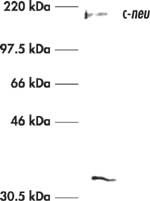
Anti-c-ErbB2/c-Neu (Ab-3), mouse monoclonal, clone 3B5, recognizes the ~185 kDa c-ErbB2/c-Neu protein in HEK293 cells. It is validated for WB, IF, IP, and IHC on frozen and paraffin sections.
Purified mouse monoclonal antibody generated by immunizing BALB/c mice with the specified immunogen and fusing splenocytes with Sp2/0.Ag14 cells (see application references). Recognizes the ~185 kDa c-Erb2/c-Neu protein.
Recognizes the ~185 kDa c-ErbB2/c-Neu protein in HEK293 cells.

Immunogen

Human
a synthetic peptide (TAENPEYLGLDVPV) corresponding to amino acids 1242-1255 from the C-terminal domain of human c-ErbB2/c-Neu

Application


Frozen Sections (2.5 g/ml)
Immunoblotting (2-3 g/ml, see application references)
Immunofluorescence (2.5 g/ml)
Immunoprecipitation (1 g/sample, see application references)
Paraffin Sections (2.5 g/ml, pressure cooker, heat or trypsin pre-treatment required, see application references)

Packaging

Please refer to vial label for lot-specific concentration.

Physical form

In 0.05 M sodium phosphate buffer, 0.2% gelatin.

Analysis Note

Negative Control
HepG2 cells or normal skin
Positive Control
SK-BR-3 cells or breast carcinoma tissue

Other Notes

For paraffin sections, we recommend pre-treating with a pressure cooker, but trypsin and heat will also work well. Including 0.05% saponin during staining of paraffin sections may help reduce background. In one study ductal carcinomas in situ displaying large-cell, comedo growth type, were stained while none of 16 ductal carcinomas in situ of small-cell, papillary, or cribriform growth type were stained by this antibody. Antibody should be titrated for optimal results in individual systems.
Mamcs, J.R., et al. 1994. Ann. Surg.219, 332.
Tetu, B., et al. 1994. Cancer73, 2359.
DiFiore, P.P., et al. 1987. Science237, 178.
Slamon, D.J., et al. 1987. Science235, 177.
Varley, J.M., et al. 1987. Oncogene1, 423.
Bargmann, C.I., et al. 1986. Nature319, 226.
Yamamoto, T., et al. 1986. Nature319, 230.
Blick, M., et al. 1984. Blood64, 1234.
Schwab, M., et al. 1984. Cold Spring Harbor Laboratory 2, 215.

Legal Information

CALBIOCHEM is a registered trademark of Merck KGaA, Darmstadt, Germany

Disclaimer

Toxicity: Standard Handling (A)


Still not finding the right product?

Explore all of our products under

ou

Essayez notre Outil de sélection de produits pour affiner vos choix.


Classe de stockage

10 - Combustible liquids

wgk

nwg

flash_point_f

Not applicable

flash_point_c

Not applicable


Certificats d'analyse (COA)

Recherchez un Certificats d'analyse (COA) en saisissant le numéro de lot du produit. Les numéros de lot figurent sur l'étiquette du produit après les mots "Lot" ou "Batch".

Déjà en possession de ce produit ?

Retrouvez la documentation relative aux produits que vous avez récemment achetés dans la Bibliothèque de documents.

Consulter la Bibliothèque de documents


Peter Nagy et al.
Journal of cell science, 115(Pt 22), 4251-4262 (2002-10-12)
The ErbB family of transmembrane receptor tyrosine kinases plays an important role in the pathogenesis of many cancers. The four members of the family, ErbB1-4, form various homo- and heterodimers during the course of signal transduction. A second hierarchical level
Zongming Liu et al.
Scientific reports, 9(1), 622-622 (2019-01-27)
Breast cancer brain metastasis (BCBM) remains a major clinical problem. Approximately 10-16% of patients with breast cancer develop brain metastases (BCBM). However, no systemic therapy has gained regulatory approval for the specific treatment of BCBM and this remains an area
Edwin W Lai et al.
Cell cycle (Georgetown, Tex.), 6(15), 1946-1950 (2007-08-03)
Pheochromocytoma (PCC) is a rare catecholamine-producing tumor that arises from the adrenal medulla and is often familial. The genetic basis for familial PCC involves mutations of RET, VHL, SHDx or NF-1 in more than 20% of cases. Additional genes may