
OP43

Anti-p53 (Ab-6) (Pantropic) Mouse mAb (DO-1)
liquid, clone DO-1, Calbiochem®
別名:
Anti-p53 Antibody, Mouse Anti-p53, p53 Detection Antibody
ログインで組織・契約価格をご覧ください。
サイズを選択してください
表示を変更する
この商品について
NACRES:
NA.43
UNSPSC Code:
12352203
Clone:
DO-1, monoclonal
Species reactivity:
feline, human
Application:
—
Citations:
172
biological source
mouse
Quality Segment
antibody form
purified antibody
antibody product type
primary antibodies
clone
DO-1, monoclonal
form
liquid
contains
≤0.1% sodium azide as preservative
species reactivity
feline, human
should not react with
mouse, rat
manufacturer/tradename
Calbiochem®
storage condition
do not freeze
dilution
(Frozen sections (1 µg/mL)
Immunoblotting (0.1-1 µg/mL)
Immunocytochemistry (1-2.5 µg/mL)
Immunoprecipitation (1 µg/mL)
Paraffin sections (1 µg/mL, pepsin, heat or pressure cooker pre-treatment required))
isotype
IgG2a
shipped in
wet ice
storage temp.
2-8°C
target post-translational modification
unmodified
Gene Information
human ... TP53(7157)
General description
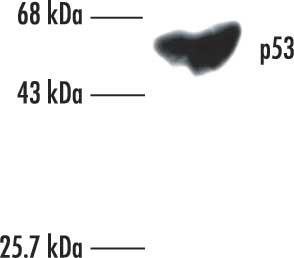
Purified mouse monoclonal antibody generated by immunizing BALB/c mice with the specified immunogen and fusing splenocytes with X63Ag8.653 mouse myeloma cells (see application references). Recognizes the ~53 kDa wild-type and mutant forms of p53.
Recognizes the ~53 kDa wild-type and mutant p53 protein in A431 cells and breast carcinoma tissue.
This Anti-p53 (Ab-6) (Pantropic) Mouse mAb (DO-1) is validated for use in Frozen sections, Immunoblotting, ICC, IP, Paraffin sections for the detection of p53 (Ab-6) (Pantropic).
Immunogen
Epitope: Within amino acids 21-25 of human p53
Human
wild type, recombinant, human p53
Application
Frozen sections (1 g/ml; see application references)
Immunoblotting (0.1-1 g/ml; see application references)
Immunocytochemistry (1-2.5 g/ml; see application references)
Immunoprecipitation (1 g/ml or use Cat. No. OP43A; see application references)
Paraffin sections (1 g/ml, pepsin, heat or pressure cooker pre-treatment required; see application references)
Packaging
Please refer to vial label for lot-specific concentration.
Physical form
In 0.05 M sodium phosphate buffer, 0.2% gelatin.
Analysis Note
Negative Control
SK-OV-3 cells or normal skin tissue
SK-OV-3 cells or normal skin tissue
Positive Control
A431 cells or breast carcinoma tissue
A431 cells or breast carcinoma tissue
Other Notes
El-Deiry, W.S., et al. 1994. Cancer Res.54, 1169.
Greenblatt, M.S., et al. 1994. Cancer Res.54, 4855.
Legros, Y., et al. 1994. Oncogene9, 2071.
Barak, Y., et al. 1993. EMBO J.12, 461.
Kastan, M.B., et al. 1992. Cell71, 587.
Kuerbitz, S.J. 1992. Proc. Natl. Acad. Sci. USA89, 7491.
Lane, D.P. 1992. Nature358, 15.
Vojtesek, B., et al. 1992. J. Immunol. Meth.151, 237.
Kastan, M.B., et al. 1991 Cancer Res.51, 6304.
Greenblatt, M.S., et al. 1994. Cancer Res.54, 4855.
Legros, Y., et al. 1994. Oncogene9, 2071.
Barak, Y., et al. 1993. EMBO J.12, 461.
Kastan, M.B., et al. 1992. Cell71, 587.
Kuerbitz, S.J. 1992. Proc. Natl. Acad. Sci. USA89, 7491.
Lane, D.P. 1992. Nature358, 15.
Vojtesek, B., et al. 1992. J. Immunol. Meth.151, 237.
Kastan, M.B., et al. 1991 Cancer Res.51, 6304.
Recognizes both mutant and wild-type p53 under denaturing and non-denaturing conditions. This antibody reacts weakly with rodent p53; we do not recommend it for rodent samples. For gel shift assay, use Cat. No. OP43L resuspended in 100 μl of buffer. Wild-type p53 has a short half life and is present in low amounts in cells. For immunoprecipitation increasing the amount of sample and labeling with 35S-Met for less than or equal to 1 h will aid in visualizing wild-type p53. Antibody should be titrated for optimal results in individual systems.
Legal Information
CALBIOCHEM is a registered trademark of Merck KGaA, Darmstadt, Germany
Disclaimer
Toxicity: Standard Handling (A)
Still not finding the right product?
Explore all of our products under Anti-p53 (Ab-6) (Pantropic) Mouse mAb (DO-1)
— または —
製品選択ツール}で選択肢を絞り込んでください。
保管分類
12 - Non Combustible Liquids
引火点 (F)
Not applicable
引火点(°C)
Not applicable