
PC130

Anti-Rad51 (Ab-1) Rabbit pAb
liquid, Calbiochem®
동의어(들):
Anti-Rad51, Rabbit Anti-Rad51, Rad51 Detection Antibody
조직 및 계약 가격을 보려면 로그인를 클릭합니다.
크기 선택
제품정보 (DICE 배송 시 비용 별도)
NACRES:
NA.41
UNSPSC Code:
12352203
Clone:
polyclonal
Species reactivity:
mouse, rat, human
Application:
—
Citations:
213
biological source
rabbit
antibody form
affinity isolated antibody
antibody product type
primary antibodies
clone
polyclonal
form
liquid
contains
≤0.1% sodium azide as preservative
species reactivity
mouse, rat, human
manufacturer/tradename
Calbiochem®
storage condition
OK to freeze
dilution
(Immunoblotting (1:2500)
Immunoprecipitation (40 µL/500µg total protein from lysate)
Immunocytochemistry (1:500))
isotype
IgG
shipped in
wet ice
Quality Level
Gene Information
human ... RAD51(5888)
storage temp.
2-8°C
target post-translational modification
unmodified
General description
Affinity purified rabbit polyclonal antibody. Recognizes the ~43 kDa Rad51 protein.
Recognizes the ~43 kDa Rad51 protein in ovarian tissue.
The bacterial RecA and the yeast RAD51 proteins are involved in homologous recombination and DNA repair. The human RAD51 protein is the homologue of these two proteins. While the modular structure of these proteins is conserved and the homology is very strong with the bacterial protein there are functional differences seen with RAD51 including an ATP hydrolysis rate 1/10 that seen with RecA. Although RAD51 is a nuclear protein and is largely absent from the cytoplasm and nucleoli, the protein lacks a nuclear localization signal and requires other proteins in a complex to be translocated into the nucleus. Treatment of cells with DNA synthesis inducing agents will cause an increase in the levels of RAD51 protein which then undergo a shift in distribution becoming focal in nature. This focal distribution may be blocked by inhibitors of transcription. RAD51 can be shown to interact directly with the chromosomes and during the process of meiosis, its distribution of RAD51 undergoes dynamic change. RAD51 has been shown to interact with a wide variety of different proteins that include the wild-type form of p53, BRCA2, and RAD52, which specifically modulates its activity.
This Anti-Rad51 (Ab-1) Rabbit pAb is validated for use in Immunoblotting, Immunoprecipitation, Immunocytochemistry for the detection of Rad51 (Ab-1).
Immunogen
Human
recombinant, human Rad51
Application
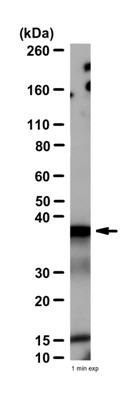
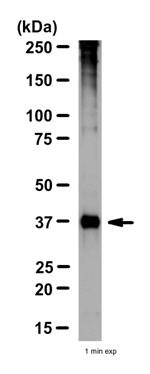
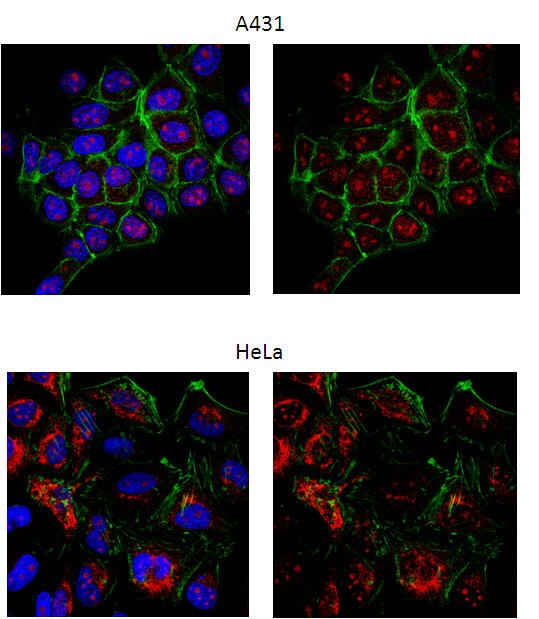
Immunoblotting (1:2500)
Immunoprecipitation (40 l/500g total protein from lysate)
Immunocytochemistry (1:500)
Physical form
In 150 mM NaCl, 100 mM Tris-Glycine, pH 7.4
Preparation Note
Following initial thaw, aliquot and freeze (-20°C).
Analysis Note
Positive Control
A431 cells, HeLa cells
A431 cells, HeLa cells
Other Notes
Brendel, V., et al. 1997. J. Mol. Evol.44, 528.
Boulikas, T., et al. 1997. Anticancer Res.17, 843.
Gupta, R.C., et al. 1997. Proc. Natl. Acad. Sci. USA94, 463.
Mizuta, R., et al. 1997. Proc. Natl. Acad. Sci. USA 94, 6927.
Sharan, S.K., et al. 1997. Nature386, 304.
Li, M.J., et al. 1996. Proc. Natl. Acad. Sci. USA93, 10222.
Shen, Z., et al. 1996. J. Biol. Chem.271, 148.
Sturzbecher, H.W., et al. 1996. EMBO J. 15, 1992.
Tashiro, S., et al. 1996. Oncogene12, 2165.
Ashley, T., et al. 1995. Chromosoma104, 19.
Haaf, T., et al. 1995. Proc. Natl. Acad. Sci. USA92, 2298.
Boulikas, T., et al. 1997. Anticancer Res.17, 843.
Gupta, R.C., et al. 1997. Proc. Natl. Acad. Sci. USA94, 463.
Mizuta, R., et al. 1997. Proc. Natl. Acad. Sci. USA 94, 6927.
Sharan, S.K., et al. 1997. Nature386, 304.
Li, M.J., et al. 1996. Proc. Natl. Acad. Sci. USA93, 10222.
Shen, Z., et al. 1996. J. Biol. Chem.271, 148.
Sturzbecher, H.W., et al. 1996. EMBO J. 15, 1992.
Tashiro, S., et al. 1996. Oncogene12, 2165.
Ashley, T., et al. 1995. Chromosoma104, 19.
Haaf, T., et al. 1995. Proc. Natl. Acad. Sci. USA92, 2298.
Due to a high degree of sequence identity, this antibody is also expected to cross-react with bovine, equine, and canine RAD51. Antibody should be titrated for individual systems.
Legal Information
CALBIOCHEM is a registered trademark of Merck KGaA, Darmstadt, Germany
Disclaimer
Toxicity: Standard Handling (A)
적합한 제품을 찾을 수 없으신가요?
당사의 제품 선택기 도구.을(를) 시도해 보세요.
저장 등급
12 - Non Combustible Liquids
wgk
WGK 3
flash_point_f
Not applicable
flash_point_c
Not applicable
시험 성적서(COA)
제품의 로트/배치 번호를 입력하여 시험 성적서(COA)을 검색하십시오. 로트 및 배치 번호는 제품 라벨에 있는 ‘로트’ 또는 ‘배치’라는 용어 뒤에서 찾을 수 있습니다.
Roberto de la Fuente et al.
PLoS genetics, 3(11), e198-e198 (2007-11-07)
In most eutherian mammals, sex chromosomes synapse and recombine during male meiosis in a small region called pseudoautosomal region. However in some species sex chromosomes do not synapse, and how these chromosomes manage to ensure their proper segregation is under
Karen J Ouyang et al.
PLoS biology, 7(12), e1000252-e1000252 (2009-12-04)
The gene mutated in Bloom's syndrome, BLM, is important in the repair of damaged replication forks, and it has both pro- and anti-recombinogenic roles in homologous recombination (HR). At damaged forks, BLM interacts with RAD51 recombinase, the essential enzyme in
Nuria Coll-Bonfill et al.
Proteomics, 20(5-6), e1800406-e1800406 (2019-12-14)
Hutchinson Gilford progeria syndrome (HGPS) is a devastating accelerated aging disease caused by LMNA gene mutation. The truncated lamin A protein produced "progerin" has a dominant toxic effect in cells, causing disruption of nuclear architecture and chromatin structure, genomic instability
Yue Sun et al.
Cell death & disease, 11(4), 292-292 (2020-04-29)
Genome instability is the fundamental hallmark of malignant tumors. Tumor suppressors often play a role in maintaining genome stability. Our previous genetic screen identified inositol polyphosphate 4-phosphatase type B (INPP4B), primarily hydrolyzing phosphatidylinositol 3, 4-disphosphate, is a potential tumor suppressor
Non-specific chemical inhibition of the Fanconi anemia pathway sensitizes cancer cells to cisplatin.
Céline Jacquemont et al.
Molecular cancer, 11, 26-26 (2012-04-28)
Platinum compounds such as cisplatin and carboplatin are DNA crosslinking agents widely used for cancer chemotherapy. However, the effectiveness of platinum compounds is often tempered by the acquisition of cellular drug resistance. Until now, no pharmacological approach has successfully overcome
국제 무역 품목 번호
| SKU | GTIN |
|---|---|
| PC130-100ULCN | 07790788053949 |
자사의 과학자팀은 생명 과학, 재료 과학, 화학 합성, 크로마토그래피, 분석 및 기타 많은 영역을 포함한 모든 과학 분야에 경험이 있습니다..
고객지원팀으로 연락바랍니다.