Millipore Sigma Vibrant Logo
Attention: We have moved. Merck Millipore products are no longer available for purchase on MerckMillipore.com.Learn More

05-631 Anti-IKKγ Antibody

View Products on Sigmaaldrich.com
05-631
100 µg  
Purchase on Sigma-Aldrich

Special Offers

Overview

Replacement Information

Key Spec Table

Species ReactivityKey ApplicationsHostFormatAntibody Type
H, MWBMPurifiedMonoclonal Antibody
Description
Catalogue Number05-631
Brand Family Upstate
Trade Name
  • Upstate
DescriptionAnti-IKKγ Antibody
OverviewIKKγ/IKK3 is also known as NEMO, FIP-3 and IKKAP-1
References
Product Information
FormatPurified
PresentationPBS, pH 7.4, containing 0.05% sodium azide
Quality LevelMQ100
Applications
ApplicationAnti-IKKγ Antibody is an antibody against IKKγ for use in WB.
Key Applications
  • Western Blotting
Biological Information
ImmunogenHis-tagged, full-length human IKKgamma/IKK3
HostMouse
SpecificityIKKγ/IKK3
IsotypeIgG
Species Reactivity
  • Human
  • Mouse
Antibody TypeMonoclonal Antibody
Entrez Gene Number
Entrez Gene SummaryFamilial incontinentia pigmenti (IP) is a genodermatosis that segregates as an X-linked dominant disorder and is usually lethal prenatally in males (The International Incontinentia Pigmenti Consortium, 2000 [PubMed 10839543]). In affected females it causes highly variable abnormalities of the skin, hair, nails, teeth, eyes, and central nervous system. The prominent skin signs occur in 4 classic cutaneous stages: perinatal inflammatory vesicles, verrucous patches, a distinctive pattern of hyperpigmentation, and dermal scarring. Cells expressing the mutated X chromosome are eliminated selectively around the time of birth, so females with IP exhibit extremely skewed X-inactivation. Familial incontinentia pigmenti is caused by mutations in the NEMO gene and is here referred to as IP2, or 'classical' incontinentia pigmenti. Sporadic incontinentia pigmenti, the so-called IP1, which maps to Xp11, is categorized as hypomelanosis of Ito (MIM 300337).[supplied by OMIM]
Gene Symbol
  • IKBKG
  • FIP3
  • IPD2
  • NEMO
  • IP2
  • Fip3p
  • IP1
  • IKKG
  • IKK-gamma
  • AMCBX1
  • FIP-3
  • IKKAP1
  • IP
Purification MethodProtein G Chromatography
UniProt Number
UniProt SummaryFUNCTION: SwissProt: Q9Y6K9 # Regulatory subunit part of the IKK-signalosome complex activation. Also considered to be a mediator for TAX activation of NF-kappa-B. Could be implicated in NF-kappa-B-mediated protection from cytokine toxicity.
SIZE: 419 amino acids; 48198 Da
SUBUNIT: Interacts preferentially with IKBKB/IKK-beta but also able to interact with CHUK/IKK-alpha, IKAP, RIP and MAP3K14/NIK. Found in a complex composed of NCOA2, NCOA3, CHUK/IKKA, IKBKB/IKKB and CREBBP. Interacts with COPS3, CYLD, NALP2, TRPC4AP and LRDD. Activated through binding to HTLV-1 Tax oncoprotein.
SUBCELLULAR LOCATION: Cytoplasm. Nucleus.
TISSUE SPECIFICITY: Heart, brain, placenta, lung, liver, skeletal muscle, kidney and pancreas.
DISEASE: SwissProt: Q9Y6K9 # Defects in IKBKG are the cause of X-linked anhidrotic ectodermal dysplasia with immunodeficiency (XL-EDA-ID) [MIM:300291]; also known as hypohidrotic ectodermal dysplasia with immunodeficiency (HED-ID). Ectodermal dysplasias (EDs) constitute a heterogeneous group of developmental disorders affecting tissues of ectodermal origin. EDs are characterized by abnormal development of two or more ectodermal structures such as hair, teeth, nails and sweat glands, with or without any additional clinical sign. Each combination of clinical features represents a different type of ectodermal dysplasia. XL-EDA-ID is characterized by absence of sweat glands, sparse scalp hair, rare conical teeth and immunological abnormalities resulting in severe infectious diseases. & Defects in IKBKG are the cause of anhidrotic ectodermal dysplasia with immunodeficiency, osteopetrosis and lymphedema (OL- EDA-ID) [MIM:300301]. & Defects in IKBKG are a cause of immunodeficiency without anhidrotic ectodermal dysplasia [MIM:300584]; also called isolated immunodeficiency or pure immunodeficiency. & Defects in IKBKG are the cause of susceptibility to X- linked familial atypical micobacteriosis type 1 (AMCBX1) [MIM:300636]; also known as X-linked disseminated atypical mycobacterial infection type 1 or X-linked susceptibility to mycobacterial disease type 1. AMCBX1 is the X-linked recessive form of mendelian susceptibility to mycobacterial disease (MSMD). MSMD is a congenital syndrome resulting in predisposition to clinical disease caused by weakly virulent mycobacterial species, such as bacillus Calmette-Guerin vaccines and non-tuberculous, environmental mycobacteria. Patients are also susceptible to the more virulent species Mycobacterium tuberculosis. & Defects in IKBKG are the cause of recurrent isolated invasive pneumococcal disease type 2 (IPD2) [MIM:300640]. Recurrent invasive pneumococcal disease (IPD) is defined as two episodes of IPD occurring at least 1 month apart, whether caused by the same or different serotypes or strains. Recurrent IPD occurs in at least 2% of patients in most series, making IPD the most important known risk factor for subsequent IPD. & Defects in IKBKG are the cause of familial incontinentia pigmenti type II (IP2) [MIM:308300]. IP2 is a X-linked dominant disease causing death in male fetuses. In heterozygous female, it is characterized by disturbance of skin pigmentation sometimes associated with a variety of malformations of the eye, nails, teeth, skeleton, heart, and central nervous system. The prominent skin signs occur in four classic cutaneous stages: perinatal inflammatory vesicles, verrucous patches, a distinctive pattern of hyperpigmentation and dermal scarring.
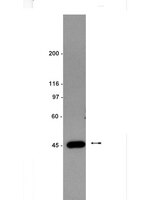
Molecular Weight48kDa
Physicochemical Information
Dimensions
Materials Information
Toxicological Information
Safety Information according to GHS
Safety Information
Product Usage Statements
Quality Assuranceroutinely evaluated by immunoblot on RIPA lysates from Jurkat cells
Usage Statement
  • Unless otherwise stated in our catalog or other company documentation accompanying the product(s), our products are intended for research use only and are not to be used for any other purpose, which includes but is not limited to, unauthorized commercial uses, in vitro diagnostic uses, ex vivo or in vivo therapeutic uses or any type of consumption or application to humans or animals.
Storage and Shipping Information
Storage Conditions2 years at -20°C
Packaging Information
Material Size100 µg
Transport Information
Supplemental Information
Specifications
Global Trade Item Number
Catalogue Number GTIN
05-631 04053252285967

Documentation

Anti-IKKγ Antibody MSDS

Title

Safety Data Sheet (SDS) 

Anti-IKKγ Antibody Certificates of Analysis

TitleLot Number
Anti-IKKγ/IKK3 (mouse monoclonal IgG1) 3134700
Anti-IKKγ/IKK3 (mouse monoclonal IgG1) - 4043507 4043507
Anti-IKKγ/IKK3 -2691208 2691208

References

Reference overviewApplicationPub Med ID
Oncoprotein Suppression of Tumor Necrosis Factor-induced NF{kappa}B Activation Is Independent of Raf-controlled Pathways
Hanson, J. L., et al
J Biol Chem, 278:34910-34917 (2003)  2003

Kinase Assay12851413 12851413