
Capillary Column Ferrule Selection and Installation

Section Overview
Introduction
To ensure a leak-tight seal, an ideal gas chromatography (GC) ferrule should accommodate column outside diameter (O.D.) variations, seal effectively with minimal torque, and resist sticking to the column or fittings. The proper selection of any GC ferrule depends on compatibility with the column material, operating temperature, connection requirements, and variations in column diameter. Our Supeltex® ferrules and CapSeal Bullet® ferrules deliver leak-free across a wide range of applications.
Choosing the Correct Ferrule I.D. for Capillary Columns
After selecting a ferrule material appropriate for the capillary column and application, the next step is to choose a ferrule size that matches the column. Before tightening, the ferrule should fit snugly around the column, as loose ferrules may crack or damage the column wall during tightening. This damage can lead to leaks or column breakage after repeated heating and cooling cycles.
Proper Ferrule Installation
Correct installation of the ferrule is critical to maintaining column performance and ensuring a reliable, leak-free connection. The following steps are recommended
- If sealed, cut the capillary column end squarely using a dedicated tool such as a Capillary Cleaving™ Tool (23740-U) or Shortix® Tubing Cutter (21386-U).
- Select a ferrule with an internal diameter that matches the column outer diameter.
- Keep the column end pointed towards the floor during cutting the end and while installing the nut and ferrule. This allows column fragments and ferrule particles to fall away from the column.
- Install the nut and ferrule onto the column according to the instrument manufacturer’s instructions.
- After installing the ferrule, remove potential debris by cutting approximately one inch from the column end. This step should be performed each time a ferrule is installed.
- Inspect the cut surface using a magnifier(e.g. EISCO-PH0502B, not available everywhere, or HS15092d) to ensure it is square and clean.
- Follow the instrument manufacturer’s specified insertion distances when positioning a fused silica column in the injector or detector port, as improper placement can adversely affect column performance.
- Insert the column into the inlet and detector ends, tighten fittings by hand, and use a wrench for final tightening while avoiding excessive force.
- Verify all connections using an electronic leak detector (GOW-MAC® Miniature Leak Detector, 110 V, 22807) to ensure the system is leak-free.
Choosing the Correct Ferrule and Nut Combination
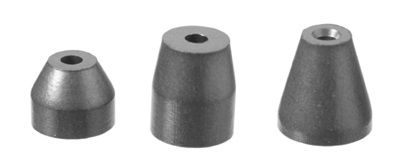
Representative ferrule designs: short, long, and general (left to right).
Ferrule Designs
Ferrules are available in different designs to ensure compatibility with specific GC fittings and nuts.
Short design ferrules fit:
- Original nuts supplied with Agilent GCs
Long design ferrules fit:
- MSD source nuts for Agilent GCs
- Original nuts supplied with PerkinElmer® GCs
- Original nuts supplied with Varian GCs
General purpose ferrules fit:
- Supelco® ferrule nut adapters for Agilent GCs
- 1/16 inch compression nuts for PerkinElmer® GCs
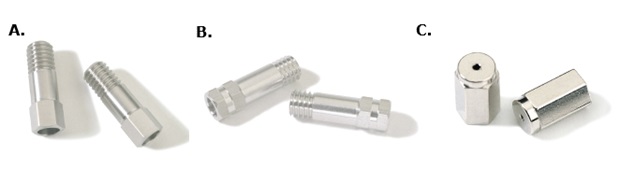
Ferrule Nuts
SilTite® Ferrules and SilTite® FingerTite® Ferrules
We offer two innovative metal ferrule systems for gas chromatography, SilTite® ferrules and SilTite® FingerTite® ferrules. Both the products represent significant improvements over traditional graphite and composite ferrules, providing better sealing and temperature tolerance, but differing in key design features and installation methods. This comparison highlights the essential differences between these two high-performance GC connection systems.
Table 7. SilTite® ferrules and SilTite® FingerTite® ferrules for capillary GC columns by size
Table 8. SilTite® nuts and SilTite® FingerTite® ferrule nuts
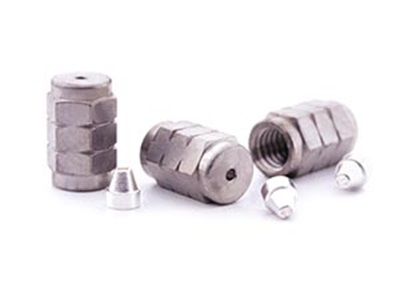
SilTite® metal nuts and ferrules.
Table 9. SilTite® FingerTite® kits and included components
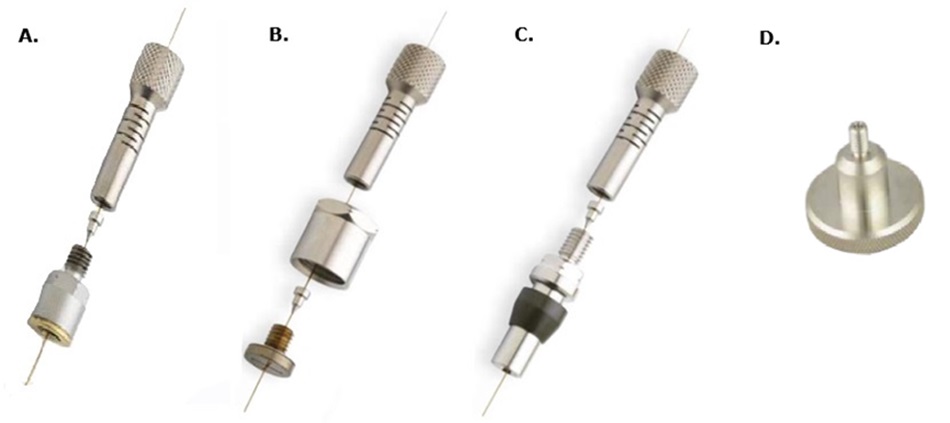
(A) SilTite® FingerTite® Generic Starter Kit on Fused Silica Tubing, (B) SilTite® FingerTite® Injector for Agilent, (C) SilTite® FingerTite® FID Adapter Instillation, (D) SilTite® FingerTite® Instillation Tool
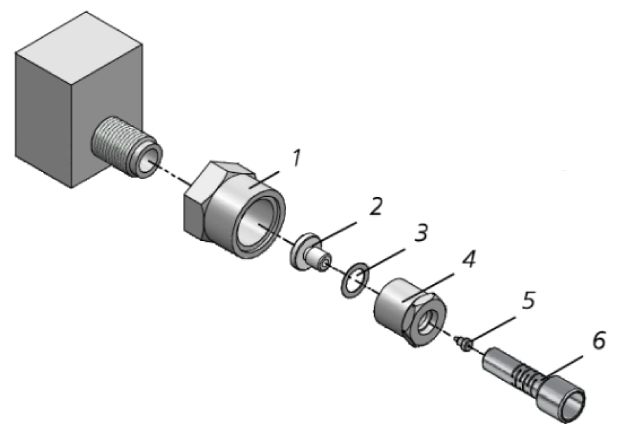
Figure 1.Exploded diagram of the injection port SilTite® FingerTite® assembly. (1) Original injector nut (not supplied) (2) Adapter-base seal injection port (3) base seal washer (4) nut injection port (5) 0.4 mm SilTite® FingerTite® ferrule (6) SilTite® FingerTite® nut.

Figure 2.Exploded diagram of the FID detector SilTite® FingerTite® assembly. (1) Adapter-FID port (2) 0.4 mm SilTite® FingerTite® ferrule (3) SilTite® FingerTite® nut (4) FID ferrule (GVF) (5) Nut FID
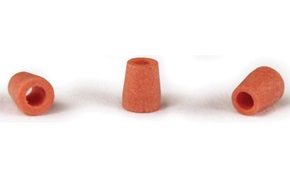
M-1 ferrule
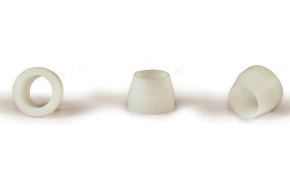
M-1P ferrule
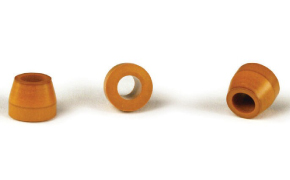
M-2 ferrule
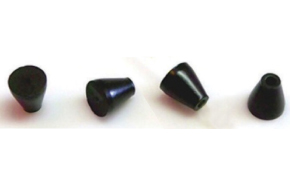
M-2A ferrule
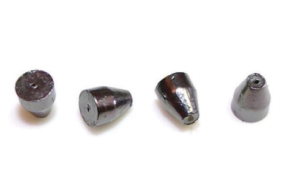
M-4 ferrule
Tips and Best Practices
- For oxygen-sensitive detectors such as MSD or ECD, always use non-porous ferrule materials like Vespel/Graphite or SilTite® metal ferrules.
- Vespel and Vespel/Graphite ferrules shrink upon heating and may require retightening after initial temperature cycles to prevent leaks.
- Precondition graphite-containing ferrules before use with sensitive detectors to minimize background signals.
- Replace ferrules when reinstalling a column rather than reusing existing ones.
- Metal ferrules provide the highest temperature stability.
For column selection, refer to the GC Capillary Column Selection Guide.
Conclusion
Selecting the appropriate ferrule for your analysis does not need to be complex. Following a straightforward selection approach can help reduce the risk of leaks and prevent issues such as ferrules becoming stuck in fittings. Proper ferrule selection and installation can save significant time and effort each time a new capillary GC column is installed.