Millipore Sigma Vibrant Logo

564702 Anti-SERCA2 ATPase Mouse mAb ( IID8)

564702
  
Retrieving price...
Price could not be retrieved
Minimum Quantity is a multiple of
Maximum Quantity is
Upon Order Completion More Information
You Saved ()
 
Request Pricing
Limited Availability
In Stock 
Discontinued
Limited Quantities Available
Availability to be confirmed
    Remaining : Will advise
      Remaining : Will advise
      Will advise
      Contact Customer Service
      Contact Customer Service


      Contact Customer Service

      Overview

      Replacement Information

      Key Spec Table

      Host
      M
      Description
      Overview

      This product has been discontinued.


      We are offering Anti-SERCA2 Antibody, clone IID8 (Cat. No. MAB2636) as a possible alternative. Please read the alternative product documentation carefully and contact technical service if you need additional information.


      Recognizes the ~100 kDa SERCA2 ATPase in type I (slow) skeletal and cardiac muscle. Recognizes rat SERCA2 ATPase only by immunohistochemistry. Also recognizes SERCA2 ATPase from rabbit stomach smooth muscle, porcine liver, and SERCA2b ATPase from the cerebrum and cerebellum of both rat and pig.
      Catalogue Number564702
      Brand Family Calbiochem®
      Application Data
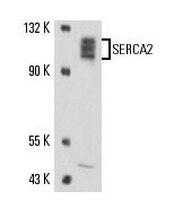
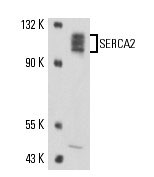
      Detection of canine SERCA2 ATPase by immunoblotting. Sample: Whole cell lysate from MDCK cells. Primary antibody: Anti-SERCA2 ATPase Mouse mAb (IID8) (Cat. No. 564702) (1:1000). Detection: chemiluminescence.
      References
      ReferencesSharp, A.H., et al. 1993. J. Neuroscience 13, 3051.
      Spencer, G.G., et al. 1991. Biochim. Biophys. Acta 1063, 15.
      Molnar, E., et al. 1990. Biochim. Biophys. Acta 1023, 147.
      Jorgensen, A.O., et al. 1988. Cell Motil. Cytoskeleton 9, 164.
      Product Information
      FormLiquid
      FormulationAscites diluted in PBS.
      Positive controlBrain tissue (cerebrum and cerebellum)
      Preservative≤0.1% sodium azide
      Applications
      Key Applications Immunoblotting (Western Blotting)
      Immunofluorescence
      Immunohistochemistry
      Application NotesImmunoblotting (≥ 1:2500)
      Immunofluorescence (≥ 1:500)
      Immunohistochemistry (see comments)
      Application CommentsDoes not distinguish between SERCA2a and SERCA2b. Has also been used to detect SERCA2b in the cerebrum and cerebellum of pigs and rat. In rats, the antibody works only in immunohistochemistry. Strongly labels the entire type I myofiber by immunofluorescence. Variables associated with assay conditions will dictate the proper working dilution.
      Biological Information
      Immunogenpurified canine cardiac sarcoplasmic reticulum
      ImmunogenCanine
      Clone IID8
      HostMouse
      IsotypeIgG₁
      Physicochemical Information
      Dimensions
      Materials Information
      Toxicological Information
      Safety Information according to GHS
      Safety Information
      Product Usage Statements
      Storage and Shipping Information
      Ship Code Blue Ice Only
      Toxicity Standard Handling
      Storage -20°C
      Avoid freeze/thaw Avoid freeze/thaw
      Do not freeze Ok to freeze
      Special InstructionsFollowing initial thaw, aliquot and freeze (-20°C).
      Packaging Information
      Transport Information
      Supplemental Information
      Specifications
      Global Trade Item Number
      Catalogue Number GTIN
      564702 0

      Documentation

      References

      Reference overview
      Sharp, A.H., et al. 1993. J. Neuroscience 13, 3051.
      Spencer, G.G., et al. 1991. Biochim. Biophys. Acta 1063, 15.
      Molnar, E., et al. 1990. Biochim. Biophys. Acta 1023, 147.
      Jorgensen, A.O., et al. 1988. Cell Motil. Cytoskeleton 9, 164.
      Data Sheet

      Note that this data sheet is not lot-specific and is representative of the current specifications for this product. Please consult the vial label and the certificate of analysis for information on specific lots. Also note that shipping conditions may differ from storage conditions.

      Revision15-August-2007 RFH
      ApplicationImmunoblotting (≥ 1:2500)
      Immunofluorescence (≥ 1:500)
      Immunohistochemistry (see comments)
      Application Data
      Detection of canine SERCA2 ATPase by immunoblotting. Sample: Whole cell lysate from MDCK cells. Primary antibody: Anti-SERCA2 ATPase Mouse mAb (IID8) (Cat. No. 564702) (1:1000). Detection: chemiluminescence.
      DescriptionMouse monoclonal antibody generated by immunizing Balb/c mice with the specified immunogen and fusing splenocytes with NS-1 myeloma cells. Supplied as diluted ascites. Recognizes the ~110 kDa SERCA2 ATPase protein.
      BackgroundATP-dependent calcium pumps are responsible in part for the maintenance of low cytoplasmic free Ca2+ concentrations. The ATP pumps that reside in intracellular organelles are encoded by a family of structurally related enzymes termed the sarco-plasmic or endoplasmic reticulum Ca2+ (SERCA) ATPases. The SERCA1 gene is subject to tissue dependent processing which is responsible for the generation of SERCA2a muscle-specific isoform expressed in type I (slow) skeletal, cardiac, and smooth muscle and the SERCA2b isoform expressed in all cell types.
      HostMouse
      Immunogen speciesCanine
      Immunogenpurified canine cardiac sarcoplasmic reticulum
      Clone IID8
      IsotypeIgG₁
      Speciescanine, guinea pig, human, porcine, rabbit, rat
      Positive controlBrain tissue (cerebrum and cerebellum)
      FormLiquid
      FormulationAscites diluted in PBS.
      Preservative≤0.1% sodium azide
      CommentsDoes not distinguish between SERCA2a and SERCA2b. Has also been used to detect SERCA2b in the cerebrum and cerebellum of pigs and rat. In rats, the antibody works only in immunohistochemistry. Strongly labels the entire type I myofiber by immunofluorescence. Variables associated with assay conditions will dictate the proper working dilution.
      Storage Avoid freeze/thaw
      -20°C
      Do Not Freeze Ok to freeze
      Special InstructionsFollowing initial thaw, aliquot and freeze (-20°C).
      Toxicity Standard Handling
      ReferencesSharp, A.H., et al. 1993. J. Neuroscience 13, 3051.
      Spencer, G.G., et al. 1991. Biochim. Biophys. Acta 1063, 15.
      Molnar, E., et al. 1990. Biochim. Biophys. Acta 1023, 147.
      Jorgensen, A.O., et al. 1988. Cell Motil. Cytoskeleton 9, 164.