
OP97

Anti-mTOR/FRAP (Ab-2) Mouse mAb (22C2)
liquid, clone 22C2, Calbiochem®
Iniciar sesión para ver los precios por organización y contrato.
Seleccione un Tamaño
Cambiar Vistas
Acerca de este artículo
UNSPSC Code:
12352203
Clone:
22C2, monoclonal
Species reactivity:
human
Application:
—
Citations:
4
Servicio técnico
¿Necesita ayuda? Nuestro equipo de científicos experimentados está aquí para ayudarle.
Permítanos ayudarlebiological source
mouse
Quality Level
antibody form
purified antibody
antibody product type
primary antibodies
clone
22C2, monoclonal
form
liquid
contains
≤0.1% sodium azide as preservative
species reactivity
human
manufacturer/tradename
Calbiochem®
storage condition
do not freeze
isotype
IgG1
shipped in
wet ice
storage temp.
2-8°C
target post-translational modification
unmodified
Gene Information
human ... MTOR(2475)
General description
Purified mouse monoclonal antibody generated by immunizing mice with the specified immunogen and fusing splenocytes with SpAG8 mouse myeloma cells. Recognizes the ~290 kDa mTOR/FRAP protein.
Recognizes the ~290 kDa mTOR protein in HEK293 and Jurkat cells.
This Anti-mTOR/FRAP (Ab-2) Mouse mAb (22C2) is validated for use in Immunoblotting, Immunoprecipitation for the detection of mTOR/FRAP (Ab-2).
Immunogen
Human
a synthetic peptide corresponding to amino acids 230-240 of human TOR
Application
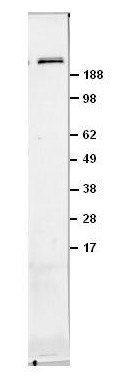
Immunoblotting (1.7 g/ml, see application references)
Immunoprecipitation (1-10 g/ml, see application references)
Packaging
Please refer to vial label for lot-specific concentration.
Physical form
In 50 mM sodium phosphate buffer, 0.2% gelatin.
Analysis Note
Positive Control
Jurkat or HeLa cells
Jurkat or HeLa cells
Other Notes
Kimura N et al. 2003. Genes Cells8, 65.
Sekulic A et al. 2000. Cancer Res.60, 3504.
Hosoi, H. 1999. Cancer Res.59, 886.
Alarcon, C.M., et al. 1996. Genes Dev.10, 279.
Freeman, K., and Livi, G.P. 1996. Gene172, 143.
Hosoi, H., et al. 1996. AACR 87th Ann. Mtg. Abstract 3445.
Cardenas, M.E., and Heitman, J. 1995. EMBO J.14, 5892.
Lorenz, M.C., and Heitman, J. 1995. J. Biol. Chem.270, 27531.
Sabatini, D.M., et al. 1995. J. Biol. Chem.270, 20875.
Zheng, X.F., et al. 1995. Cell82, 121.
Brown, E.J., et al. 1994. Nature369, 756.
Sabatini, D.M., et al. 1994. Cell78, 35.
Stan, R., et al. 1994. J. Biol. Chem.269, 32027.
Kunz, J., et al. 1993. Cell73, 585.
Heitman, J., et al. 1991. Science253, 905.
Sekulic A et al. 2000. Cancer Res.60, 3504.
Hosoi, H. 1999. Cancer Res.59, 886.
Alarcon, C.M., et al. 1996. Genes Dev.10, 279.
Freeman, K., and Livi, G.P. 1996. Gene172, 143.
Hosoi, H., et al. 1996. AACR 87th Ann. Mtg. Abstract 3445.
Cardenas, M.E., and Heitman, J. 1995. EMBO J.14, 5892.
Lorenz, M.C., and Heitman, J. 1995. J. Biol. Chem.270, 27531.
Sabatini, D.M., et al. 1995. J. Biol. Chem.270, 20875.
Zheng, X.F., et al. 1995. Cell82, 121.
Brown, E.J., et al. 1994. Nature369, 756.
Sabatini, D.M., et al. 1994. Cell78, 35.
Stan, R., et al. 1994. J. Biol. Chem.269, 32027.
Kunz, J., et al. 1993. Cell73, 585.
Heitman, J., et al. 1991. Science253, 905.
The immunogen sequence is 100% conserved in mouse and rat, but cross-reactivity has not been tested. Antibody should be titrated for optimal results in individual systems.
Legal Information
CALBIOCHEM is a registered trademark of Merck KGaA, Darmstadt, Germany
Disclaimer
Toxicity: Standard Handling (A)
Still not finding the right product?
Pruebe nuestra Herramienta de selección de productos para limitar sus opciones
wgk
WGK 1
Clase de almacenamiento
11 - Combustible Solids
flash_point_f
Not applicable
flash_point_c
Not applicable
Certificados de análisis (COA)
Busque Certificados de análisis (COA) introduciendo el número de lote del producto. Los números de lote se encuentran en la etiqueta del producto después de las palabras «Lot» o «Batch»
¿Ya tiene este producto?
Encuentre la documentación para los productos que ha comprado recientemente en la Biblioteca de documentos.
Giuliana Gatti et al.
Biomedicines, 9(10) (2021-10-24)
Nuclear lamina components have long been regarded as scaffolding proteins, forming a dense fibrillar structure necessary for the maintenance of the nucleus shape in all the animal kingdom. More recently, mutations, aberrant localisation and deregulation of these proteins have been
Kuppusamy Balamurugan et al.
Nature communications, 4, 1662-1662 (2013-04-12)
Toll-like receptor 4 (Tlr4) has a pivotal role in innate immune responses, and the transcription factor CCAAT/enhancer binding protein delta (C/EBPδ, Cebpd) is a Tlr4-induced gene. Here we identify a positive feedback loop in which C/EBPδ activates Tlr4 gene expression
V Felzen et al.
Cell death & disease, 6, e1812-e1812 (2015-07-15)
Breast cancer is a heterogeneous disease and approximately 70% of newly diagnosed breast cancers are estrogen receptor (ER) positive. Out of the two ER types, α and β, ERα is the only ER that is detectable by immunohistochemistry in breast