Millipore Sigma Vibrant Logo

818638 N,N-Dimethylcyclohexylamine
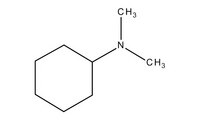
818638
View Pricing & Availability

Overview

Replacement Information

Key Spec Table

CAS #EC NumberHill FormulaChemical FormulaMolar Mass
98-94-2202-715-5C₈H₁₇NC₆H₁₁N(CH₃)₂127.22 g/mol
Description
Catalogue Number818638
SynonymsN-Cyclohexyldimethylamine
DescriptionN,N-Dimethylcyclohexylamine
References
Product Information
CAS number98-94-2
EC number202-715-5
Hill FormulaC₈H₁₇N
Chemical formulaC₆H₁₁N(CH₃)₂
Molar Mass127.22 g/mol
Structure formula ImageStructure formula Image
Quality LevelMQ200
Applications
ApplicationN,N-Dimethylcyclohexylamine for synthesis. CAS 98-94-2, EC Number 202-715-5, chemical formula C₆H₁₁N(CH₃)₂.
Biological Information
Physicochemical Information
Boiling point160 - 161 °C (1013 hPa)
Density0.85 g/cm3 (20 °C)
Explosion limit3.6 - 19 %(V)
Flash point41 °C
Ignition temperature215 °C
Melting Point-60 °C
pH value12 (5 g/l, H₂O, 20 °C)
Vapor pressure3.6 hPa (20 °C)
Solubility13.4 g/l
Dimensions
Materials Information
Toxicological Information
LD 50 oralLD50 Rat 272 mg/kg
LD 50 dermalLD50 Rat > 400 mg/kg
Safety Information according to GHS
Hazard Pictogram(s) Hazard Pictogram(s)
Hazard Pictogram(s)
Hazard Pictogram(s)
Hazard Statement(s)H226: Flammable liquid and vapour.
H290: May be corrosive to metals.
H301 + H311: Toxic if swallowed or in contact with skin.
H314: Causes severe skin burns and eye damage.
H332: Harmful if inhaled.
Precautionary Statement(s)P210: Keep away from heat.
P280: Wear protective gloves/ protective clothing/ eye protection/ face protection.
P301 + P330 + P331: IF SWALLOWED: Rinse mouth. Do NOT induce vomiting.
P302 + P352: IF ON SKIN: Wash with plenty of soap and water.
P305 + P351 + P338: IF IN EYES: Rinse cautiously with water for several minutes. Remove contact lenses, if present and easy to do. Continue rinsing.
P308 + P310: IF exposed or concerned: immediately call a POISON CENTER or doctor/ physician.
Signal WordDanger
Storage class3 Flammable liquids
WGKWGK 1 slightly hazardous to water
Disposal3
Relatively unreactive organic reagents should be collected in container A. If halogenated, they should be collected in container B. For solid residues use container C.
Safety Information
Hazard Symbols Hazard SymbolsCorrosive
Categories of dangerflammable, harmful, corrosive
R PhraseR 10-20/21/22-34
Flammable.Harmful by inhalation, in contact with skin and if swallowed.Causes burns.
S PhraseS 26-36/37/39-45
In case of contact with eyes, rinse immediately with plenty of water and seek medical advice.Wear suitable protective clothing, gloves and eye/face protection.In case of accident or if you feel unwell, seek medical advice immediately (show the label where possible).
Product Usage Statements
Storage and Shipping Information
StorageStore below +30°C.
Packaging Information
Transport Information
Declaration (railroad and road) ADR, RIDUN 2264 , 8 (3), II
Declaration (transport by air) IATA-DGRUN 2264 , 8 (3), II
Declaration (transport by sea) IMDG-CodeUN 2264 , 8 (3), II
Supplemental Information
Specifications
Assay (GC, area%)≥ 99.0 % (a/a)
Density (d 20 °C/ 4 °C)0.848 - 0.849
Identity (IR)passes test

Related Products & Applications

Categories

Reagents, Chemicals and Labware > Organic Synthesis > Organic Synthesis Product Groups > Amines and Ammonium Compounds > Aliphatic, Alicyclic and Araliphatic Amines and Hydroxyl Amines > Tertiary Amines and Nitroxides
Reagents, Chemicals and Labware > Organic Synthesis > Product Line for synthesis > Amines and Ammonium Compounds > Aliphatic, Alicyclic and Araliphatic Amines and Hydroxyl Amines > Tertiary Amines and Nitroxides
Reagents, Chemicals and Labware > Organic Synthesis > Organic Synthesis Products for Pharma > Organic Synthesis Building Blocks and Reagents for Pharma > Amines and Ammonium Compounds > Aliphatic, Alicyclic and Araliphatic Amines and Hydroxyl Amines > Tertiary Amines and Nitroxides