Wenn Sie das Fenster schließen, wird Ihre Konfiguration nicht gespeichert, es sei denn, Sie haben Ihren Artikel in die Bestellung aufgenommen oder zu Ihren Favoriten hinzugefügt.
Klicken Sie auf OK, um das MILLIPLEX® MAP-Tool zu schließen oder auf Abbrechen, um zu Ihrer Auswahl zurückzukehren.
Wählen Sie konfigurierbare Panels & Premixed-Kits - ODER - Kits für die zelluläre Signaltransduktion & MAPmates™
Konfigurieren Sie Ihre MILLIPLEX® MAP-Kits und lassen sich den Preis anzeigen.
Konfigurierbare Panels & Premixed-Kits
Unser breites Angebot enthält Multiplex-Panels, für die Sie die Analyten auswählen können, die am besten für Ihre Anwendung geeignet sind. Unter einem separaten Register können Sie das Premixed-Cytokin-Format oder ein Singleplex-Kit wählen.
Kits für die zelluläre Signaltransduktion & MAPmates™
Wählen Sie gebrauchsfertige Kits zur Erforschung gesamter Signalwege oder Prozesse. Oder konfigurieren Sie Ihre eigenen Kits mit Singleplex MAPmates™.
Die folgenden MAPmates™ sollten nicht zusammen analysiert werden: -MAPmates™, die einen unterschiedlichen Assaypuffer erfordern. -Phosphospezifische und MAPmate™ Gesamtkombinationen wie Gesamt-GSK3β und Gesamt-GSK3β (Ser 9). -PanTyr und locusspezifische MAPmates™, z.B. Phospho-EGF-Rezeptor und Phospho-STAT1 (Tyr701). -Mehr als 1 Phospho-MAPmate™ für ein einziges Target (Akt, STAT3). -GAPDH und β-Tubulin können nicht mit Kits oder MAPmates™, die panTyr enthalten, analysiert werden.
.
Bestellnummer
Bestellinformationen
St./Pkg.
Liste
Dieser Artikel wurde zu Ihren Favoriten hinzugefügt.
Wählen Sie bitte Spezies, Panelart, Kit oder Probenart
Um Ihr MILLIPLEX® MAP-Kit zu konfigurieren, wählen Sie zunächst eine Spezies, eine Panelart und/oder ein Kit.
Custom Premix Selecting "Custom Premix" option means that all of the beads you have chosen will be premixed in manufacturing before the kit is sent to you.
Catalogue Number
Ordering Description
Qty/Pack
List
Dieser Artikel wurde zu Ihren Favoriten hinzugefügt.
Spezies
Panelart
Gewähltes Kit
Menge
Bestellnummer
Bestellinformationen
St./Pkg.
Listenpreis
96-Well Plate
Menge
Bestellnummer
Bestellinformationen
St./Pkg.
Listenpreis
Weitere Reagenzien hinzufügen (MAPmates erfordern die Verwendung eines Puffer- und Detektionskits)
Menge
Bestellnummer
Bestellinformationen
St./Pkg.
Listenpreis
48-602MAG
Buffer Detection Kit for Magnetic Beads
1 Kit
Platzsparende Option Kunden, die mehrere Kits kaufen, können ihre Multiplex-Assaykomponenten in Kunststoffbeuteln anstelle von Packungen erhalten, um eine kompaktere Lagerung zu ermöglichen.
Dieser Artikel wurde zu Ihren Favoriten hinzugefügt.
Das Produkt wurde in Ihre Bestellung aufgenommen
Sie können nun ein weiteres Kit konfigurieren, ein Premixed-Kit wählen, zur Kasse gehen oder das Bestell-Tool schließen.
341286
Sigma-AldrichAnti-Farnesyl Rabbit pAb
Anti-Farnesyl, rabbit polyclonal, recognizes farnesyl in a wide variety of species. Also recognizes KLH. It is validated for use in ELISA and immunofluorescence.
More>>Anti-Farnesyl, rabbit polyclonal, recognizes farnesyl in a wide variety of species. Also recognizes KLH. It is validated for use in ELISA and immunofluorescence. Less<<
Anti-Farnesyl Rabbit pAb: SDB (Sicherheitsdatenblätter), Analysenzertifikate und Qualitätszertifikate, Dossiers, Broschüren und andere verfügbare Dokumente.
ELISA (1:1000) Immunofluorescence (1:50) Immunoblotting (not recommended; see comments)
Application Comments
Recognizes proteins that have been isoprenylated by farnesyltransferase of geranylgeranyltransferase at the C-A-A-X motif. Also recognizes KLH. Not suitable for immunoblotting due to the hydrophobicity of the isoprenylated motif. Variables associated with assay conditions will dictate the optimal working dilution.
Biological Information
Immunogen
farnesyl cysteine conjugated to KLH
Host
Rabbit
Isotype
IgG
Species Reactivity
A Broad Range Of Species
Antibody Type
Polyclonal Antibody
Concentration Label
Please refer to vial label for lot-specific concentration
Physicochemical Information
Dimensions
Materials Information
Toxicological Information
Safety Information according to GHS
Safety Information
Product Usage Statements
Storage and Shipping Information
Ship Code
Blue Ice Only
Toxicity
Standard Handling
Storage
-20°C
Avoid freeze/thaw
Avoid freeze/thaw
Do not freeze
Ok to freeze
Special Instructions
Following initial thaw, aliquot and freeze (-20°C).
Baron, R., et al. 2000. Proc. Natl. Acad. Sci. USA97, 11626. Lin, H.P., et al. 1999. J. Gen. Virol.80, 91. Aspbury, R.A., et al. 1998. Biochim Biophys Acta1392, 265. Gromov, P.S., et al. 1996. Electrophoresis17, 1728. Zhang, F.L. & Casey, P.J. 1996. Annu. Rev. Biochem.65, 241.
Datenblatt
Note that this data sheet is not lot-specific and is representative of the current specifications for this product. Please consult the vial label and the certificate of analysis for information on specific lots. Also note that shipping conditions may differ from storage conditions.
Revision
04-October-2007 RFH
Application
ELISA (1:1000) Immunofluorescence (1:50) Immunoblotting (not recommended; see comments)
Application Data
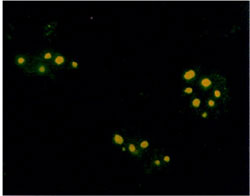
Detection of farnesyl by immunofluorescence. Sample: Plasmids encoding isoprenylated protein. Primary antibody: Anti-Farnesyl Rabbit pAb (Cat. No. 341286) (assay dependent on Primary Antibody). Detection: fluorescence.
Prenylation of proteins is a post-translational modification that is necessary for membrane association of proteins as well as protein-protein interactions. The nature of the linked isoprenyl group can influence the protein interactions, such as the interaction between G proteins and receptors. Approximately 0.5% of cellular proteins are affected by protein isoprenylation. Farnesyltransferase and geranylgeranyltransferase are the two enzymes involved in catalyzing the attachment of two prenyl groups to the sulfhydryl group of the C-terminal cysteine groups. These enzymes transfer a 15 carbon farnesyl or a 20 carbon geranygeranyl, respectively, from a prenyl-pyrophosphate to the protein. Proteins which are prenylated by these enzymes have a distinct motif at the C-terminal of the protein, C-A1-A2-X (C= Cysteine, A1 & A2 = aliphatic amino acids). Some of the proteins that contain the C-A-A-X motif are members of the Ras small G protein family, the nuclear lamins, and the γ-subunit of trimeric G proteins.
Host
Rabbit
Immunogen
farnesyl cysteine conjugated to KLH
Isotype
IgG
Species
a broad range of species
Form
Liquid
Formulation
In PBS.
Concentration Label
Please refer to vial label for lot-specific concentration
Preservative
≤0.1% sodium azide
Comments
Recognizes proteins that have been isoprenylated by farnesyltransferase of geranylgeranyltransferase at the C-A-A-X motif. Also recognizes KLH. Not suitable for immunoblotting due to the hydrophobicity of the isoprenylated motif. Variables associated with assay conditions will dictate the optimal working dilution.
Storage
Avoid freeze/thaw
-20°C
Do Not Freeze
Ok to freeze
Special Instructions
Following initial thaw, aliquot and freeze (-20°C).
Toxicity
Standard Handling
References
Baron, R., et al. 2000. Proc. Natl. Acad. Sci. USA97, 11626. Lin, H.P., et al. 1999. J. Gen. Virol.80, 91. Aspbury, R.A., et al. 1998. Biochim Biophys Acta1392, 265. Gromov, P.S., et al. 1996. Electrophoresis17, 1728. Zhang, F.L. & Casey, P.J. 1996. Annu. Rev. Biochem.65, 241.