Wenn Sie das Fenster schließen, wird Ihre Konfiguration nicht gespeichert, es sei denn, Sie haben Ihren Artikel in die Bestellung aufgenommen oder zu Ihren Favoriten hinzugefügt.
Klicken Sie auf OK, um das MILLIPLEX® MAP-Tool zu schließen oder auf Abbrechen, um zu Ihrer Auswahl zurückzukehren.
Wählen Sie konfigurierbare Panels & Premixed-Kits - ODER - Kits für die zelluläre Signaltransduktion & MAPmates™
Konfigurieren Sie Ihre MILLIPLEX® MAP-Kits und lassen sich den Preis anzeigen.
Konfigurierbare Panels & Premixed-Kits
Unser breites Angebot enthält Multiplex-Panels, für die Sie die Analyten auswählen können, die am besten für Ihre Anwendung geeignet sind. Unter einem separaten Register können Sie das Premixed-Cytokin-Format oder ein Singleplex-Kit wählen.
Kits für die zelluläre Signaltransduktion & MAPmates™
Wählen Sie gebrauchsfertige Kits zur Erforschung gesamter Signalwege oder Prozesse. Oder konfigurieren Sie Ihre eigenen Kits mit Singleplex MAPmates™.
Die folgenden MAPmates™ sollten nicht zusammen analysiert werden: -MAPmates™, die einen unterschiedlichen Assaypuffer erfordern. -Phosphospezifische und MAPmate™ Gesamtkombinationen wie Gesamt-GSK3β und Gesamt-GSK3β (Ser 9). -PanTyr und locusspezifische MAPmates™, z.B. Phospho-EGF-Rezeptor und Phospho-STAT1 (Tyr701). -Mehr als 1 Phospho-MAPmate™ für ein einziges Target (Akt, STAT3). -GAPDH und β-Tubulin können nicht mit Kits oder MAPmates™, die panTyr enthalten, analysiert werden.
.
Bestellnummer
Bestellinformationen
St./Pkg.
Liste
Dieser Artikel wurde zu Ihren Favoriten hinzugefügt.
Wählen Sie bitte Spezies, Panelart, Kit oder Probenart
Um Ihr MILLIPLEX® MAP-Kit zu konfigurieren, wählen Sie zunächst eine Spezies, eine Panelart und/oder ein Kit.
Custom Premix Selecting "Custom Premix" option means that all of the beads you have chosen will be premixed in manufacturing before the kit is sent to you.
Catalogue Number
Ordering Description
Qty/Pack
List
Dieser Artikel wurde zu Ihren Favoriten hinzugefügt.
Spezies
Panelart
Gewähltes Kit
Menge
Bestellnummer
Bestellinformationen
St./Pkg.
Listenpreis
96-Well Plate
Menge
Bestellnummer
Bestellinformationen
St./Pkg.
Listenpreis
Weitere Reagenzien hinzufügen (MAPmates erfordern die Verwendung eines Puffer- und Detektionskits)
Menge
Bestellnummer
Bestellinformationen
St./Pkg.
Listenpreis
48-602MAG
Buffer Detection Kit for Magnetic Beads
1 Kit
Platzsparende Option Kunden, die mehrere Kits kaufen, können ihre Multiplex-Assaykomponenten in Kunststoffbeuteln anstelle von Packungen erhalten, um eine kompaktere Lagerung zu ermöglichen.
Dieser Artikel wurde zu Ihren Favoriten hinzugefügt.
Das Produkt wurde in Ihre Bestellung aufgenommen
Sie können nun ein weiteres Kit konfigurieren, ein Premixed-Kit wählen, zur Kasse gehen oder das Bestell-Tool schließen.
The stress-activated protein kinase 1 family is also referred to as the jun N-terminal kinase family, in light of the substrate preference of these serine/threonine kinases. The SAPK family shares 42-45% identity in the kinase domains with the MAPK family, and the SAPKs are activated by phosphorylation of a threonine and tyrosine by MKK4 and SKK4, just as the MAP kinases are phosphorylated on a threonine and tyrosine by MEK1 and MEK2. By contrast to the mitogen-activated kinases, the stress-activated kinases are only weakly activated by mitogenic stimuli, but potently activated by stress stimuli, such as inflammatory cytokines, ischemia, chemotherapeutic agents and irradiation. The JNK/SAPK1 kinases, like the other MAPK-like kinases, are thought to phosphorylate multiple substrates and regulate many processes, including proliferation (in some cell types) and apoptosis. The SAPK2/3 family is most widely referred to as the p38 family. These kinases are also activated by stresses, most notably inflammatory cytokines, irradiation, and certain toxins such as anisomycin and arsenite. The activating kinases of SAPK2/3 are SKK2/MEK3 for SAPK2a and 2b, and MKK6 for SAPK3. The targets of the SAPK2/3 family include the MAPKAP kinases 2 and 3/3pK. In addition, SKK4 is related to this family, exhibiting 60% identity, and is activated by MKK6.
The protein encoded by this gene is a member of the MAP kinase family. MAP kinases act as an integration point for multiple biochemical signals, and are involved in a wide variety of cellular processes such as proliferation, differentiation, transcription regulation and development. This protein is a neuronal-specific form of c-Jun N-terminal kinases (JNKs). Through its phosphorylation and nuclear localization, this kinase plays regulatory roles in the signaling pathways during neuronal apoptosis. Beta-arrestin 2, a receptor-regulated MAP kinase scaffold protein, is found to interact with, and stimulate the phosphorylation of this kinase by MAP kinase kinase 4 (MKK4). Cyclin-dependent kianse 5 can phosphorylate, and inhibit the activity of this kinase, which may be important in preventing neuronal apoptosis. Four alternatively spliced transcript variants encoding distinct isoforms have been reported. [provided by RefSeq]
FUNCTION: Responds to activation by environmental stress and pro-inflammatory cytokines by phosphorylating a number of transcription factors, primarily components of AP-1 such as c-Jun and ATF2 and thus regulates AP-1 transcriptional activity. Required for stress-induced neuronal apoptosis and the pathogenesis of glutamate excitotoxicity By similarity.
Catalytic activity ATP + a protein = ADP + a phosphoprotein.
Cofactor Magnesium By similarity.
Enzyme regulation Activated by threonine and tyrosine phosphorylation by two dual specificity kinases, MAP2K4 and MAP2K7. MAP2K7 phosphorylates MAPK10 on Thr-221 causing a conformational change and a large increase in Vmax for the enzyme. MAP2K4 then phosphorylates Tyr-223 resulting in a further increase in Vmax. Inhibited by dual specificity phosphatases, such as DUSP1. Inhibited by HDAC9 By similarity.
SUBUNIT: Binds to at least four scaffolding proteins, MAPK8IP1/JIP-1, MAPK8IP2/JIP-2, MAPK8IP3/JIP-3/JSAP1 and SPAG9/MAPK8IP4/JIP-4. These proteins also bind other components of the JNK signaling pathway. Interacts with HDAC9 and MAPKBP1 By similarity.
DOMAIN: The TXY motif contains the threonine and tyrosine residues whose phosphorylation activates the MAP kinases.
PTM:Dually phosphorylated on Thr-221 and Tyr-223, which activates the enzyme By similarity.
SIMILARITY: Belongs to the protein kinase superfamily. CMGC Ser/Thr protein kinase family. MAP kinase subfamily.
Contains 1 protein kinase domain.
Molecular Weight
46-54kDa
Physicochemical Information
Dimensions
Materials Information
Toxicological Information
Safety Information according to GHS
Safety Information
Product Usage Statements
Quality Assurance
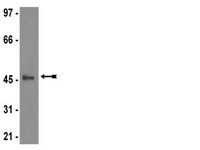
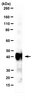
Routinely evaluated by western blot on RIPA lysates from A431 cells.
Usage Statement
Unless otherwise stated in our catalog or other company documentation accompanying the product(s), our products are intended for research use only and are not to be used for any other purpose, which includes but is not limited to, unauthorized commercial uses, in vitro diagnostic uses, ex vivo or in vivo therapeutic uses or any type of consumption or application to humans or animals.
The ASK1-JNK3 signaling pathway plays a pivotal role in the pathogenesis of Parkinson's disease (PD). The specific binding of β-arrestin2 to JNK3 is essential for activation of the ASK1-JNK3 cascade, representing a potential therapeutic target for preventing dopaminergic neuronal death in PD. The aim of this study was to identify a novel strategy for the prevention of dopaminergic neuronal death in PD.Based on the specific binding of β-arrestin2 to JNK3, a 21-amino-acid fusion peptide, termed JNK3-N-Tat, was synthesized. We evaluated the ability of this peptide to inhibit the binding of β-arrestin2 to its target domain in JNK3 in vitro and in vivo.The JNK3-N-Tat peptide inhibited activation of the ASK1-JNK3 cascade by disrupting the interaction between β-arrestin2 and JNK3. JNK3-N-Tat exerted beneficial effects through pathways downstream of JNK3 and improved mitochondrial function, resulting in attenuated MPP+/MPTP-induced damage. JNK3-N-Tat protected mesencephalic dopaminergic neurons against MPTP-induced toxicity.JNK3-N-Tat, a JNK3-inhibitory peptide, protects dopaminergic neurons against MPP+/MPTP-induced injury by inhibiting the ASK1-JNK3 signaling pathway.
SUMOylation of the kainate receptor subunit GluK2 contributes to the activation of the MLK3-JNK3 pathway following kainate stimulation. Qiu-Ju Zhu,Yan Xu,Cai-Ping Du,Xiao-Yu Hou FEBS letters
586
2011
Protein SUMOylation has been implicated in the pathogenesis of ischemic stroke. However, the underlying mechanisms remain unclear. Here, we found that global brain ischemia evokes a sustained elevation of GluK2 SUMOylation in the rat hippocampal CA1 region. Over-expression of wild-type GluK2, but not SUMOylation-deficient mutant, significantly increased the activity of MLK3 and JNK3 after kainate stimulation. SUMOylation deficiency attenuated the kainate-stimulated interaction between MLK3 and GluK2. In addition, inhibition of kainate-evoked GluK2 endocytosis decreased the activation of MLK3-JNK3 signaling and the binding of MLK3-GluK2 in cultured cortical neurons. These results suggest that the internalization of GluK2 following SUMO modification promotes its binding with MLK3, thereby activating the MLK3-JNK3 pathway, which may be responsible for ischemic neuronal cell death.