
216666

Tétrakis(triphénylphosphine)palladium(0)
99%, solid
Synonyme(s) :
Palladium-tétrakis(triphénylphosphine), Pd(PPh3)4
Sélectionner une taille de conditionnement
A propos de cet article
Nom du produit
Tétrakis(triphénylphosphine)palladium(0), 99%
InChI key
NFHFRUOZVGFOOS-UHFFFAOYSA-N
InChI
1S/4C18H15P.Pd/c4*1-4-10-16(11-5-1)19(17-12-6-2-7-13-17)18-14-8-3-9-15-18;/h4*1-15H;
SMILES string
[Pd].c1ccc(cc1)P(c2ccccc2)c3ccccc3.c4ccc(cc4)P(c5ccccc5)c6ccccc6.c7ccc(cc7)P(c8ccccc8)c9ccccc9.c%10ccc(cc%10)P(c%11ccccc%11)c%12ccccc%12
assay
99%
form
solid
reaction suitability
core: palladium, reaction type: Cross Couplings, reaction type: Heck Reaction, reaction type: Hiyama Coupling, reaction type: Negishi Coupling, reaction type: Sonogashira Coupling, reaction type: Stille Coupling, reaction type: Suzuki-Miyaura Coupling, reagent type: catalyst
reaction type: Buchwald-Hartwig Cross Coupling Reaction
parameter
air sensitive
storage temp.
2-8°C
Quality Level
Vous recherchez des produits similaires ? Visite Guide de comparaison des produits
General description
Le tétrakis(triphénylphosphine)palladium (Pd(PPh3)4) est un complexe à base de palladium(0) fréquemment utilisé dans la synthèse de produits chimiques. C'est un catalyseur essentiel de diverses réactions organiques, en particulier les réactions de couplage croisé C-C, C-N, C-O et C-hétéroatome. Le Pd(PPh3)4 a de nombreuses applications dans les réactions de formation de liaison carbone-carbone telles que les réactions bien connues de Heck, de Suzuki-Miyaura et de Stille. Ces réactions permettent de coupler des halogénures d'aryle, d'alkyle ou de vinyle avec d'autres composés organiques pour donner des produits de grand intérêt. Le cycle catalytique consiste en une addition oxydante de l'halogénure organique sur du palladium(0), une transmétallation avec un réactif organométallique approprié ou de l'acide boronique, puis une élimination réductrice pour former le produit recherché. Le Pd(PPh3)4 a aussi été utilisé dans diverses autres transformations, notamment des substitutions allyliques, des additions nucléophiles sur des alcènes et des alcynes, et des cycloadditions.
Application
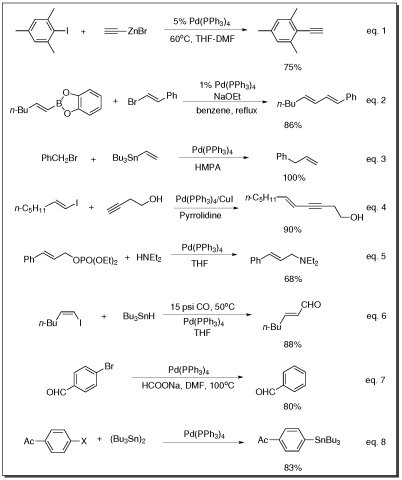
- couplage de Negishi (éq. 1), couplage de Suzuki (éq. 2), couplage de Stille (éq. 3) couplage de Sonogashira (éq. 4) amination de Buchwald-Hartwig (éq. 5)
- carbonylation d'iodures de vinyle (éq. 6)
- réduction de bromures d'aryle (éq. 7)
- formation de liaisons carbone-étain (éq. 8)

signalword
Warning
hcodes
Hazard Classifications
Acute Tox. 4 Oral
Classe de stockage
11 - Combustible Solids
wgk
WGK 3
flash_point_f
Not applicable
flash_point_c
Not applicable
ppe
Eyeshields, Gloves, type N95 (US)
Faites votre choix parmi les versions les plus récentes :
Déjà en possession de ce produit ?
Retrouvez la documentation relative aux produits que vous avez récemment achetés dans la Bibliothèque de documents.
Which document(s) contains shelf-life or expiration date information for a given product?
If available for a given product, the recommended re-test date or the expiration date can be found on the Certificate of Analysis.
How do I get lot-specific information or a Certificate of Analysis?
The lot specific COA document can be found by entering the lot number above under the "Documents" section.
The color of Product 216666, Pd tetrakis(triphenylphosphine)Cl was a yellow or gold color, but now my material has turned a tan, brown, or green color. Is it still good to use?
A change in color of the material indicates oxidation and it will no longer be active as a catalyst.
How do I find price and availability?
There are several ways to find pricing and availability for our products. Once you log onto our website, you will find the price and availability displayed on the product detail page. You can contact any of our Customer Sales and Service offices to receive a quote. USA customers: 1-800-325-3010 or view local office numbers.
What is the Department of Transportation shipping information for this product?
Transportation information can be found in Section 14 of the product's (M)SDS.To access the shipping information for this material, use the link on the product detail page for the product.
My question is not addressed here, how can I contact Technical Service for assistance?
Ask a Scientist here.
Notre équipe de scientifiques dispose d'une expérience dans tous les secteurs de la recherche, notamment en sciences de la vie, science des matériaux, synthèse chimique, chromatographie, analyse et dans de nombreux autres domaines..
Contacter notre Service technique