Accéder au contenu
Merck

NA57

Anti-DNA-PK (Ab-2) Mouse mAb (18-2)

liquid, clone 18-2, Calbiochem®

Synonyme(s) :

Anti-DNA Dependent Protein Kinase

Se connecter pour consulter les tarifs organisationnels et contractuels.

Sélectionner une taille de conditionnement


A propos de cet article

NACRES:
NA.43
UNSPSC Code:
12352203
Service technique
Besoin d'aide ? Notre équipe de scientifiques expérimentés est là pour vous.
Laissez-nous vous aider
Service technique
Besoin d'aide ? Notre équipe de scientifiques expérimentés est là pour vous.
Laissez-nous vous aider

Nom du produit

Anti-DNA-PK (Ab-2) Mouse mAb (18-2), liquid, clone 18-2, Calbiochem®

biological source

mouse

antibody form

purified antibody

antibody product type

primary antibodies

clone

18-2, monoclonal

form

liquid

contains

≤0.1% sodium azide as preservative

species reactivity

human

manufacturer/tradename

Calbiochem®

storage condition

OK to freeze

dilution

(Frozen Sections (1:50-1:100)
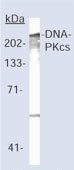
Immunoblotting (1:250-1:500)
Immunofluorescence (1:50-1:100)
Immunoprecipitation (10 µL/mg protein lysate)
Neutralization Studies
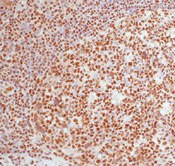
Paraffin Sections (1:50-1:100, heat/pressure cooker pre-treatment required))

isotype

IgG1

shipped in

wet ice

storage temp.

2-8°C

target post-translational modification

unmodified

Quality Level

Gene Information

human ... PRKDC(5591)

Analysis Note

Positive Control
A-431, HeLa, or HL-60 cells or normal tonsil, normal colon, or breast carcinoma tissue

Application


Frozen Sections (1:50-1:100)
Immunoblotting (1:250-1:500)
Immunofluorescence (1:50-1:100)
Immunoprecipitation (10 l/mg protein lysate)
Neutralization Studies (see comments)
Paraffin Sections (1:50-1:100, heat/pressure cooker pre-treatment required)

Disclaimer

Toxicity: Standard Handling (A)

General description

Purified mouse monoclonal antibody generated by immunizing BALB/c mice with the specified immunogen and fusing the splenocytes with mouse myeloma SP2/0 cells (see application references). Recognizes the ~460 kDa DNA-PK protein.
Recognizes the ~470 kDa DNA-PK protein in A431, HeLa, and HL60 cells, normal tonsil, normal colon, and breast carcinoma tissue.
This Anti-DNA-PK (Ab-2) Mouse mAb (18-2) is validated for use in Frozen Sections, Immunoblotting, IF, IP, Neutralization Studies, Paraffin Sections for the detection of DNA-PK (Ab-2).

Immunogen

DNA-PK purified from HeLa cells
Epitope: within amino acids 1-2713 of DNA-PK
Human

Other Notes

Kharbanda, S., et al. 1997. Nature386, 732.
McConnell, K.R., et al. 1997 J. Immunol.158, 2083-2089.
Peterson, S.R., et al. 1997. J. Biol. Chem.272, 10227.
Anderson, C.W. and Carter, T.H. 1996. Curr. Top. Microbiol. Immunol.217, 91.
Blunt, T., et al. 1996. Proc. Natl. Acad. Sci. USA93, 10285.
Carpenter, C.L. and Cantley, L.C. 1996. Curr. Opin. Cell. Biol.8, 153.
Chan, D.W. and Lees-Miller, S.P. 1996. J. Biol. Chem.271, 8936.
Connelly, M.A., et al. 1996. Gene175, 271.
Danska, J.S., et al. 1996. Mol. Cell. Biol.16, 5507.
Han, Z., et al. 1996. J. Biol. Chem.271, 25035.
Lees-Miller, S.P. 1996. Biochem. Cell. Biol.74, 503.
Song, Q., et al. 1996. EMBO J.15, 3238.
Teraoka, H., et al. 1996. FEBS Lett.393, 1.
Blunt, T., et al. 1995. Cell80, 813.
Hartley, K.O., et al. 1995. Cell82, 849.
Kirchgessner, C.U., et al. 1995. Science267, 1178.
Lees-Miller, S.P., et al. 1995. Science267, 1183.
Poltoratsky, V.P., et al. 1995. J. Immunol.155, 4529.
Anderson, C.W. 1993. Trends Biochem. Sci.18, 433.
Gottleib, T.M. and Jackson, S.P. 1993. Cell72, 131.
This antibody will inhibit (approximately 50%) the kinase activity of DNA-PKcs. However, preincubation of the enzyme with DNA protects DNA-PKcs against inactivation by Clone 18-2. Antibody should be titrated for optimal results in individual systems.

Packaging

Please refer to vial label for lot-specific concentration.

Physical form

In 10 mM PBS, 0.2% BSA, pH 7.4.

Preparation Note

For long-term storage, aliquot and freeze (-20°C). Avoid freeze/thaw cycles.

Legal Information

CALBIOCHEM is a registered trademark of Merck KGaA, Darmstadt, Germany

Vous ne trouvez pas le bon produit ?  

Essayez notre Outil de sélection de produits.

Classe de stockage

12 - Non Combustible Liquids

wgk

WGK 2

flash_point_f

Not applicable

flash_point_c

Not applicable


Certificats d'analyse (COA)

Recherchez un Certificats d'analyse (COA) en saisissant le numéro de lot du produit. Les numéros de lot figurent sur l'étiquette du produit après les mots "Lot" ou "Batch".

Déjà en possession de ce produit ?

Retrouvez la documentation relative aux produits que vous avez récemment achetés dans la Bibliothèque de documents.

Consulter la Bibliothèque de documents

Tewodros Mamo et al.
Biochemical and biophysical research communications, 486(2), 307-313 (2017-03-17)
Osteosarcoma survival rate has not improved over the past three decades, and the debilitating side effects of the surgical treatment suggest the need for alternative local control approaches. Radiotherapy is largely ineffective in osteosarcoma, indicating a potential role for radiosensitizers.
Xiaosheng Wu et al.
Journal of immunology (Baltimore, Md. : 1950), 174(2), 934-941 (2005-01-07)
Activation-induced cytidine deaminase (AID) is required for Ig class switch recombination, a process that introduces DNA double-strand breaks in B cells. We show in this study that AID associates with the DNA-dependent protein kinase catalytic subunit (DNA-PKcs) promoting cell survival
Benu Brata Das et al.
The EMBO journal, 28(23), 3667-3680 (2009-10-24)
Human tyrosyl-DNA phosphodiesterase (TDP1) hydrolyzes the phosphodiester bond at a DNA 3' end linked to a tyrosyl moiety. This type of linkage is found at stalled topoisomerase I (Top1)-DNA covalent complexes, and TDP1 has been implicated in the repair of
Stéphanie Solier et al.
Proceedings of the National Academy of Sciences of the United States of America, 109(32), 12866-12872 (2012-07-04)
The "apoptotic ring" is characterized by the phosphorylation of histone H2AX at serine 139 (γ-H2AX) by DNA-dependent protein kinase (DNA-PK). The γ-H2AX apoptotic ring differs from the nuclear foci patterns observed in response to DNA-damaging agents. It contains phosphorylated DNA
Kristen E Hurov et al.
Genes & development, 24(17), 1939-1950 (2010-09-03)
In response to DNA damage, cells activate a complex signal transduction network called the DNA damage response (DDR). To enhance our current understanding of the DDR network, we performed a genome-wide RNAi screen to identify genes required for resistance to

Notre équipe de scientifiques dispose d'une expérience dans tous les secteurs de la recherche, notamment en sciences de la vie, science des matériaux, synthèse chimique, chromatographie, analyse et dans de nombreux autres domaines..

Contacter notre Service technique