Millipore Sigma Vibrant Logo

PC85 Anti-ATM (Ab-1) (13-24) Rabbit pAb

PC85
  
Retrieving price...
Price could not be retrieved
Minimum Quantity is a multiple of
Maximum Quantity is
Upon Order Completion More Information
You Saved ()
 
Request Pricing
Limited Availability
In Stock 
Discontinued
Limited Quantities Available
Availability to be confirmed
    Remaining : Will advise
      Remaining : Will advise
      Will advise
      Contact Customer Service
      Contact Customer Service


      Contact Customer Service

      Overview

      Replacement Information

      Key Spec Table

      Host
      Rb
      Description
      Overview

      This product has been discontinued.


      Recognizes the ~350 kDa ATM protein in Daudi, HeLa, and AT169a cells.
      Catalogue NumberPC85
      Brand Family Calbiochem®
      SynonymsAnti-Ataxia Telangiectasia
      Application Data
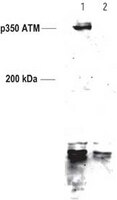
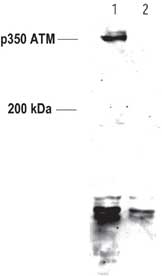
      Detection of human ATM by immunobotting. Samples: Whole cell lysate from Daudi cells (150 µg) (lane 1) and AT169a cells (150 µg) (lane 2) Primary antibody: Anti-ATM (Ab-1) (13-24) Rabbit pAb (Cat. No. PC85) (2 µg/ml). Detection: chemiluminescence.
      References
      ReferencesFriedberg, E.C., et al. 1995. Wash. D.C.: Amer. Soc. of Microbiolgy (meeting report).
      Meyn, S.M. 1995. Cancer Res. 55, 5991.
      Savitsky, K., et al. 1995. Science 268, 1749.
      Savitsky, K., et al. 1995. Hum. Molec. Genet. 4, 2025.
      Zakian, V., 1995. Cell 82, 685.
      Beamish, H., et al. 1993. Rad. Res. 138, 130.
      Kastan, M. B., et al. 1992. Cell 71, 587.
      Painter, R.B. and Young B.R., 1980. Proc. Natl. Acad. Sci. USA 77, 7315.
      Product Information
      FormLiquid
      FormulationIn 0.05 M sodium phosphate buffer, 0.2% gelatin.
      Positive controlDaudi or HeLa cells
      Preservative≤0.1% sodium azide
      Applications
      Key Applications Immunoblotting (Western Blotting)
      Application NotesImmunoblotting (2 µg/ml, see comments)
      Application CommentsRecommended for immunoblotting as described below. Detection of p350ATM/ATM (Ab-1) complexes is done using HRP conjugated goat anti-rabbit IgG at 50 ng/ml (Cat. No. DC03L).

      NOTES
      1. ATM (Ab-1) detects a 350 kDa protein in immunoblotting of lysates of normal and transformed cells or tumor lines derived from individuals homozygous wild type for the ATM gene.

      2. In cells derived from patients with Ataxia-Telangiectasia and carrying homozygous inactivating mutations in ATM, no 350 kDa protein is detected.

      3. The ATM (Ab-1) polyclonal also detects smaller molecular weight proteins present in both ATM mutant and wild type cells.

      4. Immunoblotting of p350ATM requires loading 100 to 150 µg of cell lysate on low percentage acrylamide gels (5%) (SDS/PAGE) with electrophoresis performed until the 200 kDa molecular weight marker has migrated at least halfway through the gel followed by electrophoretic transfer for 2 h using semi-dry transfer at 9V constant voltage or overnight using tank transfer at 40 V constant voltage.

      5. To transfer the gel for blotting, lay a dry piece of Whatman 3MM Chromatography paper over the wet gel. Carefully peel the 3MM paper and gel off the glass plate and immerse, gel side up, in transfer buffer until 3MM paper is thoroughly wet. Remove bubbles by rolling a pipette across the surface of the gel.

      6. To confirm detection of p350ATM, a cell line carrying a truncating mutation in ATM should be used as a negative control. Cell lines from A-T patients, such as GM02052A which show no detectable band at 350 kDa, can be obtained from the National Institute of General Medical Sciences Human Genetic Mutant Cell Repository at the Coriell Institute for Medical Research, 401 Haddon Avenue, Camden, NJ 08103. Antibody should be titrated for optimal results in individual systems.
      Biological Information
      Immunogena synthetic peptide (RQLEHDRATERK) corresponding to amino acids 13-24 of human ATM
      ImmunogenHuman
      HostRabbit
      IsotypeIgG
      Concentration Label Please refer to vial label for lot-specific concentration
      Physicochemical Information
      Dimensions
      Materials Information
      Toxicological Information
      Safety Information according to GHS
      Safety Information
      Product Usage Statements
      Storage and Shipping Information
      Ship Code Blue Ice Only
      Toxicity Standard Handling
      Storage +2°C to +8°C
      Do not freeze Yes
      Packaging Information
      Transport Information
      Supplemental Information
      Specifications
      Global Trade Item Number
      Catalogue Number GTIN
      PC85 0

      Documentation

      Anti-ATM (Ab-1) (13-24) Rabbit pAb Certificates of Analysis

      TitleLot Number
      PC85

      References

      Reference overview
      Friedberg, E.C., et al. 1995. Wash. D.C.: Amer. Soc. of Microbiolgy (meeting report).
      Meyn, S.M. 1995. Cancer Res. 55, 5991.
      Savitsky, K., et al. 1995. Science 268, 1749.
      Savitsky, K., et al. 1995. Hum. Molec. Genet. 4, 2025.
      Zakian, V., 1995. Cell 82, 685.
      Beamish, H., et al. 1993. Rad. Res. 138, 130.
      Kastan, M. B., et al. 1992. Cell 71, 587.
      Painter, R.B. and Young B.R., 1980. Proc. Natl. Acad. Sci. USA 77, 7315.
      Data Sheet

      Note that this data sheet is not lot-specific and is representative of the current specifications for this product. Please consult the vial label and the certificate of analysis for information on specific lots. Also note that shipping conditions may differ from storage conditions.

      Revision16-October-2007 RFH
      SynonymsAnti-Ataxia Telangiectasia
      ApplicationImmunoblotting (2 µg/ml, see comments)
      Application Data
      Detection of human ATM by immunobotting. Samples: Whole cell lysate from Daudi cells (150 µg) (lane 1) and AT169a cells (150 µg) (lane 2) Primary antibody: Anti-ATM (Ab-1) (13-24) Rabbit pAb (Cat. No. PC85) (2 µg/ml). Detection: chemiluminescence.
      DescriptionPurified rabbit polyclonal antibody. Recognizes the ~350 kDa ATM protein.
      BackgroundAtaxia telangiectasia (AT) is an autosomal recessive disease characterized by cerebellar degeneration, an uneven gait (ataxia), neuromotor deterioration, the appearance of dilated blood vessels (telangiectasia) in the conjunctiva of the eyes and skin, and a large increase in cancer susceptibility. Cells of AT patients have increased sensitivity to ionizing radiation, defects in G1 and G2 of the cell cycle, and are unable to effect a normal p53-dependent G1 arrest due to failure to properly induce WAF1. Identification of the gene in AT patients showed that the disease is caused by a mutation of a single gene called ATM. Cloning of the ATM cDNA indicates that it contains a large open reading frame and encodes a putative protein of 3056 amino acids. The C-terminal region has extensive homology to the catalytic domains of phosphatidylinositol 3-kinases (PI3 kinases). A family of ATM-related genes has been identifed suggesting a role for these proteins in signal transduction and cell cycle regulation. ATM may be a key regulator of p53-mediated apoptosis.
      HostRabbit
      Immunogen speciesHuman
      Immunogena synthetic peptide (RQLEHDRATERK) corresponding to amino acids 13-24 of human ATM
      IsotypeIgG
      Specieshuman, mouse
      Positive controlDaudi or HeLa cells
      FormLiquid
      FormulationIn 0.05 M sodium phosphate buffer, 0.2% gelatin.
      Concentration Label Please refer to vial label for lot-specific concentration
      Preservative≤0.1% sodium azide
      CommentsRecommended for immunoblotting as described below. Detection of p350ATM/ATM (Ab-1) complexes is done using HRP conjugated goat anti-rabbit IgG at 50 ng/ml (Cat. No. DC03L).

      NOTES
      1. ATM (Ab-1) detects a 350 kDa protein in immunoblotting of lysates of normal and transformed cells or tumor lines derived from individuals homozygous wild type for the ATM gene.

      2. In cells derived from patients with Ataxia-Telangiectasia and carrying homozygous inactivating mutations in ATM, no 350 kDa protein is detected.

      3. The ATM (Ab-1) polyclonal also detects smaller molecular weight proteins present in both ATM mutant and wild type cells.

      4. Immunoblotting of p350ATM requires loading 100 to 150 µg of cell lysate on low percentage acrylamide gels (5%) (SDS/PAGE) with electrophoresis performed until the 200 kDa molecular weight marker has migrated at least halfway through the gel followed by electrophoretic transfer for 2 h using semi-dry transfer at 9V constant voltage or overnight using tank transfer at 40 V constant voltage.

      5. To transfer the gel for blotting, lay a dry piece of Whatman 3MM Chromatography paper over the wet gel. Carefully peel the 3MM paper and gel off the glass plate and immerse, gel side up, in transfer buffer until 3MM paper is thoroughly wet. Remove bubbles by rolling a pipette across the surface of the gel.

      6. To confirm detection of p350ATM, a cell line carrying a truncating mutation in ATM should be used as a negative control. Cell lines from A-T patients, such as GM02052A which show no detectable band at 350 kDa, can be obtained from the National Institute of General Medical Sciences Human Genetic Mutant Cell Repository at the Coriell Institute for Medical Research, 401 Haddon Avenue, Camden, NJ 08103. Antibody should be titrated for optimal results in individual systems.
      Storage +2°C to +8°C
      Do Not Freeze Yes
      Toxicity Standard Handling
      ReferencesFriedberg, E.C., et al. 1995. Wash. D.C.: Amer. Soc. of Microbiolgy (meeting report).
      Meyn, S.M. 1995. Cancer Res. 55, 5991.
      Savitsky, K., et al. 1995. Science 268, 1749.
      Savitsky, K., et al. 1995. Hum. Molec. Genet. 4, 2025.
      Zakian, V., 1995. Cell 82, 685.
      Beamish, H., et al. 1993. Rad. Res. 138, 130.
      Kastan, M. B., et al. 1992. Cell 71, 587.
      Painter, R.B. and Young B.R., 1980. Proc. Natl. Acad. Sci. USA 77, 7315.