Millipore Sigma Vibrant Logo

07-1436 Anti-PDGF-AA Antibody

View Products on Sigmaaldrich.com
07-1436
50 µg  
Retrieving price...
Price could not be retrieved
Minimum Quantity is a multiple of
Maximum Quantity is
Upon Order Completion More Information
You Saved ()
 
Request Pricing
Limited Availability
In Stock 
Discontinued
Limited Quantities Available
Availability to be confirmed
    Remaining : Will advise
      Remaining : Will advise
      Will advise
      Contact Customer Service
      Contact Customer Service

      Special Offers


      Contact Customer Service

      Overview

      Replacement Information
      Replacement Information07-1436 is a recommended replacement for AB1486P.

      Key Spec Table

      Species ReactivityKey ApplicationsHostFormatAntibody Type
      H, MIH(P), ELISA, WB, NEUTRbAffinity PurifiedPolyclonal Antibody
      Description
      Catalogue Number07-1436
      ReplacesAB1486P
      DescriptionAnti-PDGF-AA Antibody
      Alternate Names
      • Platelet-derived growth factor alpha
      • Platelet-derived growth factor alpha chain
      • Platelet-derived growth factor alpha polypeptide
      Background InformationPlatelet-Derived Growth Factor (PDGF) is a dimer of A (17 kDa) and B (14 kDa) chains (AA, AB, or BB). Its receptors are transmembrane receptor tyrosine kinases, PDGF Receptors type A and B. The type A PDGF receptor binds all three PDGFs with high affinity, whereas the type B PDGF receptor is selective for PDGF-BB. PDGF signals as a growth and survival factor, as it is a potent activator of the PI3 Kinase pathway. PDGF signaling appears to play an essential role in the development of tumors of glial origin.
      References
      Product Information
      FormatAffinity Purified
      HS Code3002 15 90
      Control
      • C2C12 cell lysate
      PresentationPurified rabbit polyclonal IgG lyophilized from PBS, pH 7.2.
      Quality LevelMQ100
      Applications
      ApplicationDetect PDGF-AA using this Anti-PDGF-AA Antibody validated for use in IH(P), ELISA, WB, NEUT.
      Key Applications
      • Immunohistochemistry (Paraffin)
      • ELISA
      • Western Blotting
      • Neutralizing
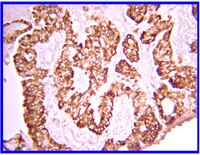
      Application NotesImmunohistochemisty (paraffin): PDGF representative staining pattern/morphology in prostate cancer. Tissue was pretreated with citrate pH 6, antigen retrieval. A previous lot of this antibody was diluted to 1:100, using IHC-Select® Detection with HRP-DAB.

      ELISA: 0.5 μg/mL dilution of a previous lot allowed detection (in direct ELISA) of 0.2-0.4 ng/well when human PDGF-AA is used to coat the plate.

      Neutralization: To yield ½ maiximal inhibition (ND50) of the biological activity of hPDGF-AA (5.0 ng/mL), a concentration of 0.05-0.07 μg/mL of a previous lot of this antibody was required.

      Optimal working dilutions must be determined by the end user.
      Biological Information
      ImmunogenHighly pure (>98%) recombinant human PDGF-AA.
      HostRabbit
      SpecificityReacts with PDGF-AA
      IsotypeIgG
      Species Reactivity
      • Human
      • Mouse
      Antibody TypePolyclonal Antibody
      Entrez Gene Number
      Entrez Gene SummaryThe protein encoded by this gene is a member of the platelet-derived growth factor family. The four members of this family are mitogenic factors for cells of mesenchymal origin and are characterized by a motif of eight cysteines. This gene product can exist either as a homodimer or as a heterodimer with the platelet-derived growth factor beta polypeptide, where the dimers are connected by disulfide bonds. Studies using knockout mice have shown cellular defects in oligodendrocytes, alveolar smooth muscle cells, and Leydig cells in the testis; nockout mice die either as embryos or shortly after birth. Two splice variants have been identified for this gene. [provided by RefSeq].
      Gene Symbol
      • PDGFA
      • PDGF-1
      • PDGF-A
      • PDGF1
      Purification MethodAffinity Purfied
      UniProt Number
      UniProt SummaryFUNCTION: Platelet-derived growth factor is a potent mitogen for cells of mesenchymal origin. Binding of this growth factor to its affinity receptor elicits a variety of cellular responses. It is released by platelets upon wounding and plays an important role in stimulating adjacent cells to grow and thereby heals the wound.
      SUBUNIT: Antiparallel disulfide-linked dimer of non-identical (A and B) chains. Homodimers of A and B chains are implicated in transformation processes. Interacts with CSPG4.
      SUBCELLULAR LOCATION: Secreted.
      ALTERNATIVE PRODUCTS: 2 named isoforms [FASTA] produced by alternative splicing.
      Name Long
      Isoform ID P04085-1
      This is the isoform sequence displayed in this entry.
      Name Short
      Isoform ID P04085-2
      Features which should be applied to build the isoform sequence: VSP_004602, VSP_004603.
      DOMAIN: The long form contains a basic insert which acts as a cell retention signal.
      MISCELLANEOUS: A-A and B-B, as well as A-B, dimers can bind to the PDGF receptor.
      SIMILARITY: Belongs to the PDGF/VEGF growth factor family.

      Molecular Weight24 kDa detected in Western Blot.
      Physicochemical Information
      Dimensions
      Materials Information
      Toxicological Information
      Safety Information according to GHS
      Safety Information
      Product Usage Statements
      Quality AssuranceRoutinely evaluated by Western Blot on C2C12 lysates.

      Western Blot Analysis:
      1:500 dilution of this lot detected PDGF-AA on 10 μg of C2C12 lysates.
      Usage Statement
      • Unless otherwise stated in our catalog or other company documentation accompanying the product(s), our products are intended for research use only and are not to be used for any other purpose, which includes but is not limited to, unauthorized commercial uses, in vitro diagnostic uses, ex vivo or in vivo therapeutic uses or any type of consumption or application to humans or animals.
      Storage and Shipping Information
      Storage ConditionsThe lyophilized antibody is stable at room temperature for at least one month and for up to one year when kept at -20ºC. When reconstituted in sterile water to a concentration of 0.1-1.0 mg/mL, the antibody is stable for at least six weeks at 2-8ºC.
      Handling Recommendations: Upon first thaw, and prior to removing the cap, centrifuge the vial and gently mix the solution. Aliquot into microcentrifuge tubes and store at -20°C. Avoid repeated freeze/thaw cycles, which may damage IgG and affect product performance.
      Packaging Information
      Material Size50 µg
      Transport Information
      Supplemental Information
      Specifications
      Global Trade Item Number
      Catalogue Number GTIN
      07-1436 04053252328589

      Documentation

      Anti-PDGF-AA Antibody SDS

      Title

      Safety Data Sheet (SDS) 

      Anti-PDGF-AA Antibody Certificates of Analysis

      TitleLot Number
      Anti-PDGF-AA - 3068070 3068070
      Anti-PDGF-AA - 3171403 3171403
      Anti-PDGF-AA - 3313323 3313323
      Anti-PDGF-AA - 3384510 3384510
      Anti-PDGF-AA - 3385750 3385750
      Anti-PDGF-AA - 3415876 3415876
      Anti-PDGF-AA - 3433058 3433058
      Anti-PDGF-AA - 3505902 3505902
      Anti-PDGF-AA - 3510184 3510184
      Anti-PDGF-AA - 3532282 3532282

      References

      Reference overviewApplicationPub Med ID
      Activation of unfolded protein response in transgenic mouse lenses.
      Reneker, LW; Chen, H; Overbeek, PA
      Investigative ophthalmology & visual science  52  2100-8  2011

      Show Abstract
      Immunofluorescence21310900 21310900