Millipore Sigma Vibrant Logo

101301 Auramine O (C.I. 41000)
101301
View Pricing & Availability

Overview

Replacement Information
Description
Catalogue Number101301
SynonymsPyoktamin® yellow, 4,4'-Bis-(dimethylamino)-benzophenonimide hydrochloride
DescriptionAuramine O (C.I. 41000)
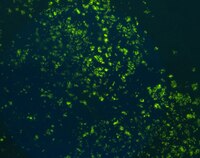
OverviewAuramine O (C.I. 41000)-for microscopy, is a dry dye for fluorescence and can be used acc. to Hagemann-Hermannof for the staining acid-fast bacteria (AFB) in smears and sections of human origin . The mechanism of the fluorescence staining is similar to the classical Ziehl-Neelsen method. The cell wall of AFB has a high proportion of wax and lipids and hence absorbs dyes only very slowly. Once the AFB have absorbed the fuchsin dye, it is virtually impossible to decolorize them again, even when they are intensively treated with a decolorizing solution such as e. g. hydrochloric acid in ethanol. Accordingly, AFB are termed as acid- and alcohol-fast for staining.
Pretreatment of the specimens with Sputofluol® dissolves the bacteria from the surrounding viscid sputum and cell material. Sputofluol® also has a disinfectant effect, with the result that any microorganisms that are present are killed off. As an IVD product and CE registered, it can be used hassle-free in diagnostics and laboratory accreditations. For more details, please see instructions for use (IFU). The IFU can be downloaded from this webpage.
References
Product Information
CAS number2465-27-2
EC index number612-097-00-2
EC number219-567-2
Hill FormulaC₁₇H₂₂ClN₃
Chemical formulaC₁₇H₂₂N₃Cl
Molar Mass303.84 g/mol
HS Code3212 90 00
Structure formula ImageStructure formula Image
Quality LevelMQ400
Applications
Applicationfor microscopy
Biological Information
Physicochemical Information
Melting Point265 °C (decomposition)
pH value6 - 7 (10 g/l, H₂O, 20 °C)
Bulk density430 kg/m3
Solubility10 g/l
Dimensions
Materials Information
Toxicological Information
LD 50 oralLD50 Rat 1000 mg/kg
Safety Information according to GHS
Hazard Pictogram(s) Hazard Pictogram(s)
Hazard Pictogram(s)
Hazard Pictogram(s)
Hazard Statement(s)H302: Harmful if swallowed.
H319: Causes serious eye irritation.
H351: Suspected of causing cancer.
H411: Toxic to aquatic life with long lasting effects.
Precautionary Statement(s)P202: Do not handle until all safety precautions have been read and understood.
P264: Wash skin thoroughly after handling.
P273: Avoid release to the environment.
P301 + P312: IF SWALLOWED: Call a POISON CENTER/doctor if you feel unwell.
P305 + P351 + P338: IF IN EYES: Rinse cautiously with water for several minutes. Remove contact lenses, if present and easy to do. Continue rinsing.
P308 + P313: IF exposed or concerned: Get medical advice/ attention.
Signal WordWarning
Storage class10 - 13 Other liquids and solids
WGKWGK 3 highly hazardous to water
Disposal3
Relatively unreactive organic reagents should be collected in container A. If halogenated, they should be collected in container B. For solid residues use container C.
Safety Information
Categories of dangerharmful, irritant, carcinogenic, dangerous for the environment
Product Usage Statements
Storage and Shipping Information
StorageStore at +2°C to +30°C.
Packaging Information
Transport Information
Declaration (railroad and road) ADR, RIDUN 3077 , 9, III
Declaration (transport by air) IATA-DGRUN 3077 , 9, III
Declaration (transport by sea) IMDG-CodeUN 3077 , 9, III, Marine Pollutant: P
Supplemental Information
Specifications
Identity (UV/VIS-Spectrum)passes test
Absorption maximum λ max (buffer pH 6.0)431 - 433 nm
Spec. Absorptivity A 1%/1cm (λmax; 0.005 g/l; buffer pH 6.0; calc. on dried substance)1100 - 1300
TLC-Testpasses test
Loss on drying (110 °C)≤ 5 %
Suitability for microscopypasses test