Millipore Sigma Vibrant Logo

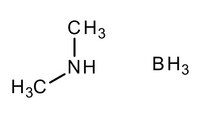
820496 Boron hydride dimethylamine
820496
View Pricing & Availability

Overview

Replacement Information

Key Spec Table

CAS #EC NumberHill FormulaChemical FormulaMolar Mass
74-94-2200-823-7C₂H₁₀BN(CH₃)₂NHBH₃58.92 g/mol
Description
Catalogue Number820496
SynonymsDimethylaminoborane, Borane-dimethylamine-complex
References
Product Information
CAS number74-94-2
EC number200-823-7
Hill FormulaC₂H₁₀BN
Chemical formula(CH₃)₂NHBH₃
Molar Mass58.92 g/mol
HS Code2942 00 00
Structure formula ImageStructure formula Image
Quality LevelMQ200
Applications
ApplicationBoron hydride dimethylamine for synthesis. CAS No. 74-94-2, EC Number 200-823-7.
Biological Information
Physicochemical Information
Density0.73 g/cm3 (20 °C)
Flash point43 °C
Ignition temperature175 °C
Melting Point33 - 36 °C
pH value8 - 9 (10 g/l, H₂O, 20 °C)
Vapor pressure<5 hPa (20 °C)
Bulk density300 - 350 kg/m3
Solubility120 g/l
Dimensions
Materials Information
Toxicological Information
LD 50 oralLD50 Rat 59 mg/kg
LD 50 dermalLD50 Rabbit 210 mg/kg
Safety Information according to GHS
Hazard Pictogram(s) Hazard Pictogram(s)
Hazard Pictogram(s)
Hazard Pictogram(s)
Hazard Pictogram(s)
Hazard Statement(s)H228: Flammable solid.
H301 + H311: Toxic if swallowed or in contact with skin.
H317: May cause an allergic skin reaction.
H318: Causes serious eye damage.
H332: Harmful if inhaled.
H411: Toxic to aquatic life with long lasting effects.
Precautionary Statement(s)P210: Keep away from heat, hot surfaces, sparks, open flames and other ignition sources. No smoking.
P273: Avoid release to the environment.
P280: Wear protective gloves/ protective clothing/ eye protection/ face protection/ hearing protection.
P301 + P310: IF SWALLOWED: Immediately call a POISON CENTER/doctor.
P302 + P352 + P312: IF ON SKIN: Wash with plenty of water. Call a POISON CENTER/doctor if you feel unwell.
P305 + P351 + P338: IF IN EYES: Rinse cautiously with water for several minutes. Remove contact lenses, if present and easy to do. Continue rinsing.
Signal WordDanger
RTECSIP9450000
Storage class4.1B Flammable solid hazardous materials
WGKWGK 2 obviously hazardous to water
Disposal26
Alkali and alkaline-earth metals should be taken up in an inert solvent and neutralized by adding 2-propanol (Cat. No. 100995) dropwise with stirring. Should the reaction be more violent than expected, conversion should be carried out with tert-butanol or octanol. Caution: This reaction produces hydrogen, which can form explosive mixtures; take necessary precautions. When the reaction has ceased, add water dropwise; neutralize; container D. In the case of alkali or alkaline-earth borohydrides, add methanol (Cat. No. 106008) with stirring; in the case of alkali or alkaline-earth amides and hydrides, organoaluminium and organotin hydrides, add 2-propanol (Cat. No. 100995) dropwise. The substances, which are usually in solid form, should be previously suspended in an ether! When the respective reaction has ceased, hydrolize with water; then neutralize. Container D or E. Lithium aluminium hydride must also be destroyed by slurrying in an ether. Under an inert gas and with thorough stirring, add dropwise a 1:4 mixture of ethyl acetate (Cat. No. 822277) and the ether used to prepare the slurry. Always ensure thorough mixing (stirring)! Container A.
Safety Information
Categories of dangertoxic, irritant, dangerous for the environment
Product Usage Statements
Storage and Shipping Information
StorageStore below +30°C.
Packaging Information
Transport Information
Declaration (railroad and road) ADR, RIDUN 2926 , 4.1 (6.1), II
Declaration (transport by air) IATA-DGRUN 2926 , 4.1 (6.1), II
Declaration (transport by sea) IMDG-CodeUN 2926 , 4.1 (6.1), II
Supplemental Information
Specifications
Assay (iodometric)≥ 97.0 %
Melting range (lower value)≥ 33 °C
Melting range (upper value)≤ 36 °C
Identity (IR)passes test

Related Products & Applications

Categories

Reagents, Chemicals and Labware > Organic Synthesis > Organic Synthesis Products for Pharma > Organic Synthesis Building Blocks and Reagents for Pharma > Organoelement Compounds > Boric Compounds
Reagents, Chemicals and Labware > Organic Synthesis > Product Line for synthesis > Amines and Ammonium Compounds > Aliphatic, Alicyclic and Araliphatic Amines and Hydroxyl Amines > Secondary Amines
Reagents, Chemicals and Labware > Organic Synthesis > Product Line for synthesis > Reduction Reagents
Reagents, Chemicals and Labware > Organic Synthesis > Organic Synthesis Products for Pharma > Organic Synthesis Building Blocks and Reagents for Pharma > Amines and Ammonium Compounds > Aliphatic, Alicyclic and Araliphatic Amines and Hydroxyl Amines > Secondary Amines
Reagents, Chemicals and Labware > Organic Synthesis > Organic Synthesis Product Groups > Amines and Ammonium Compounds > Aliphatic, Alicyclic and Araliphatic Amines and Hydroxyl Amines > Secondary Amines
Reagents, Chemicals and Labware > Organic Synthesis > Product Line for synthesis > Organoelement Compounds > Boric Compounds
Reagents, Chemicals and Labware > Organic Synthesis > Organic Synthesis Product Groups > Organoelement Compounds > Boric Compounds
Reagents, Chemicals and Labware > Organic Synthesis > Organic Synthesis Product Groups > Reduction Reagents