Millipore Sigma Vibrant Logo

845035 Dibutyltin oxide
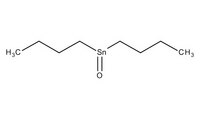
845035
View Pricing & Availability

Overview

Replacement Information

Key Spec Table

CAS #EC NumberHill FormulaChemical FormulaMolar Mass
818-08-6212-449-1C₈H₁₈OSn(CH₃CH₂CH₂CH₂)₂SnO248.94 g/mol
Description
Catalogue Number845035
DescriptionDibutyltin oxide
References
Product Information
CAS number818-08-6
EC number212-449-1
Hill FormulaC₈H₁₈OSn
Chemical formula(CH₃CH₂CH₂CH₂)₂SnO
Molar Mass248.94 g/mol
Structure formula ImageStructure formula Image
Quality LevelMQ400
Applications
ApplicationDibutyltin oxide Msynth®plus. CAS 818-08-6, chemical formula (CH₃CH₂CH₂CH₂)₂SnO.
Biological Information
Physicochemical Information
Boiling point>300 °C decomposes
Density1.5 g/cm3 (20 °C)
Ignition temperature525 °C
Bulk density650 - 750 kg/m3
Solubility0.004 g/l
Dimensions
Materials Information
Toxicological Information
LD 50 oralLD50 Rat 487 mg/kg
LD 50 dermalLD50 Rabbit > 2000 mg/kg
Safety Information according to GHS
Hazard Pictogram(s) Hazard Pictogram(s)
Hazard Pictogram(s)
Hazard Statement(s)H302: Harmful if swallowed.
H315: Causes skin irritation.
H319: Causes serious eye irritation.
H411: Toxic to aquatic life with long lasting effects.
Precautionary Statement(s)P273: Avoid release to the environment.
P302 + P352: IF ON SKIN: Wash with plenty of soap and water.
P305 + P351 + P338: IF IN EYES: Rinse cautiously with water for several minutes. Remove contact lenses, if present and easy to do. Continue rinsing.
Signal WordWarning
RTECSWH7175000
Storage class10 - 13 Other liquids and solids
WGKWGK 3 highly hazardous to water
Disposal15
Heavy metal-containing solutions and solids: container E. Stir Raney nickel (also: Urushibara nickel) in the form of an aqueous suspension into hydrochloric acid (Cat. No. 100312) until dissolved (container E). Neither Raney nickel itself nor any filter residues should be allowed to dry out, otherwise they will spontaneously ignite in air. In this context, heavy metal means any compound of antimony, arsenic, cadmium, chromium(VI), copper, lead, nickel and tin, as well as these subtances in metallic form, if they are classified as hazardous (acc. to AbfallverzeichnisV - Waste Catalogue Ordinance, Appendix 3). Other heavy metals should be collected separately.
Safety Information
Hazard Symbols Hazard SymbolsHarmful
Hazard SymbolsDangerous for the environment
Categories of dangerharmful, irritant, dangerous for the environment
R PhraseR 22-36/38-51/53
Harmful if swallowed.Irritating to eyes and skin.Toxic to aquatic organisms, may cause long-term adverse effects in the aquatic environment.
S PhraseS 22-61
Do not breathe dust.Avoid release to the environment. Refer to special instructions/ Safety data sheets.
Product Usage Statements
Storage and Shipping Information
StorageStore below +30°C.
Packaging Information
Transport Information
Declaration (railroad and road) ADR, RIDUN 3077 , 9, III
Declaration (transport by air) IATA-DGRUN 3077 , 9, III
Declaration (transport by sea) IMDG-CodeUN 3077 , 9, III, Marine Pollutant: P
Supplemental Information
Specifications
Colour (visual)white
Appearance of substance (visual)powder
Assay (ex Sn)≥ 98.0 %
Identity (IR)passes test

Related Products & Applications

Related Products

Catalogue Number Description  
803539 Dibutyltin oxide Show Pricing & Availability

Related Products By: Brand Facete

Categories

Reagents, Chemicals and Labware > Organic Synthesis > Organic Synthesis Product Groups > Organoelement Compounds > Organometal Compounds
Small Molecule Pharmaceuticals > API Synthesis > non GMP Intermediates Msynth®plus
Reagents, Chemicals and Labware > API Synthesis > Msynth®plus
Reagents, Chemicals and Labware > Organic Synthesis > Organic Synthesis Products for Pharma > Organic Synthesis Building Blocks and Reagents for Pharma > Organoelement Compounds > Organometal Compounds