Millipore Sigma Vibrant Logo

820310 Methylmagnesium chloride
Overview

Replacement Information
Description
Catalogue Number820310
SynonymsChloromethylmagnesium
References
Product Information
HS Code2931 90 00
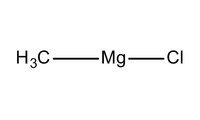
Structure formula ImageStructure formula Image
Quality LevelMQ200
Applications
Biological Information
Physicochemical Information
Boiling point65 - 66 °C (1013 hPa) (THF)
Density1.03 g/cm3 (20 °C)
Explosion limit1.5 %(V) (THF)
Flash point-20 °C (THF)
Ignition temperature215 °C (THF)
pH value>7 (H₂O, 20 °C)
Vapor pressure200 hPa (20 °C)
Dimensions
Materials Information
Toxicological Information
Safety Information according to GHS
Hazard Pictogram(s) Hazard Pictogram(s)
Hazard Pictogram(s)
Hazard Pictogram(s)
Hazard Pictogram(s)
Hazard Statement(s)H225: Highly flammable liquid and vapour.
H260: In contact with water releases flammable gases which may ignite spontaneously.
H314: Causes severe skin burns and eye damage.
H335: May cause respiratory irritation.
H336: May cause drowsiness or dizziness.
H351: Suspected of causing cancer.
EUH014: Reacts violently with water.
EUH019: May form explosive peroxides.
Precautionary Statement(s)P210: Keep away from heat, hot surfaces, sparks, open flames and other ignition sources. No smoking.
P231 + P232: Handle and store contents under inert gas. Protect from moisture.
P280: Wear protective gloves/ protective clothing/ eye protection/ face protection/ hearing protection.
P303 + P361 + P353: IF ON SKIN (or hair): Take off immediately all contaminated clothing. Rinse skin with water.
P304 + P340 + P310: IF INHALED: Remove person to fresh air and keep comfortable for breathing. Immediately call a POISON CENTER/doctor.
P305 + P351 + P338: IF IN EYES: Rinse cautiously with water for several minutes. Remove contact lenses, if present and easy to do. Continue rinsing.
P403 + P233: Store in a well-ventilated place. Keep container tightly closed.
Signal WordDanger
Storage class4.3 Hazardous materials, which set free flammable gases upon contact with water
WGKWGK 3 highly hazardous to water
Disposal8
Hydrolysis-sensitive organoelement compounds and metal alkyls, which are as a rule dissolved in organic solvents, should be carefully stirred dropwise into 1-butanol (Cat. No. 822262) in a hood with the front screen closed. Any flammable gases formed should be fed via a tube directly into the extractor duct. When gas development has ceased, continue stirring for one hour and add an excess of water. Container A.
Safety Information
Categories of dangerhighly flammable, corrosive, carcinogenic
Product Usage Statements
Storage and Shipping Information
StorageStore below +30°C.
Packaging Information
Transport Information
Declaration (railroad and road) ADR, RIDUN 3399 , 4.3 (3), I
Declaration (transport by air) IATA-DGRUN 3399 , 4.3 (3), I
Declaration (transport by sea) IMDG-CodeUN 3399 , 4.3 (3), I
Supplemental Information
Specifications
Assay (ex Mg)21.0 - 24.0 %
Assay (acidimetric)21.0 - 24.0 %
Assay (argentometric)21.0 - 24.0 %

Related Products & Applications

Categories

Reagents, Chemicals and Labware > Organic Synthesis > Organic Synthesis Product Groups > Reagents for Organometallic Synthesis
Reagents, Chemicals and Labware > Organic Synthesis > Organic Synthesis Product Groups > Organoelement Compounds > Organometal Compounds
Reagents, Chemicals and Labware > Organic Synthesis > Product Line for synthesis > Organoelement Compounds > Organometal Compounds
Reagents, Chemicals and Labware > Organic Synthesis > Product Line for synthesis > Reagents for Organometallic Synthesis
Reagents, Chemicals and Labware > Organic Synthesis > Organic Synthesis Products for Pharma > Organic Synthesis Building Blocks and Reagents for Pharma > Organoelement Compounds > Organometal Compounds